
Caring for bulbs and tubers
Planting times, leaf care and overwintering
Compiled by our master gardeners · Last updated: July 2026
To print and file away – free to download.
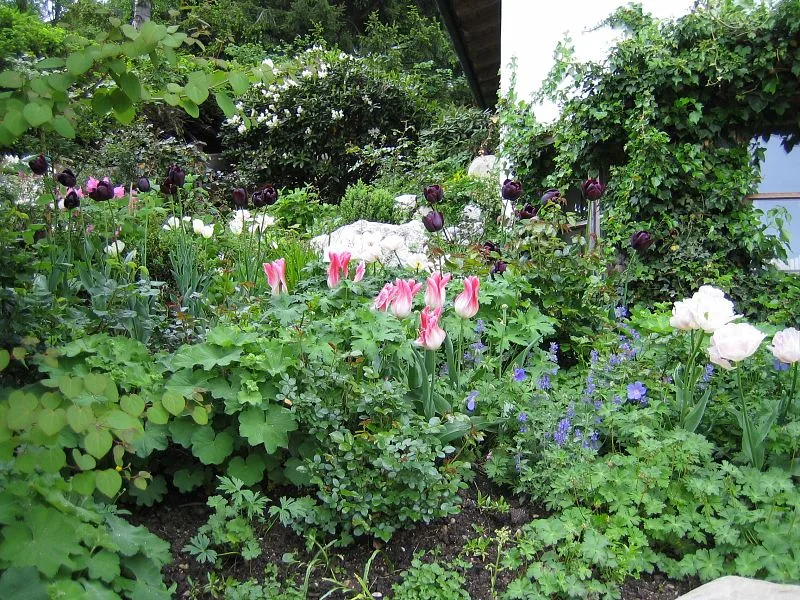
Bulbs and tubers are a diverse, species-rich group: herbaceous plants that build up food reserves in their storage organs and use them to survive unfavourable seasons. Because they appear at a specific time and then disappear again, they are perfect companions for perennials, trees and shrubs, and summer flowers – early bloomers brighten the bed before most perennials have even started to shoot.
Hardy or frost-tender?
Bulbs are generally hardy, while tubers usually tolerate little or no frost. Under trees and at the edge of woodland planting, spring geophytes such as wood anemones, corydalis, snowdrops, bluebells, daffodils and scilla feel at home. Depending on their site requirements, some tuberous species can be fully integrated into perennial planting.
Planting times at a glance
| | Examples | Planting time |
|---|---|---|
| Early spring bloomers | Snowdrops, winter aconite, spring snowflake | September |
| Spring bloomers | Tulips, daffodils, crocus, hyacinths, glory-of-the-snow | October to November |
| Summer bloomers | Gladioli, dahlias, canna, anemones, freesias | March to May |
| Late summer bloomers | Autumn crocus, colchicum, saffron, sternbergia | July to August |
In practice, early spring and spring bloomers are usually planted at the same time – October to November is a good planting window.
Pruning and foliage care
Remove faded flower heads regularly so the plant does not put energy into seed production, which is then lost to the bulb or tuber.
The long leaves of daffodils can be braided into decorative plaits; once they are brown and dry, they can simply be pulled off by hand. Lawn areas with snowdrops, crocuses or small daffodils should only be mown about 6 weeks after flowering, so the plants return and spread every year.
Feeding and watering
At planting, a light feed with compost or another organic fertiliser is recommended. From the following year, feed regularly and moderately at the start of the growing season, and a special flowering fertiliser can be used during the flowering period. Continue with light feeding until the plants enter dormancy – the plant stores these nutrients for next year. During the growing phase, bulbs and tubers need enough moisture, so water during prolonged dry spells. Waterlogging, however, must be avoided at all costs, otherwise bulbs and tubers will rot.
Overwintering tender tubers
Dahlias, canna and tuberous begonias must be lifted from the bed in autumn. Overwintering is easy: store the tubers in crates with loose, fairly dry soil in a cold but frost-free room. They are well suited to summer bedding displays; starting them early in spring brings earlier flowering.
Naturalising
Most spring bloomers, such as crocuses, daffodils and botanical tulips, are very well suited to naturalising. To do this, plant them a little deeper than usual – about three to four times as deep as the bulb is tall. For a natural look, especially in lawns, do not plant the bulbs in groups; scatter them and plant them where they land.


Answers about bulbs and tubers
When do you plant tulips and daffodils?
Can you cut back the foliage of daffodils and tulips after flowering?
When can I mow the lawn if crocuses are growing in it?
How do I overwinter dahlias?
Why are my flower bulbs rotting?
Let's talk about your project
We are happy to advise you in person, with no obligation.
Request a consultation