

Trees & Large Trees
From choosing the site and climate-resilient trees to crane planting – trees that are still the right decision in 30 years.
A tree turns a plot into a garden
Nothing changes a garden as quickly as a large tree. It gives shade, scale and the feeling that the garden has always been there. That is exactly why it pays not to skimp on size with trees – and to choose the site very carefully.
How tree sizes are measured
With trees, it is not the height that counts but the trunk girth, measured at a height of one metre. The range from our main supplier runs from avenue trees with a trunk girth of 14–16 cm to specimen trees of around 140 cm – from “clearly visible” to “defines the whole plot”.
As a rule of thumb: the bigger the tree at planting, the higher the price and effort – and the longer it takes to establish properly again. A medium-sized, well-established tree often overtakes an oversized one within a few years.

The site decides – not the variety
Before we talk about species, we clarify the space: How wide will the crown be in 20 years? How much root space is really available once you allow for the terrace, driveway and utility lines? Where does the shade fall at midday and in the evening? How close is the building?
Most problems with trees in private gardens are site problems, not maintenance problems: too close to the house, too little root space, wrong expectations of the final size. These can be solved at the planning stage and hardly at all later.

Climate-resilient trees: what will still be standing in 30 years
Dry summers and heat are hard on classic garden trees. Tree nurseries therefore now offer their own ranges under the term climate trees – species and varieties that cope better with drought, heat and compacted soils. We deliberately select with this in mind, so that your tree doesn't become a problem in 15 years.

Planting and the first three years
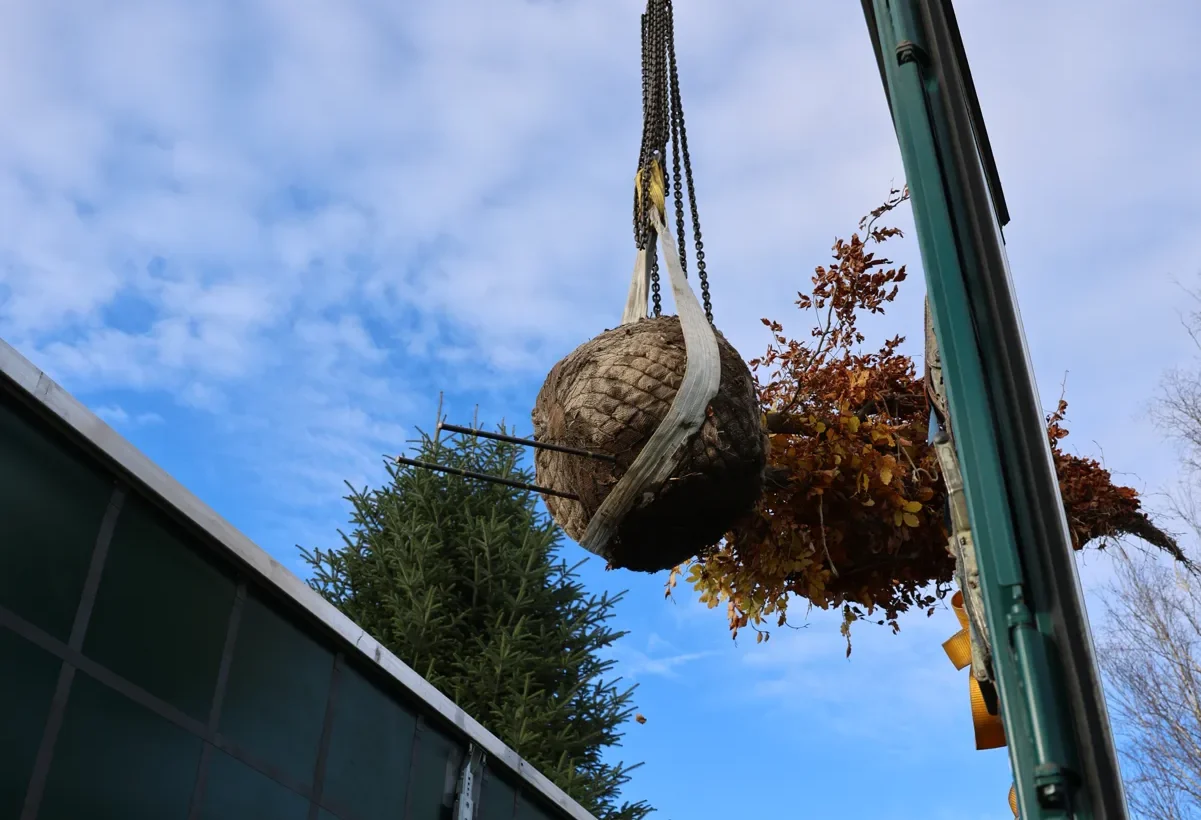
A large tree doesn't arrive in a wheelbarrow. Depending on size, planting needs a crane or excavator, a sufficiently large planting pit, improved soil and secure anchoring against wind. What matters most afterwards is watering: in the first years the tree regularly needs plenty of water at a time – not a little every day. If you wish, we install an irrigation system straight away.

Three regulations that apply to trees
Municipal tree protection ordinance. Many municipalities protect trees above a certain trunk girth: felling and heavy pruning then require a permit – even in your own garden. We clarify directly with your municipality what applies there as part of the planning. This matters not only for felling, but already when building: a protected existing tree helps determine where the terrace and driveway can go.
Boundary distance. In Bavaria, under Art. 47 AGBGB, a tree that will grow taller than 2 m must stand at least 2 m from the neighbouring boundary. This figure is often more critical for a tree than for a hedge, because the crown cannot simply be cut back without spoiling it. We therefore position the tree from the start so that it causes no dispute even with a fully grown crown. The details on boundary distances can be found under Privacy Screening & Hedges.
Nesting season. § 39 para. 5 BNatSchG also applies to trees: from 1 March to 30 September, felling and heavy intervention are prohibited. We therefore schedule tree work for the winter months.
Where our trees come from
You don't buy a tree from a catalogue, but by its habit – its growth form, branch structure and the character of the individual specimen. That's why we work with the Lorenz von Ehren tree nursery: around 600 hectares of growing area and a range of about 2,000 genera, species and varieties in around 8,000 forms and sizes – from avenue trees with a trunk girth of 14–16 cm to specimen trees of around 140 cm. For larger projects, we also go there ourselves and choose your tree.
One result of this collaboration is our show garden in Gilching with fine deciduous and coniferous trees and shrubs.
Related topics
Privacy Screening & Hedges – trees as a tree screen against overlooking from above · Plants & Planting · Perennial planting beneath the tree · Tree care by our maintenance team.
How a large tree gets to its place
A tree with a root ball of over a tonne isn't carried. It is slung, lifted, swung into position and aligned – and all of that before any soil goes into the hole. The lorry is ours, the crane comes from the crane company Hölzl – a well-rehearsed team: our colleagues at the hook know the driver, and when lifting over a house, that is exactly what counts. These pictures are from a planting in November.


Photos: Benjamin Klopp / frames for good.
A tree inside the house – and how to keep it healthy
A tree in a light well or inner courtyard is one of the loveliest features a house can have: you don't live next to it, you live around it. We think that's wonderful – and in the same breath we'll tell you that it is the location with the fewest reserves. A tree in a garden forgives mistakes, because it can spread elsewhere. A tree in a shaft can't.


Sweetgum in the light well of our garden “Opposites Attract” in Baldham. We look after this tree. Photos: Benjamin Klopp / frames for good.
Please bring us in early
The best time for this conversation is while the architects are still planning – not once the glazing is already in place. Almost everything a tree like this needs is a decision about the building, not about the plant. Six points that should be settled before the shell construction begins:
- Root space. A light well is a shaft: basement walls, foundations and the waterproofing of the building enclose the soil on all sides. For comparison, the FLL recommendations for tree planting give around 12 m³ of rootable space at a depth of roughly 1.5 m for street trees. In a light well, that volume is not created during excavation but in the floor plan. If it ends up smaller, the tree will be smaller too – or it will need regular pruning for good to keep the crown and roots in proportion.
- Water, in both directions. Downwards, the tree needs a connected drainage system; standing water in the shaft kills it faster than drought. From above, less rain arrives than you might think: the shadow of the walls and the roof overhang keep some of it off, and the soil area is small. An automatic irrigation system with its own supply line therefore belongs in the shell construction planning. Adding it later means opening up the ground again.
- Light. In a courtyard, light only comes from above, and the deeper and narrower it is, the less of it there is. How many hours it actually gets can be read from the building model before anything is built. The choice of species follows from that – not the other way round. A tree that needs full sun will grow lopsided towards the light in a courtyard and will never develop the crown shown in the picture.
- Access. Two questions that are surprisingly often left open: how does the tree get in – usually only while the roof and glazing are still open, otherwise only a small tree fits through the door. And how do we get in later, with ladder, substrate, wheelbarrow and cuttings. A courtyard without its own access turns every maintenance visit into a haul through the living room.
- Species and substrate. We choose both with you, and we choose them as a pair: the substrate determines water retention and air in the limited volume, the species determines final size, light requirements, and leaf and fruit drop. In a courtyard with glass all around, this matters too – a tree with spiky seed capsules means different work from one without.
- Health. In a courtyard the air is still, it is warmer and drier than outside, and the natural predators are missing. A tree with too little water or root space is weakened – and it is weakened trees that get spider mites or scale insects, not healthy ones. The most effective plant protection in this location is therefore planning, and the second most effective is regularly keeping an eye on it.
Who wants a tree that struggles inside their own home? If we are at the table from the first sketch, that is no longer a question: we settle root space, irrigation, access and light with the architect and the builders, select the species and substrate, plant the tree at the right stage of construction – and then take over its maintenance, so that someone is looking before anything shows. Get in touch as early as you can.
Where our large trees come from
At the tree nursery of Lorenz von Ehren in Gilching, we choose specimen trees together with our clients – the video shows what that looks like.
Answers about trees & large trees
How much does a large tree cost?
How big should a tree be when it is planted?
How far from the neighbouring property must a tree be?
Can an old tree be transplanted?
How much do I need to water a newly planted tree?
Can I simply fell a tree in my garden?
Can you plant a real tree in a light well inside the house?
How much soil does a tree in a courtyard need?
Related reading
Every Thursday, we answer a question from the garden here – often one that our customers ask us.
Let's talk about your project
We are happy to advise you in person, with no obligation.
Request a consultation