
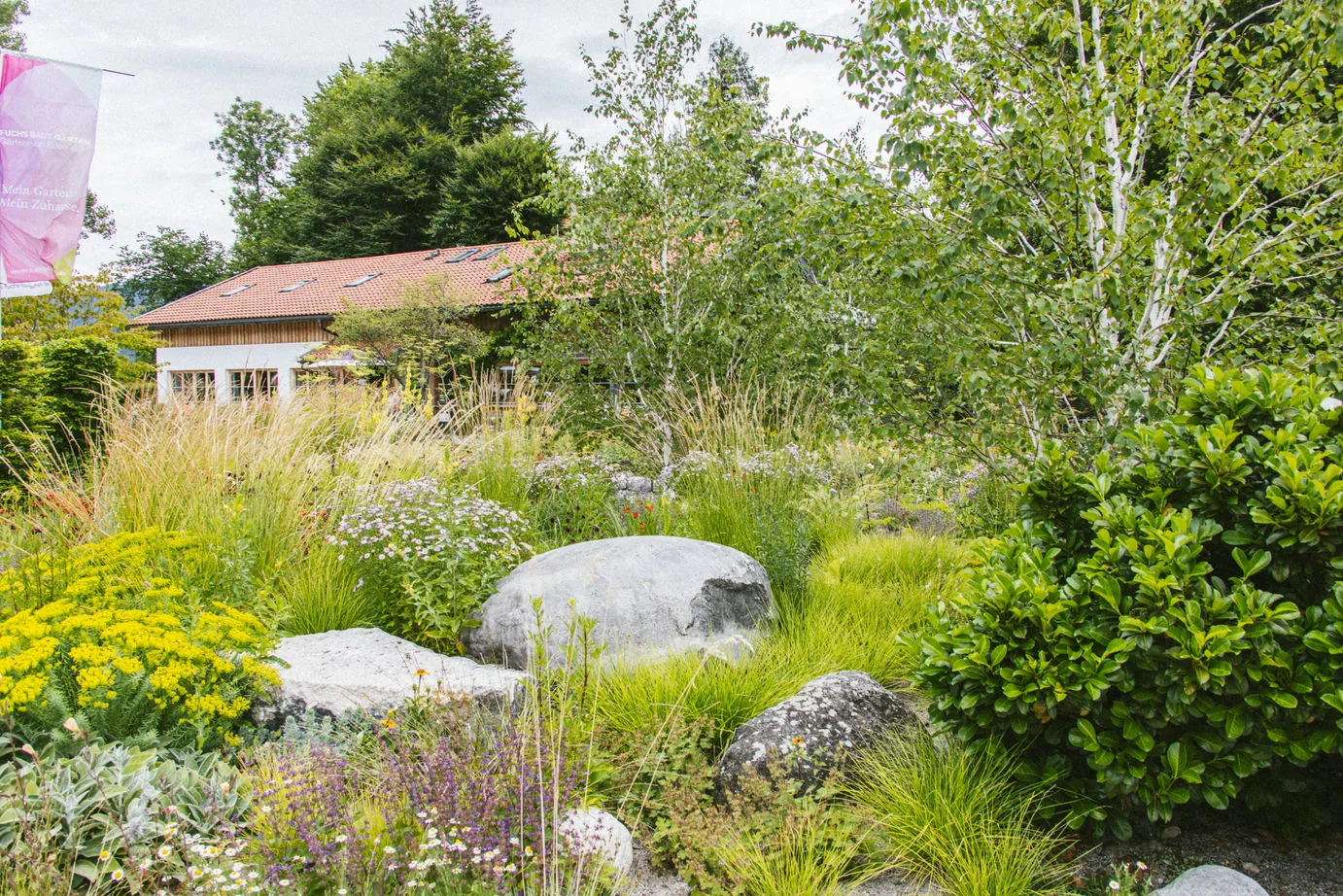
Perennial planting – natural & water-saving
Natural perennial gardens that feed insects and manage in summer without artificial irrigation – designed to suit the site and planted on lean sand.
Natural perennial gardens that need no watering
A perennial garden that breathes with the seasons, feeds insects and manages in high summer without artificial irrigation: in our own perennial garden we show how it works – designed to suit the site, planted on lean sand and tended with a good dose of calm.

With nature, not against it
“I take a step back – and let nature take a step towards me.”
This is the principle Markus Forberger (Dipl.-Ing. (FH) landscape architecture) follows when designing our perennial gardens: deliberately designed cultivated spaces, tended with a certain ease – an honest garden that is allowed to develop and needs less maintenance.
The soil decides: planting in lean sand
Instead of rich topsoil, we plant in around 20 cm of lean natural sand on well-loosened, free-draining ground. This brings four benefits at once: no waterlogging (the crowns don't rot), significantly fewer weeds (lean soil holds back rampant plants), hardly any slugs – and the soil stays loose for good.
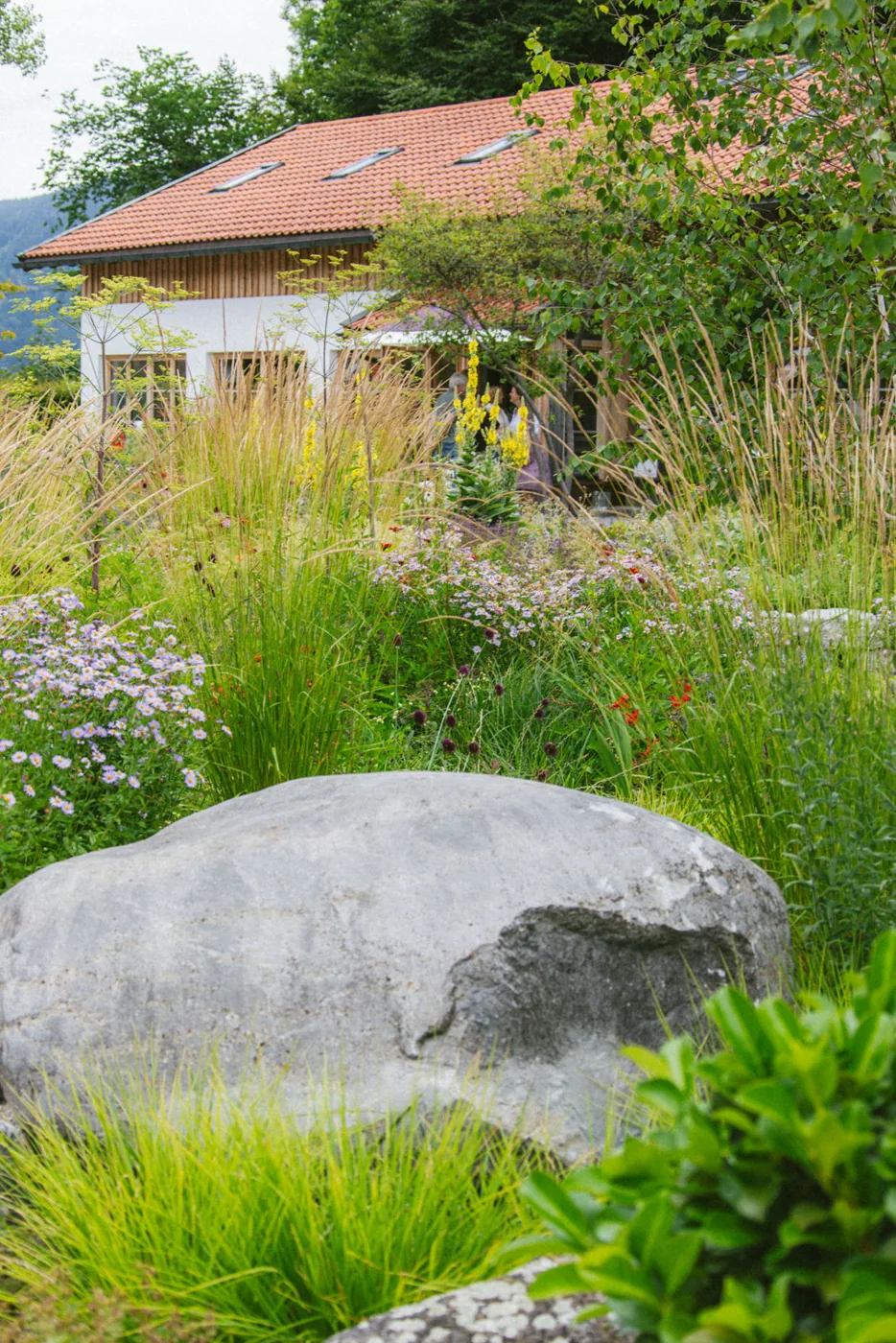
A garden that needs no watering
Watering is only needed while the plants establish. After that, the perennials are trained to seek their water deep down – water thoroughly, then let the soil dry out. They develop deep roots and withstand even hot, dry summers. With irrigation bans on the rise, this is the answer for our times: moderation instead of excess.
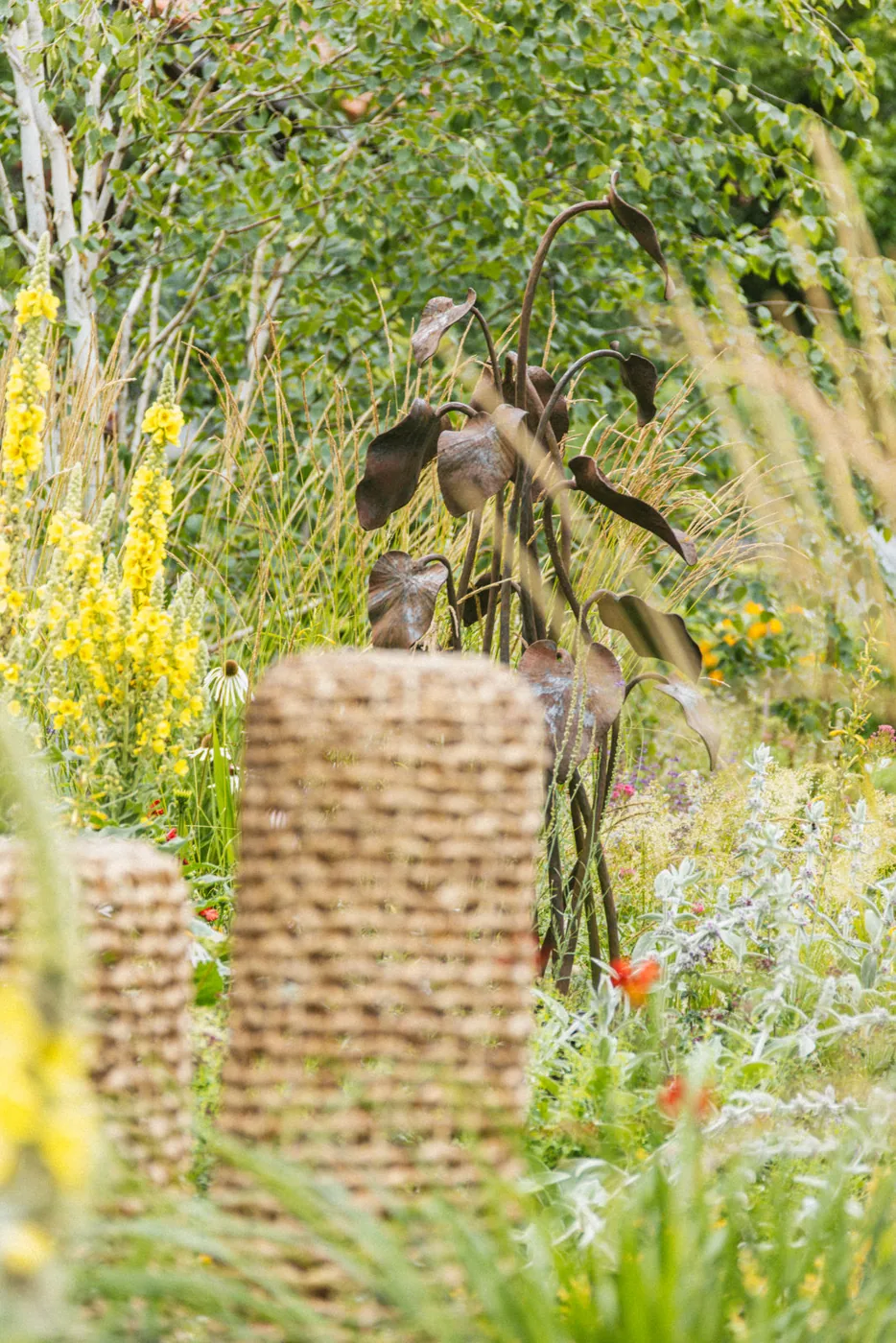
A feast for bees, wild bees and butterflies
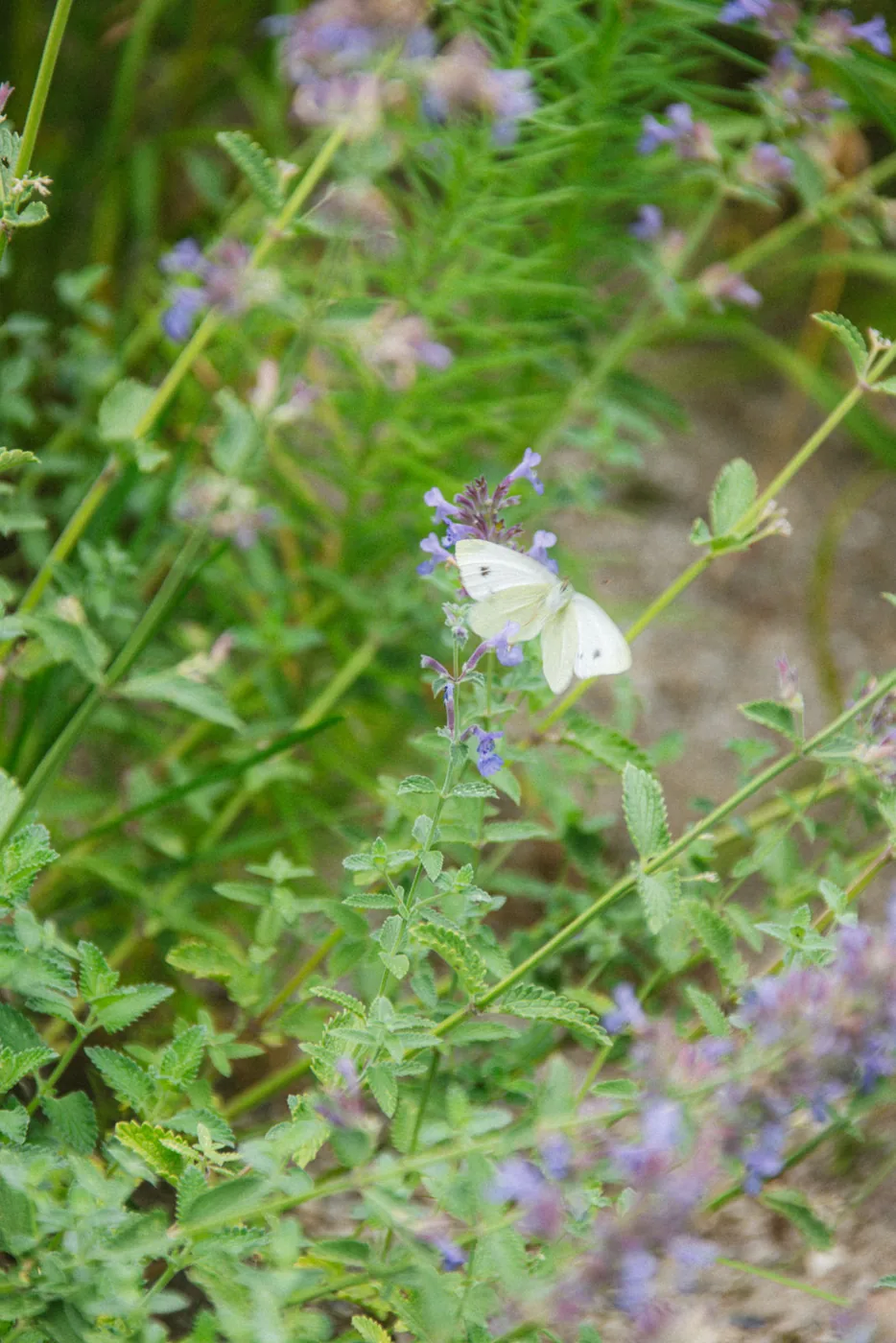
Every plant is chosen for its value to insects – often it is the small, inconspicuous flowers that provide the most nectar and pollen. This turns the garden into a habitat for honeybees and wild bees as well as butterflies and moths such as painted ladies and swallowtails. We also plan the lighting to be insect-friendly, to avoid light pollution.
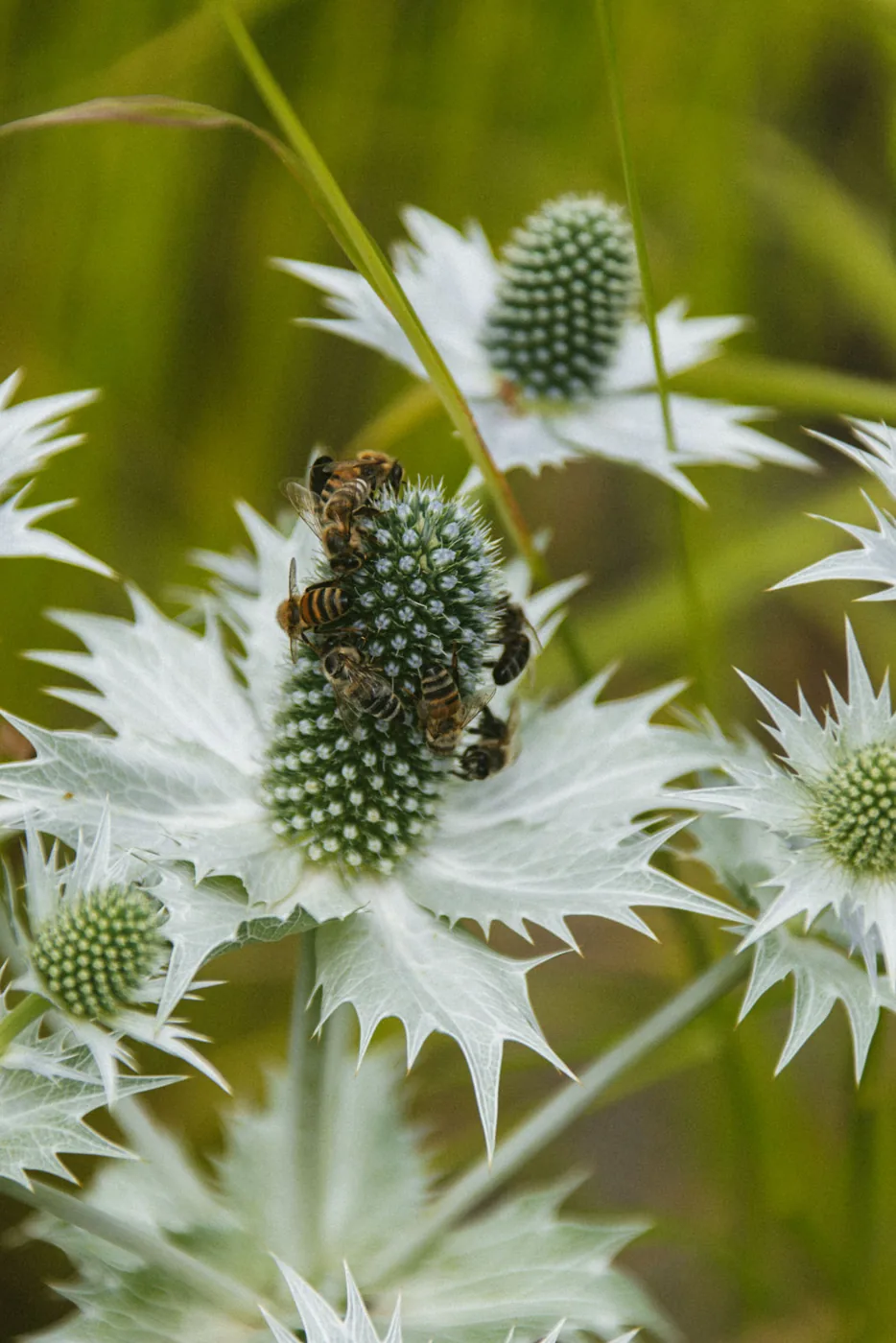
Composed by planting habitat
We combine plants according to their natural habitat – from the North American prairie, from southern Europe, some from Asia, and native species. Built up in layers: key perennials for structure, companion perennials for the area, ground cover for the lower tier.
Bee pastures & herbs
Hyssop (Hyssopus officinalis), winter savory (Satureja montana), oregano “Rosenkuppel” (Origanum laevigatum), lesser calamint (Calamintha nepeta), catmint “Walker’s Low” (Nepeta), whorled & woodland sage (Salvia verticillata / nemorosa), giant hyssop (Agastache), thyme (Thymus).
Structure & focal plants
Mullein (Verbascum), giant scabious (Cephalaria gigantea), globe thistle (Echinops ritro), giant sea holly (Eryngium giganteum), Jerusalem sage (Phlomis russeliana), masterwort/hog's fennel (Peucedanum), blazing star (Liatris spicata), red hot poker (Kniphofia).
Colour & abundance
Coneflower varieties (Echinacea), blanket flower (Gaillardia), butterfly weed (Asclepias tuberosa), red valerian (Centranthus ruber), drumstick allium (Allium sphaerocephalon), montbretia (Crocosmia “Lucifer”), dyer's chamomile & Roman chamomile, Macedonian scabious (Knautia macedonica), golden lace (Patrinia scabiosifolia).
Late bloomers for autumn
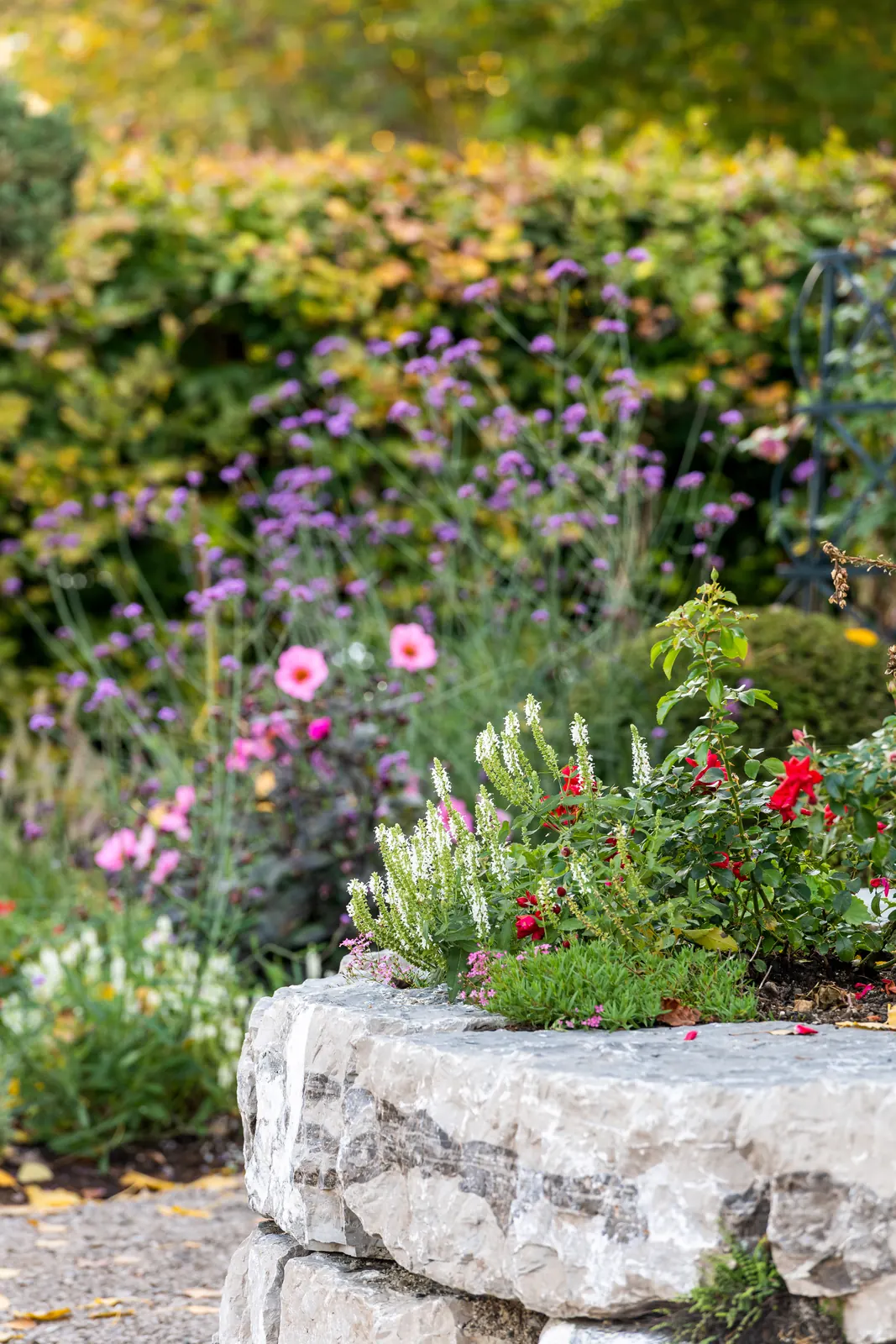
Wild & ornamental asters (Aster ageratoides “Adustus Nanus”, Aster ericoides “Snowflurry”, Kalimeris mongolica “Antonia”) and blue vervain (Verbena hastata) – they flower until the first frost and provide late food for insects.
Grasses & ground cover
Blue oat grass (Helictotrichon), giant feather grass (Stipa gigantea), Alpine rough grass (Achnatherum “Allgäu”), autumn moor grass (Sesleria autumnalis), lamb's ear (Stachys byzantina), Balkan cranesbill (Geranium renardii), snowdrop windflower (Anemone sylvestris), heuchera for partial shade.
Relaxed rather than labour-intensive
- In spring, cut back the grasses that were tied together over winter and remove any fallen stems – that's essentially all there is to it.
- Tie grasses rather than cutting them: otherwise water would run down hollow stems to the crown and cause rot.
- Don't fertilise – fertiliser attracts exactly the weeds you don't want.
- Dig out wild weeds selectively and with as much root as possible – on sand, this is easy.
A garden with no lawn at all – in 65 square metres
It used to be a front garden without plants: small, open to the street, with parked cars on either side. Today it is a green outdoor living room – on just 65 m². The brief for the design was simply “perennials instead of lawn”.
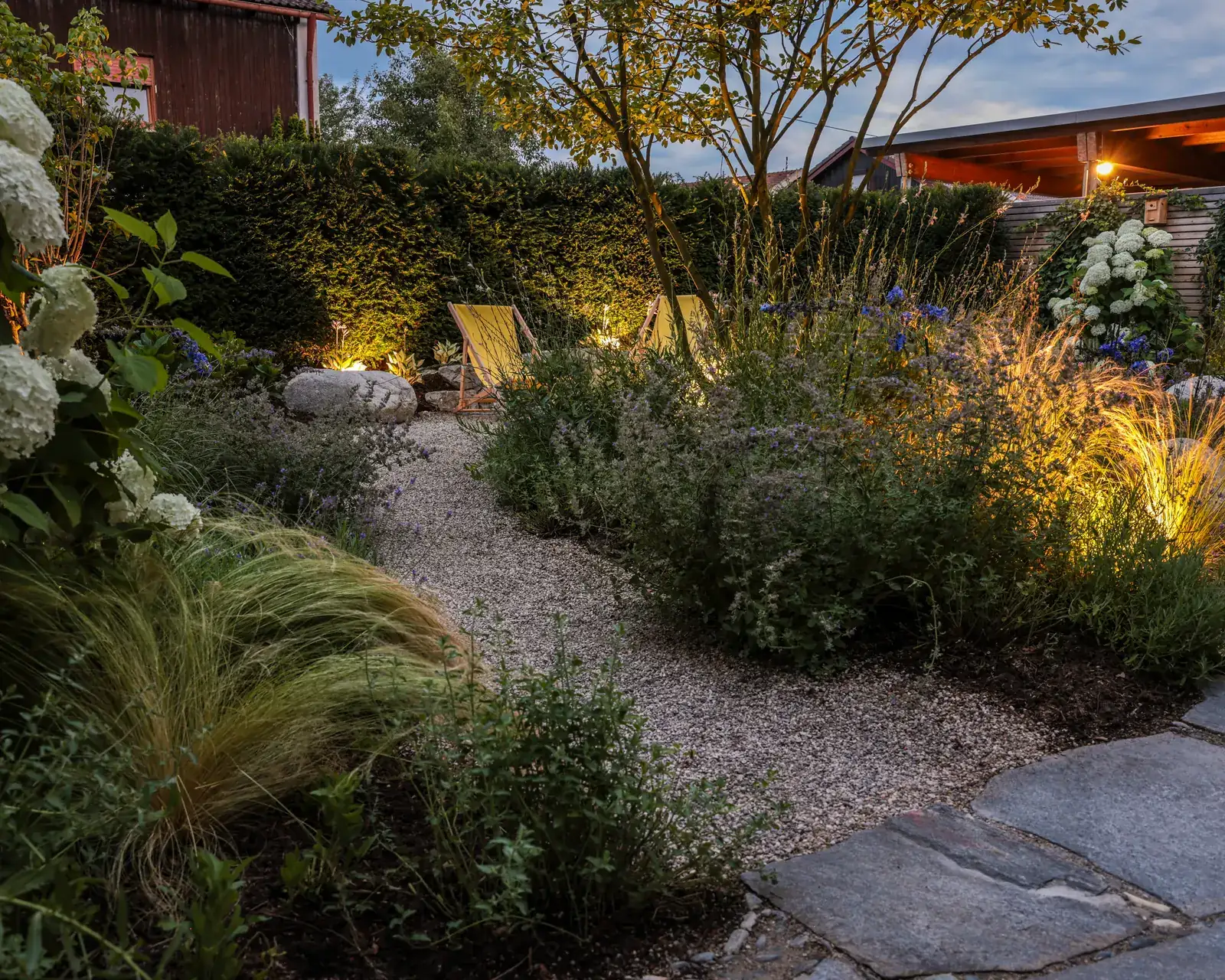
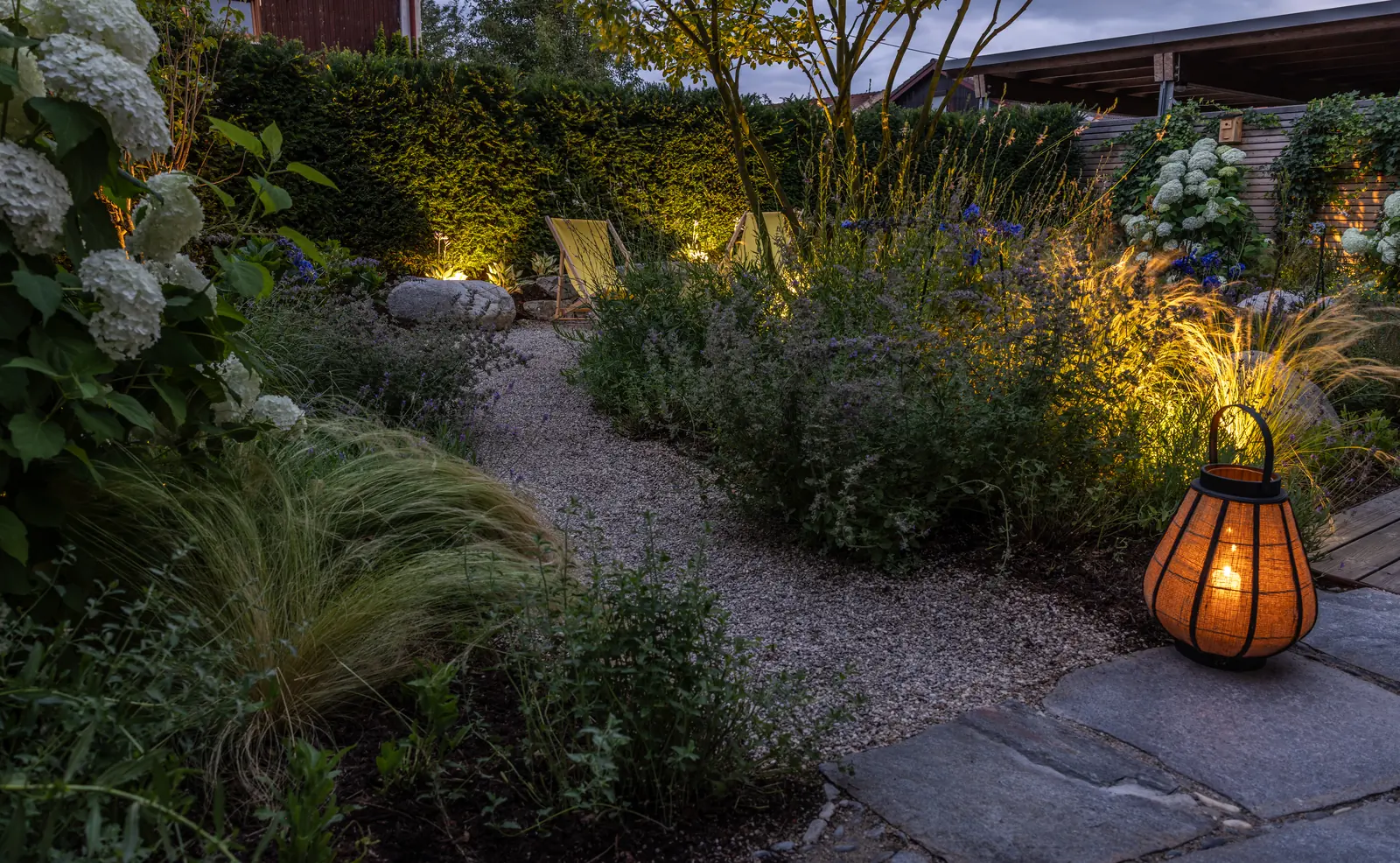
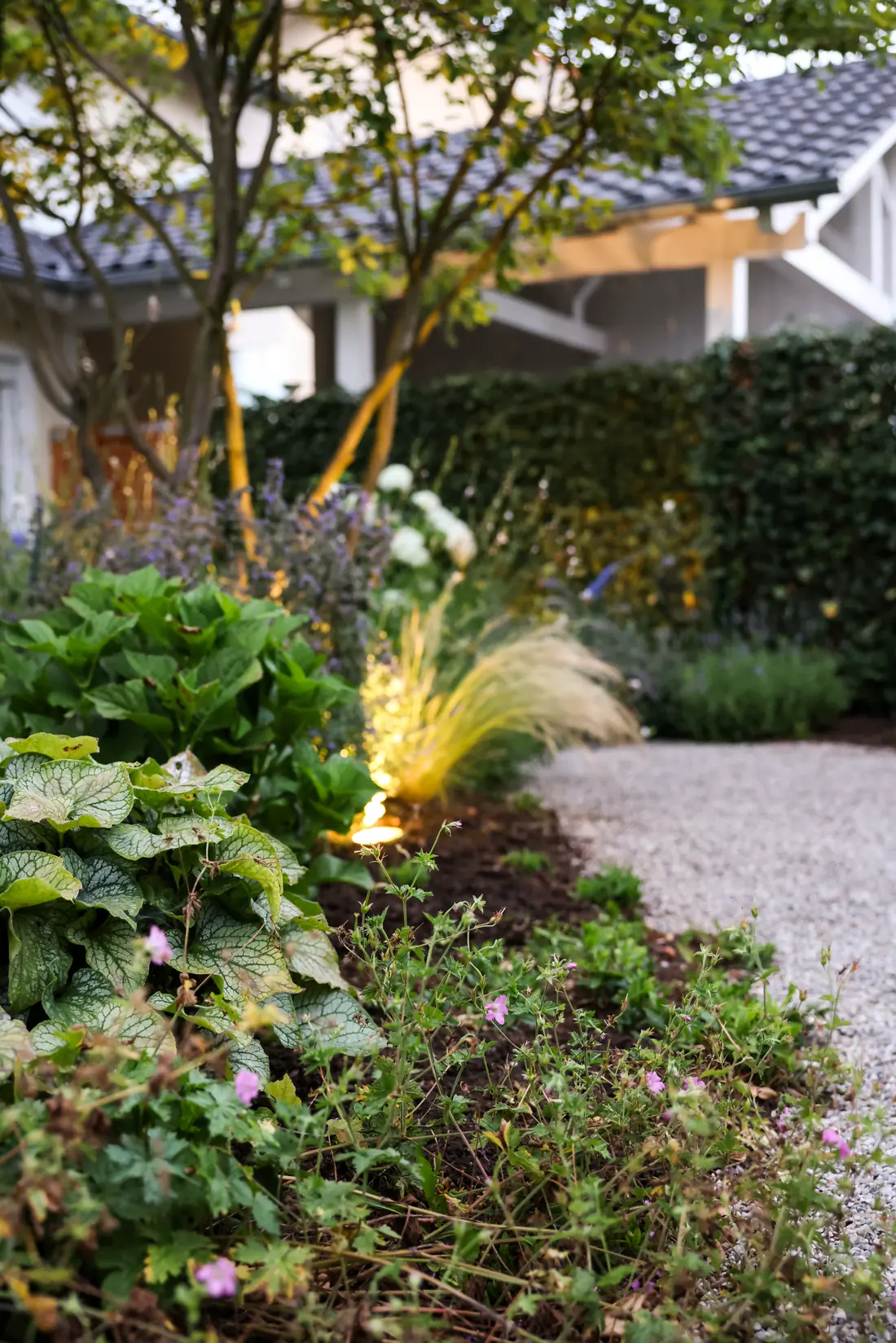
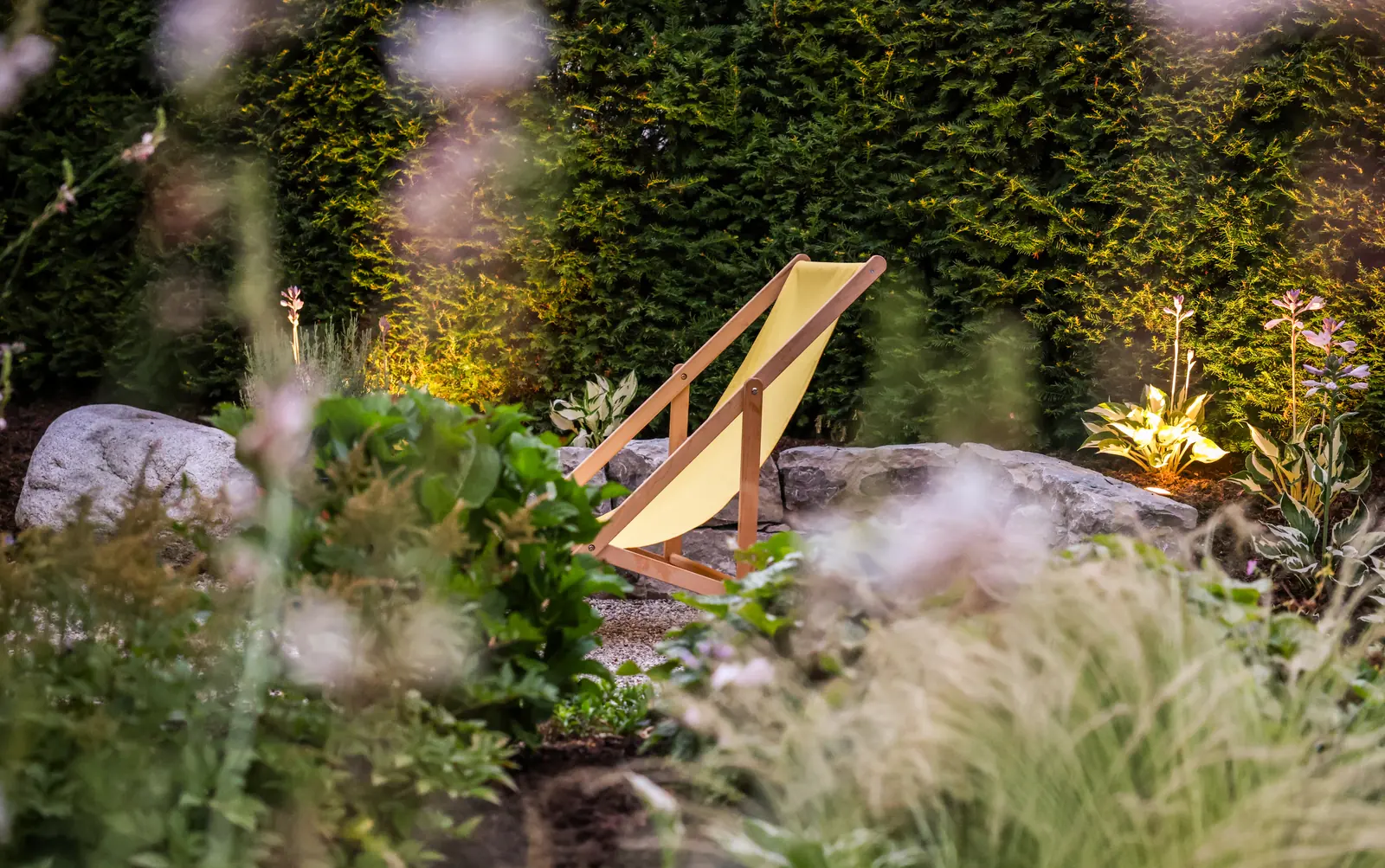
The garden is built around perennials and ornamental grasses, with a serviceberry as a focal tree and all the flowers consistently in white and blue – astilbe, Siberian bugloss, delphinium, gaura, steppe sage, feather grass, phlox. A dense yew hedge closes off the garden towards the street, and timber privacy screens keep the cars out of view. The plants came from the Lorenz von Ehren nursery, the privacy screening from Zaun Riesch in Bad Tölz.
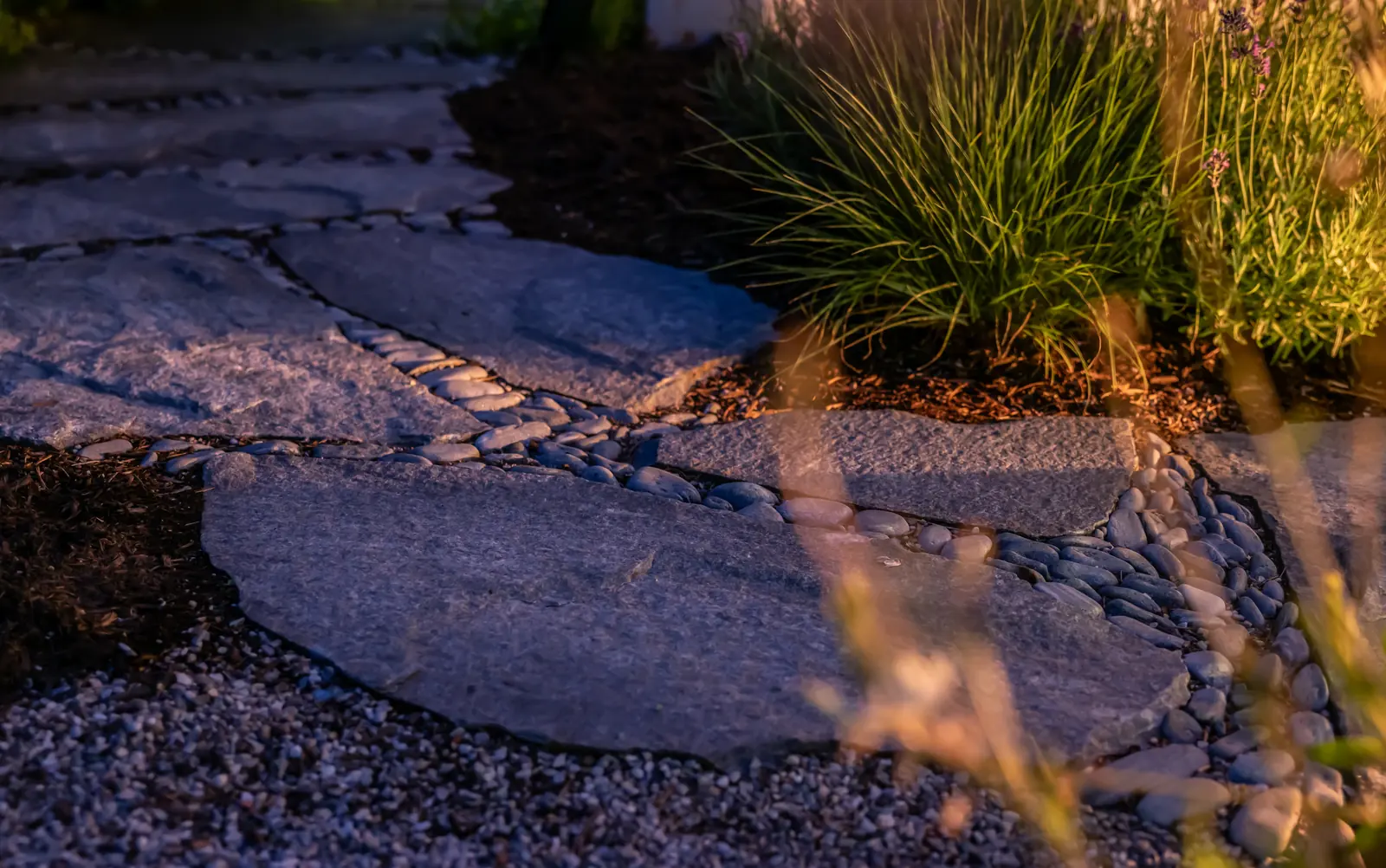
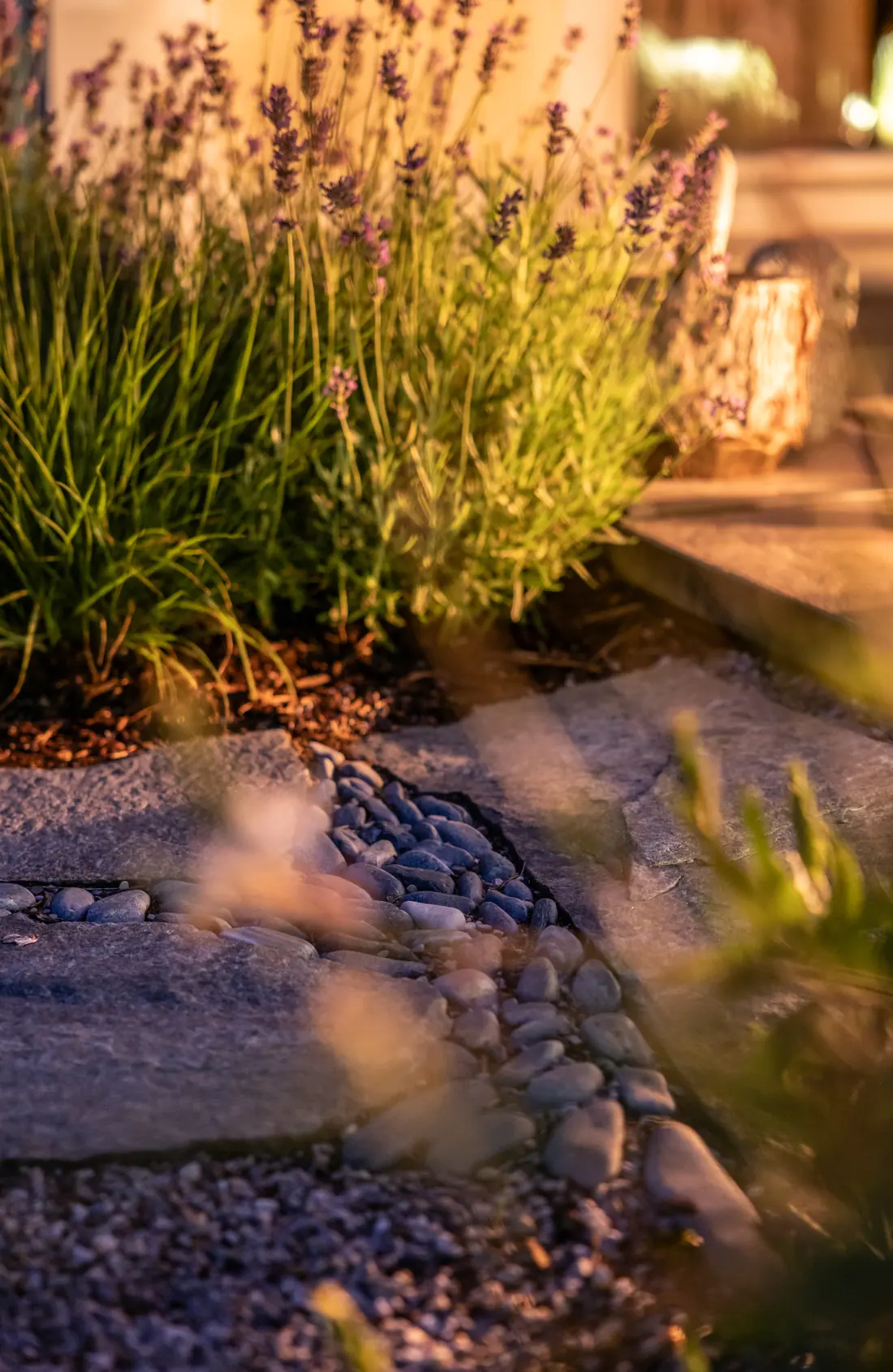
One detail we like: the quartzite natural stone slabs were still in stock from an earlier building phase – we reused them and filled the joints with pebbles. Add a timber terrace made of Kebony, and the garden was finished in spring 2022.
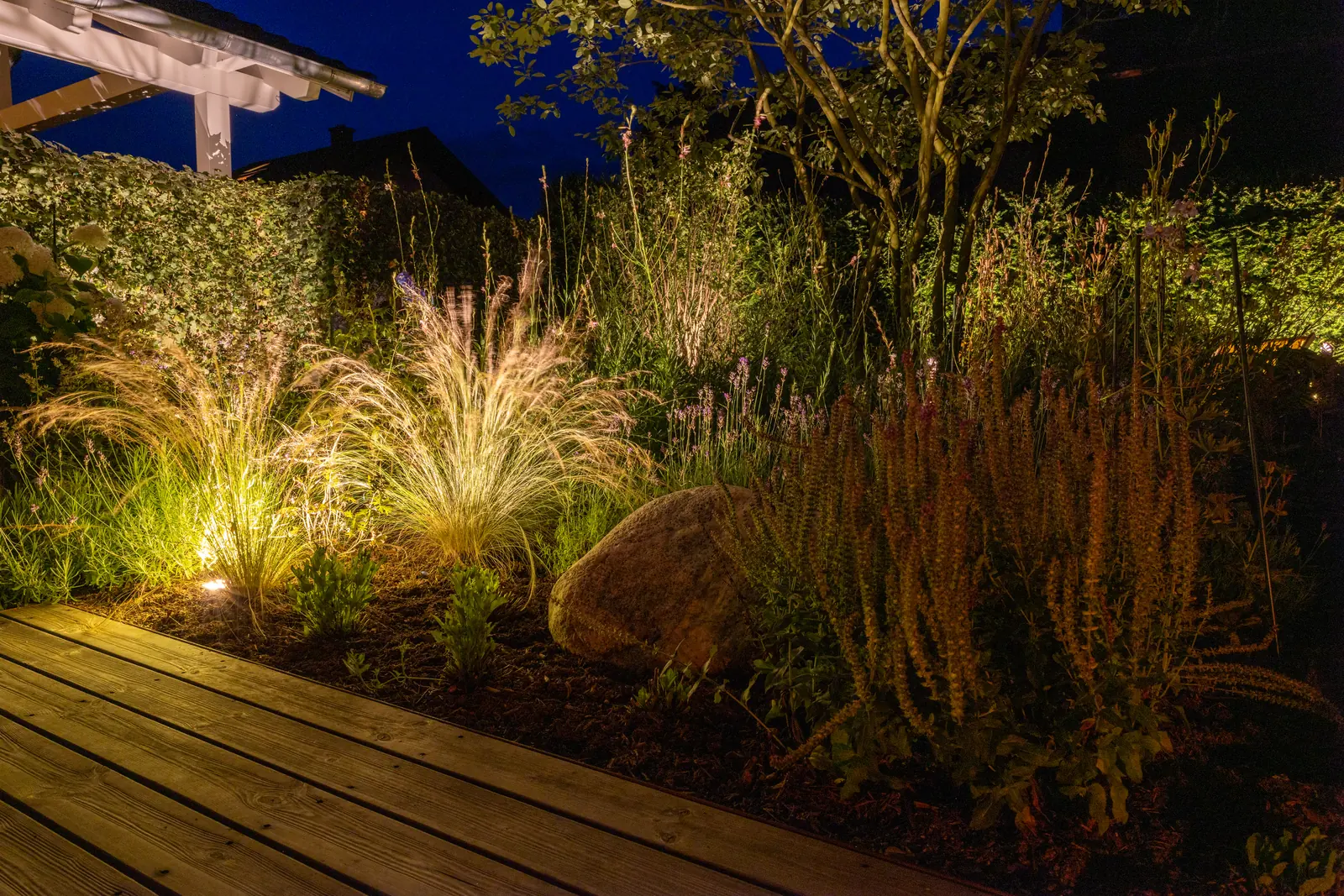
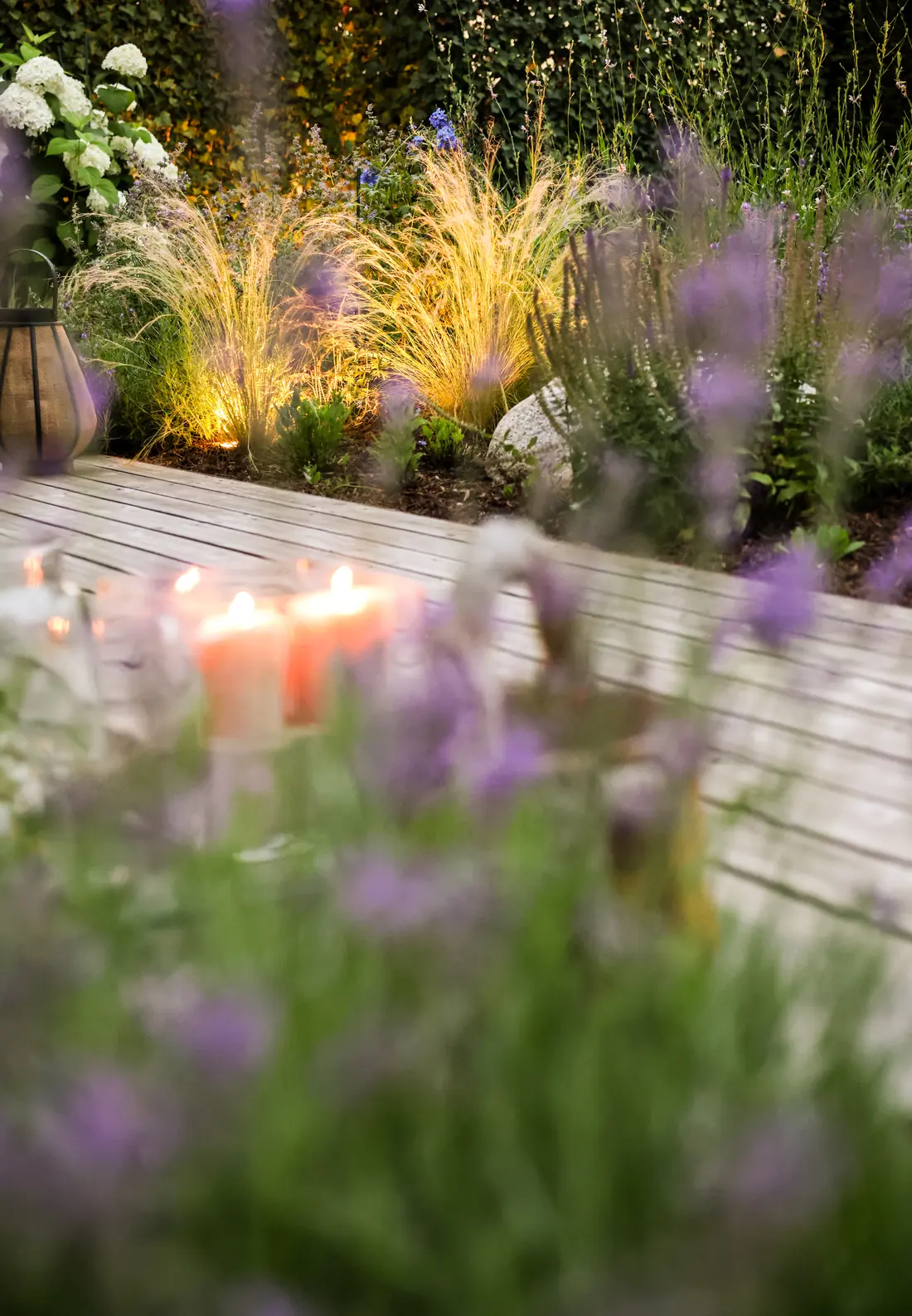
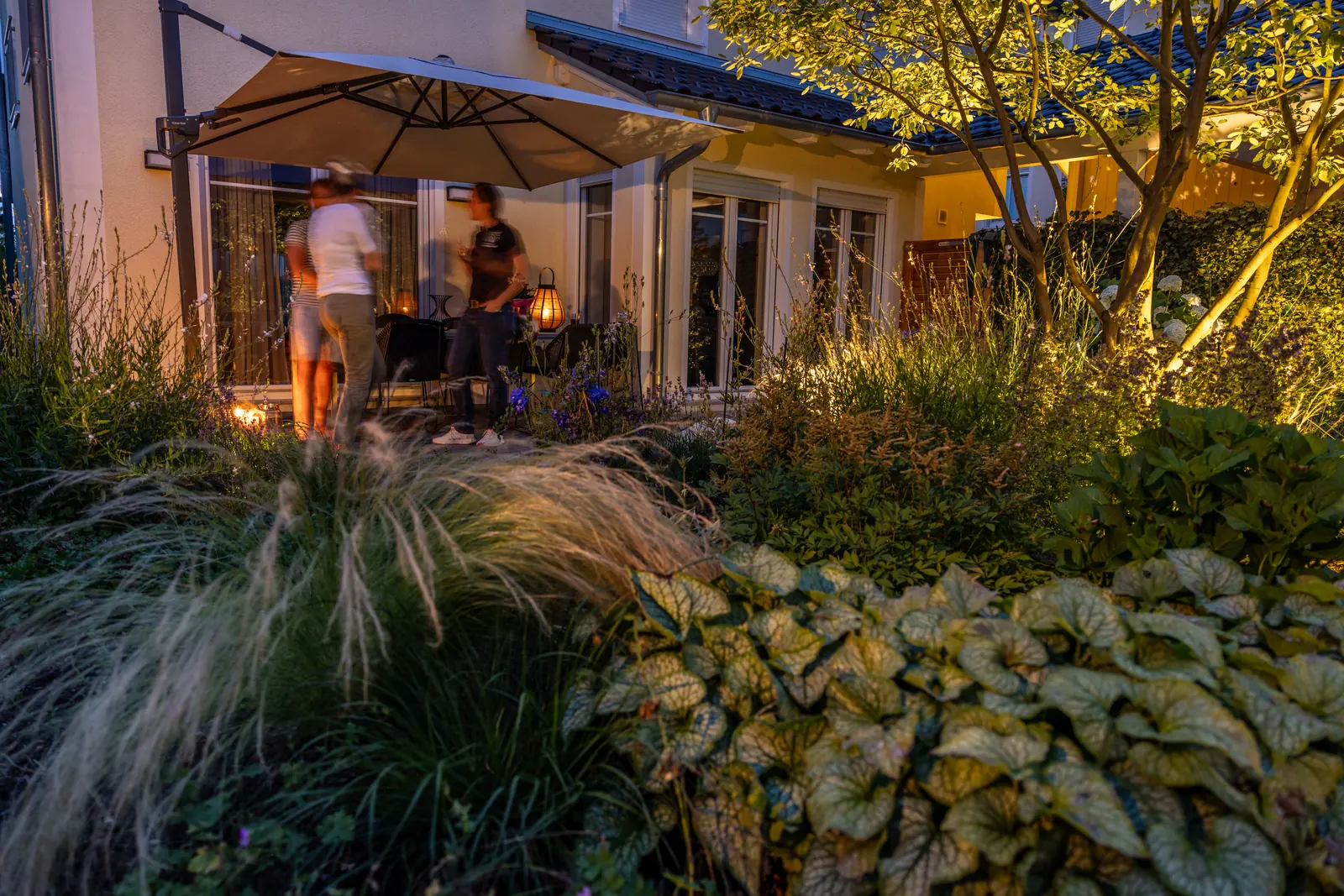
It was designed by our colleague Katharina Unterstaller, and we built and maintain it. In the evening, in-lite lighting takes over – that's how the pictures below came about. The garden made the longlist of the Callwey competition Gärten des Jahres 2024 and is featured there with one photo in the book. Location: Wolfratshausen, photos: Benjamin Klopp / frames for good.
“We wanted to show longing”
Where our perennial bed stands today, there used to be a lawn next to the car park – with a few listless shrubs and planters left over from the build. We redesigned it in May 2025. In this video, Balbina Fuchs and our designer Markus Forberger walk through the bed and see how it has turned out – including the evening primrose that simply spread across the path.
Why we're showing this: a short-lived perennial like the evening primrose doesn't stay where you planted it – it self-seeds and wanders. A perennial bed is therefore not a finished picture, but a planting that rearranges itself every year. That's exactly what makes it alive – and exactly why it needs someone who understands it: our garden maintenance.
How a bed like this really comes about
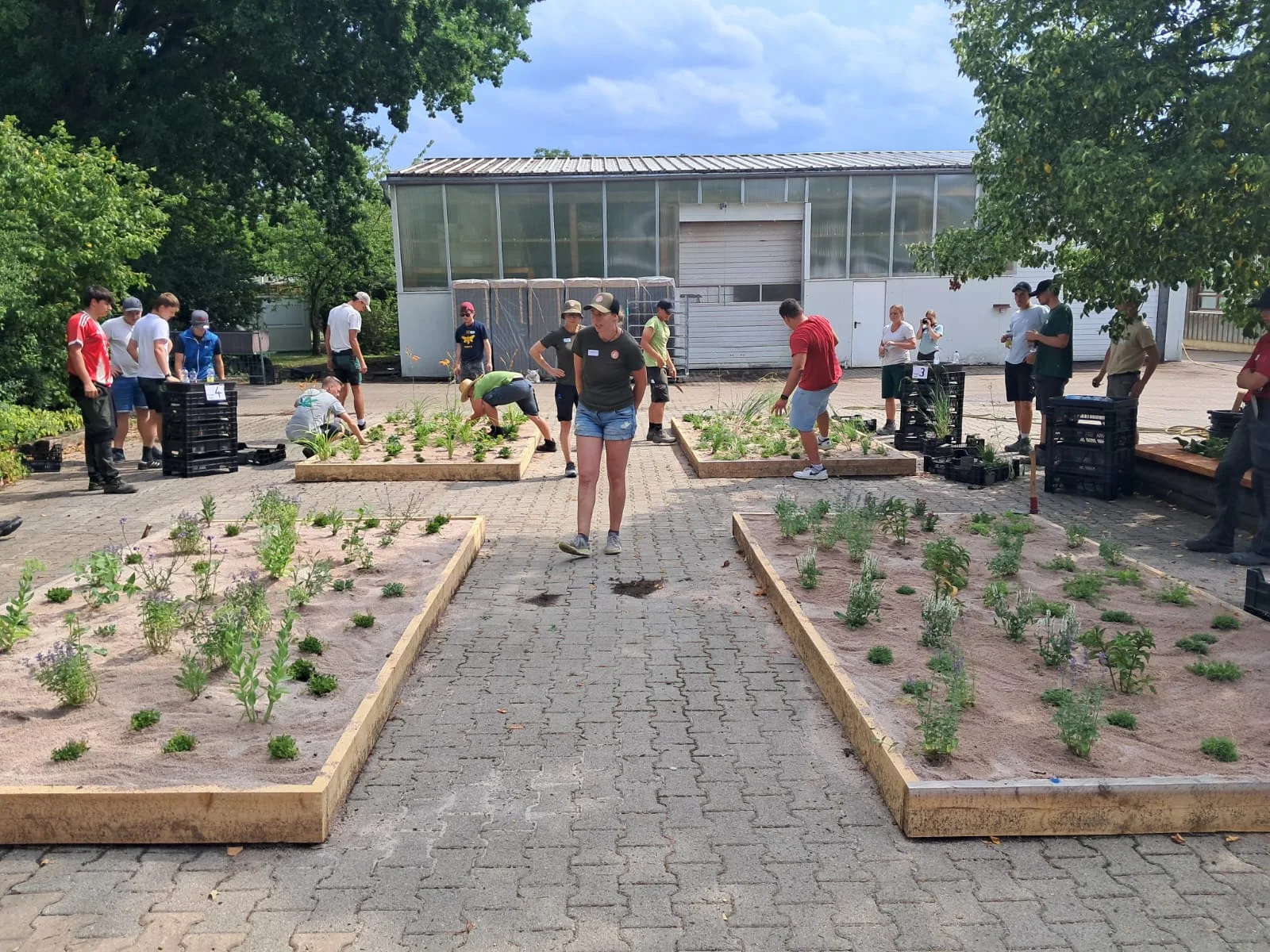
A perennial bed looks easy in photos. In reality, it means a day in the wet, bent over, with cold fingers – in late autumn, because perennials then establish without needing to be watered. Here's how it works.
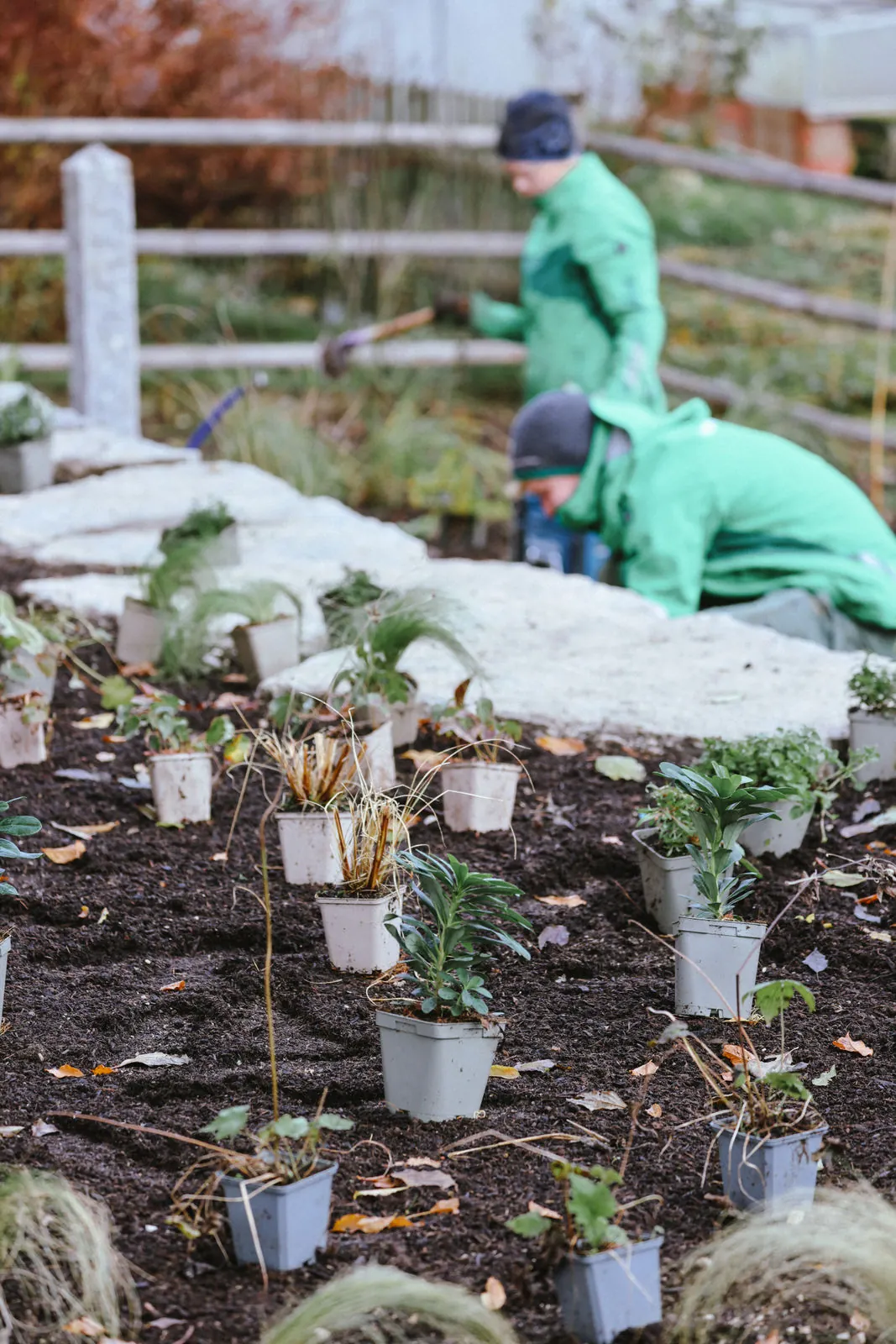
Each plant is first placed in its pot at its intended spot – following the planting plan, but adjusted by eye. Anything moved at this stage saves years later.
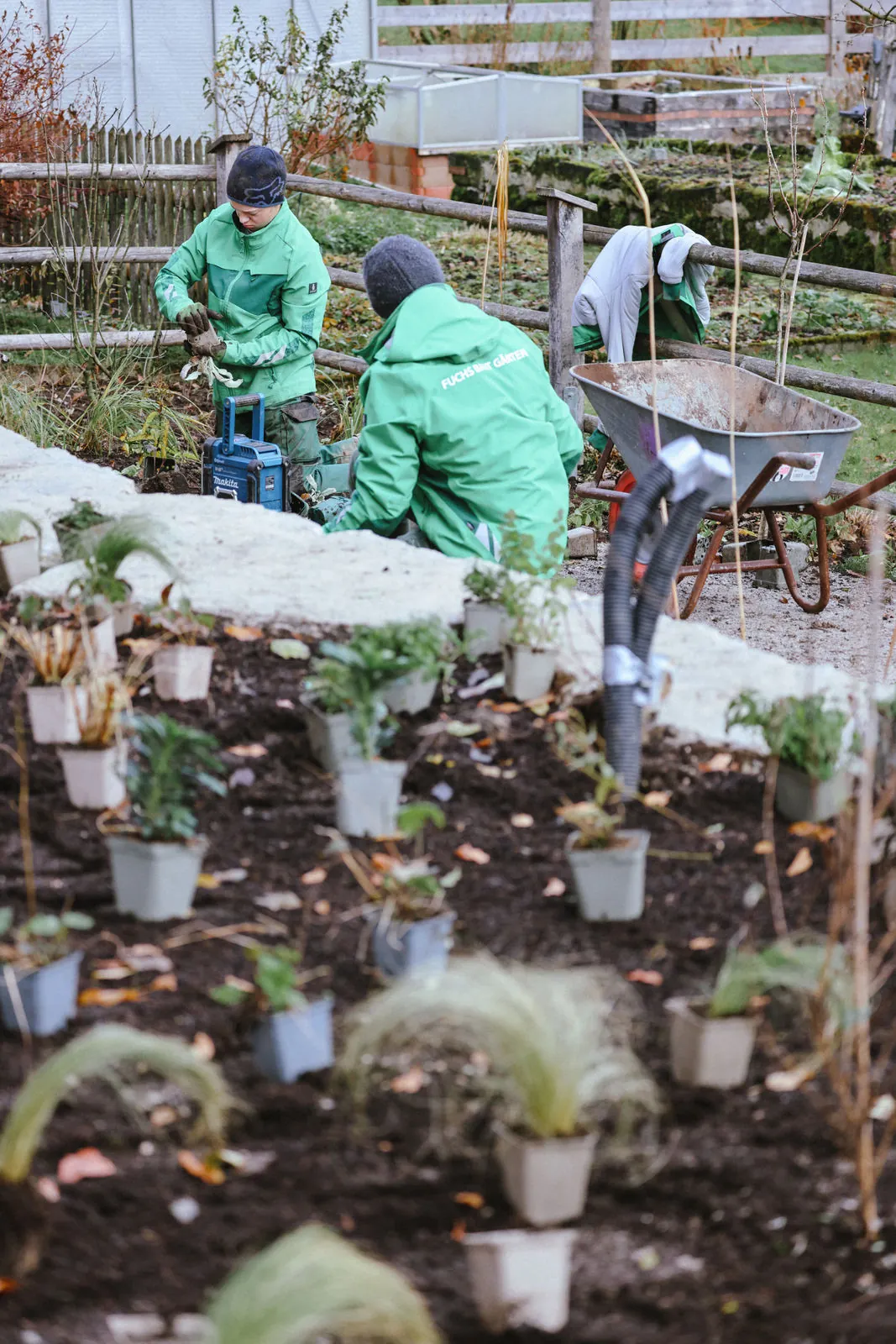
Before the first plant goes in, the soil is loosened and, if necessary, made leaner. In soil that is too rich, perennials grow soft, flop over and get overgrown by weeds.

Each perennial goes into the soil exactly as deep as it sat in its pot – deeper and the crown rots, higher and it dries out. With a few hundred plants per bed, that's the same hand movement a few hundred times.
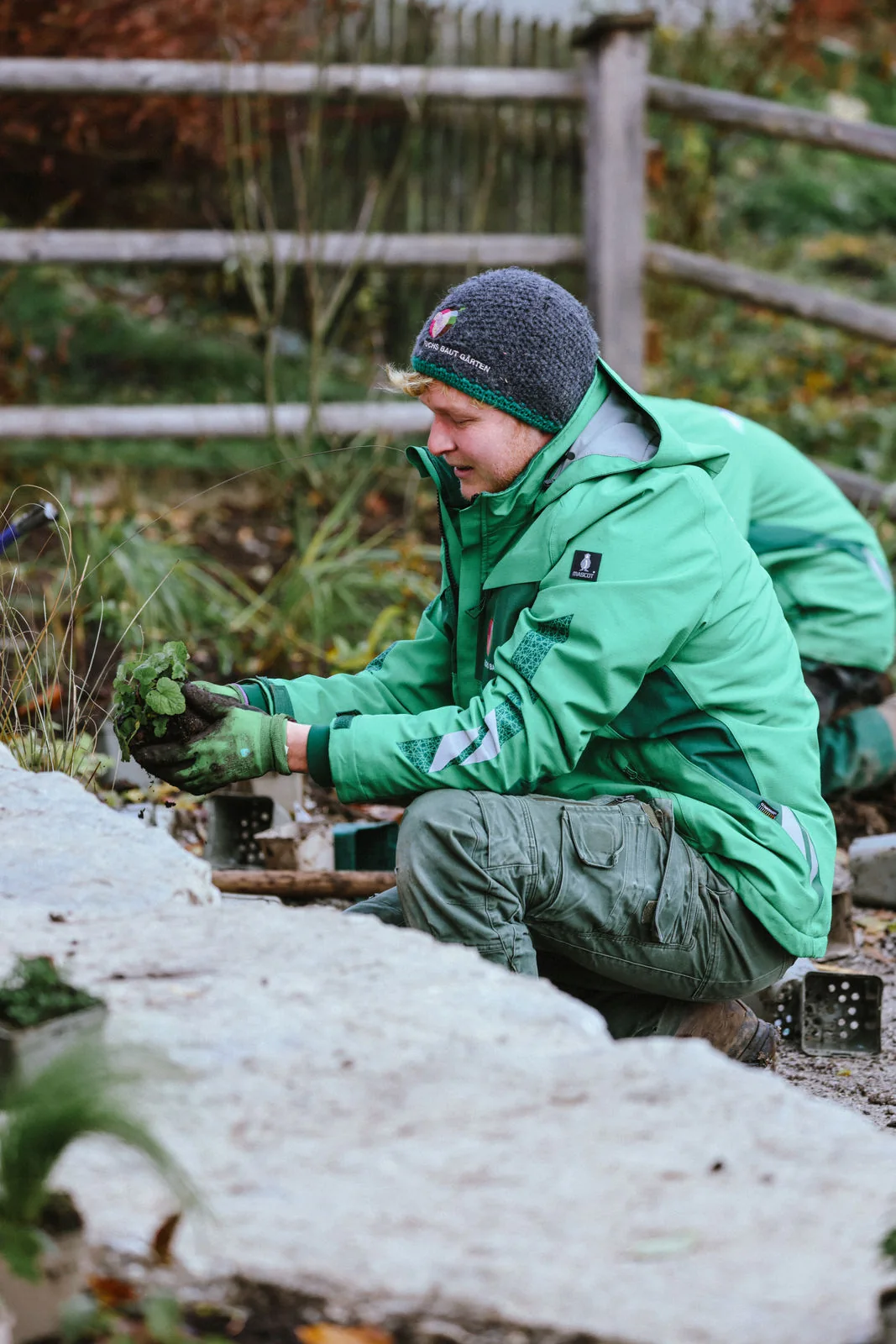
It gets fiddly where the bed meets the path and the natural stone. But that's exactly where you can later see whether a planting was done with care.
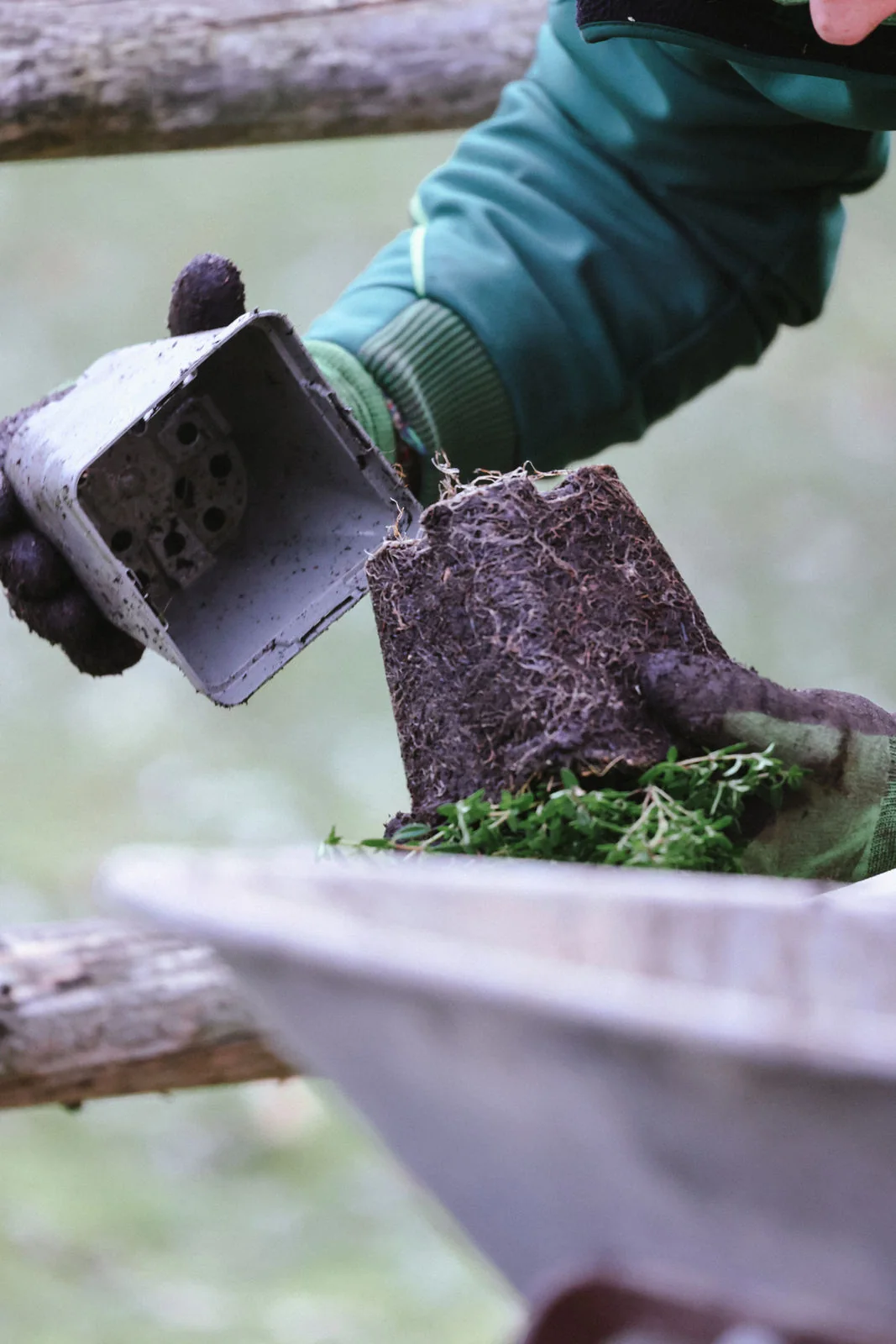
We mix the planting substrate in our own Erdenwerk – stored dry and tailored to the site, rather than bagged compost from a DIY store.
In the pictures you can see Sebastian Lechner, Michael Fischhaber and one of our apprentices at work. Photos: Benjamin Klopp / frames for good.
More impressions: perennial planting
Answers about perennial planting
Do I need to water a perennial garden?
Why do you plant in sand instead of topsoil?
How much maintenance does a bed like this need?
Isn't a natural perennial garden untidy?
Won't there be lots of slugs?
Is there something in flower all year?
Is this also suitable for my garden?
Related reading
Every Thursday, we answer a question from the garden here – often one that our customers ask us.


Let's talk about your project
We are happy to advise you in person, with no obligation.
Request a consultation