
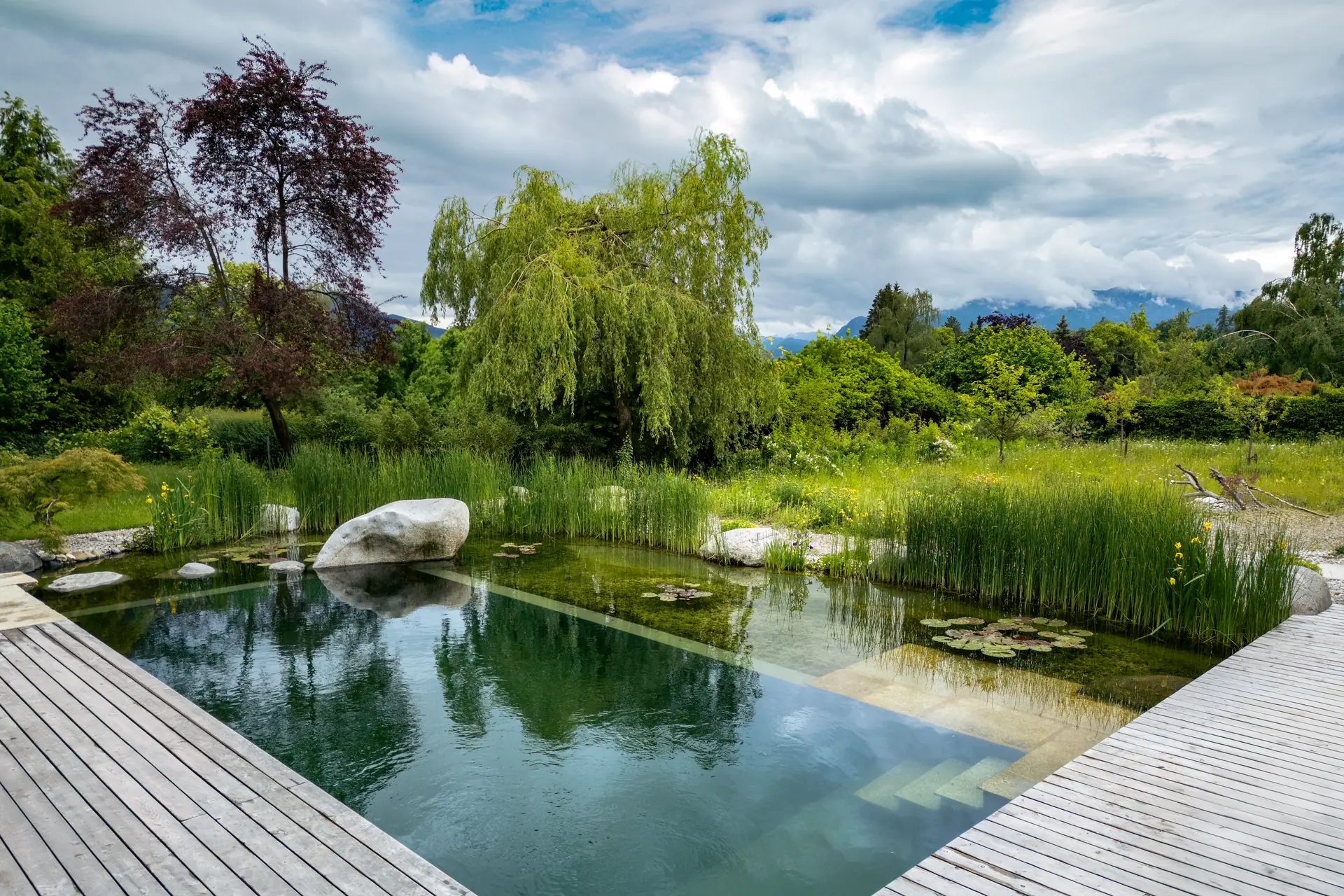
Swimming ponds, natural pools & pools
Swimming ponds, Living Pools and classic pools – designed, built and maintained. Over 440 installations, a Biotop partner for more than 30 years.
Dive in & unwind
Only with water does a garden truly come alive. With over 440 water features built and as a Biotop partner for more than 30 years, we build your water retreat – from a bubbling stone to a bathing garden.
Swimming pond, natural pool or pool?
Three ways to your own bathing water – together we will find the right solution for you:
Swipe the table sideways →
| Your question | Swimming pond | Natural pool / Living Pool | Salt water pool | Chlorinated pool |
|---|---|---|---|---|
| How is the water kept clean? | Plants & microorganisms | biological filter, no chemicals | Salt electrolysis (chlorine from salt) | Chlorine technology |
| What does it look like? | natural look, living biotope | clear pool look, crystal clear | classic pool | classic pool |
| How warm does it get? | follows nature | up to ~28 °C (heatable) | freely selectable | freely selectable, even above 28 °C |
| Chemicals in the water? | none | none | low (salt electrolysis) | yes |
| How much maintenance? | seasonal, natural | manageable, service twice a year | low, automatic salt system | regular water testing |
| How much space? | larger (regeneration zone) | more compact | compact | compact |
| What are the running costs? | low | low (no chemicals, energy-efficient pump) | medium (electricity & salt) | medium to higher (chemicals, heating) |
| Right for you if … | nature lovers | pool look without chlorine | soft water, fewer chemicals | warm & sporty swimming |
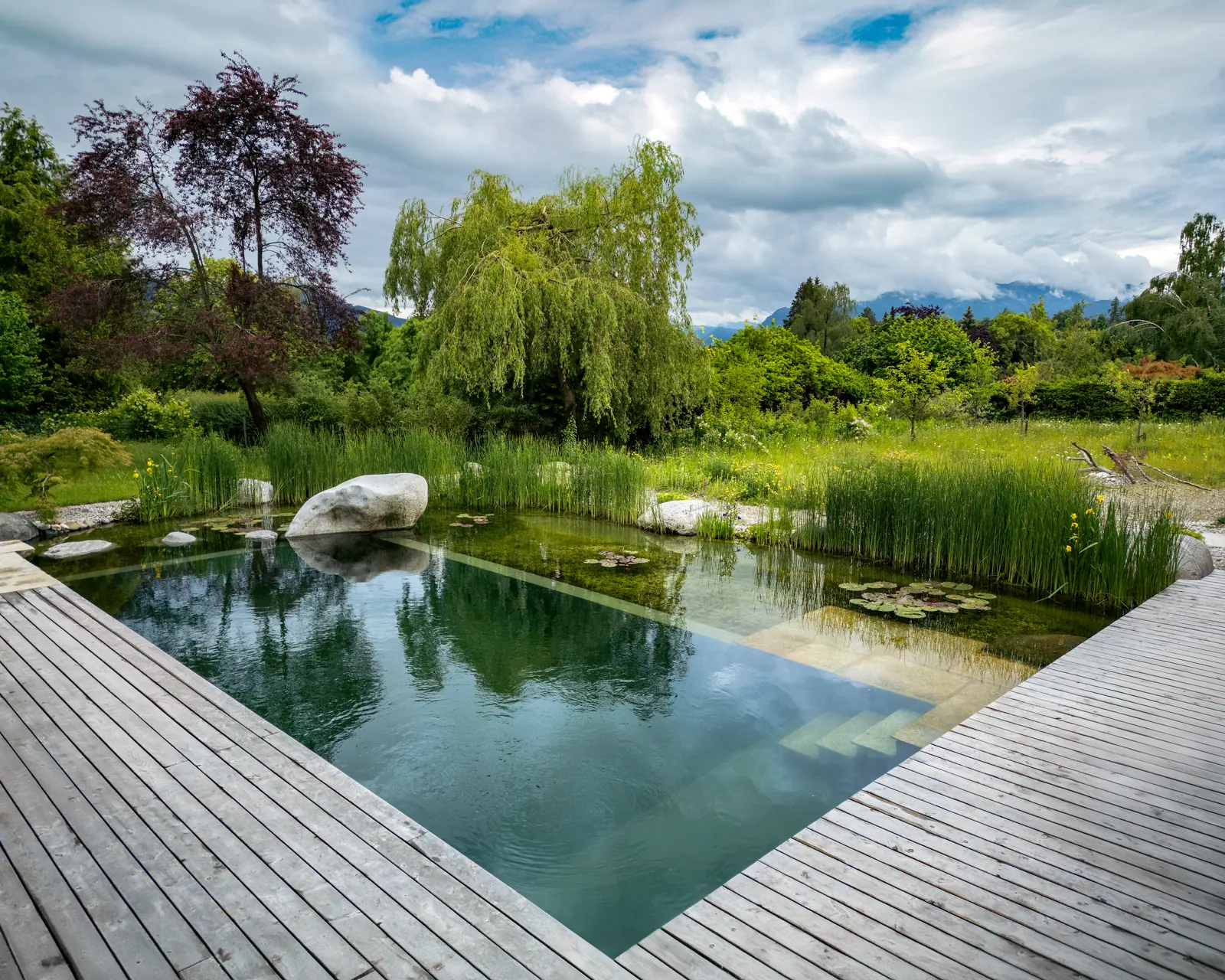
Two decisions, not one
This is where most conversations begin – and where many brochures get muddled: any water you swim in consists of a pool basin and a water treatment system. These are two separate questions, and you can combine them largely as you like.
1. How is the water cleaned?
Plant filtration – the swimming pond with a regeneration zone.
Biofilter and phosphate filter – the Living Pool, the look of a pool without chemicals.
Chlorine – the classic technology, warm and freely adjustable.
Salt water – salt electrolysis, softer to the touch; the chlorine is produced from salt.
2. What is the pool basin made of?
Concrete, also as exposed concrete.
Masonry with liner – the construction method we use most often.
Stainless steel – thin walls, precise edges.
Prefabricated pool – made in the factory and installed quickly. All four are covered below under Construction methods.
And why it matters
A prefabricated pool is a basin, not a water treatment system. The same basin can run on chlorine, salt water or biological filtration – the decisions are made separately. Likewise, a Living Pool can be built in masonry, in concrete or as a prefabricated pool. Anyone who lumps the two together is comparing apples with oranges.
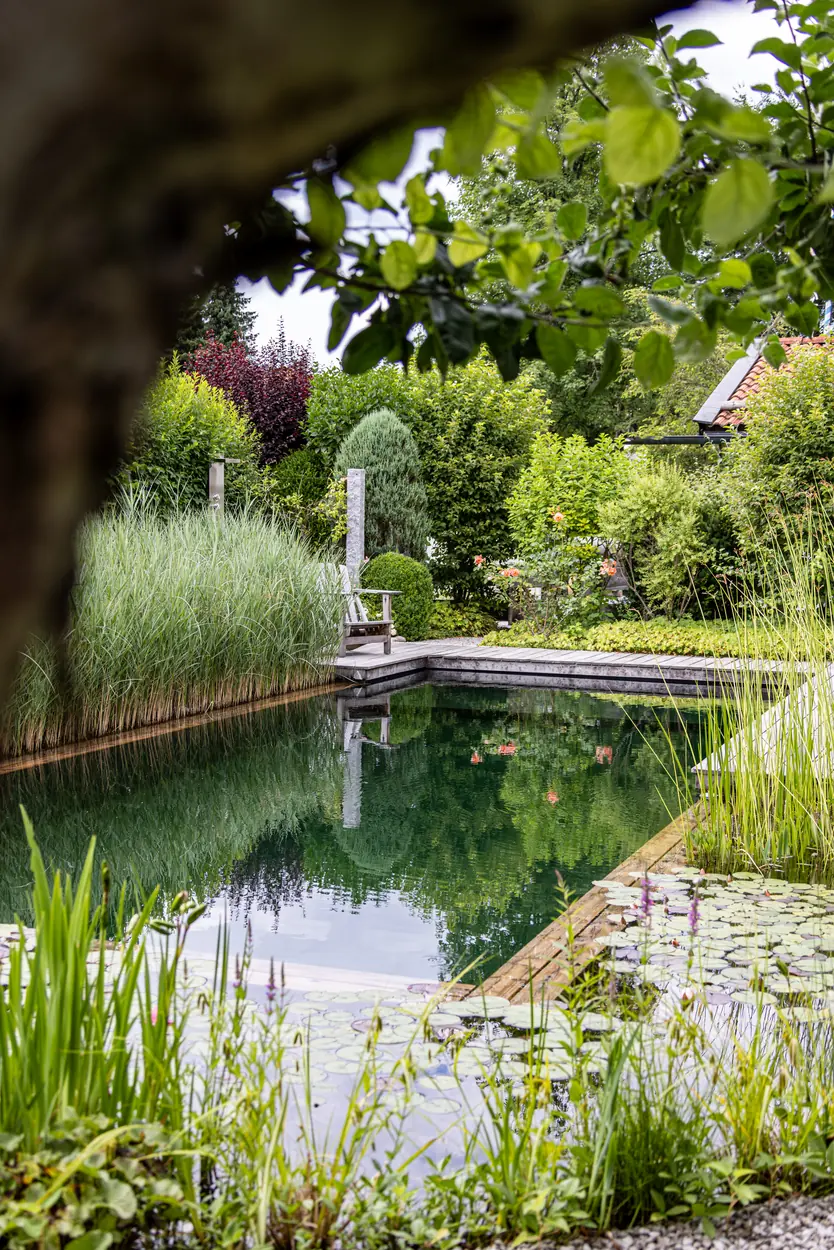
Swimming pond
Water: plant filtration. Near-natural swimming in a living biotope.
Discover the swimming pond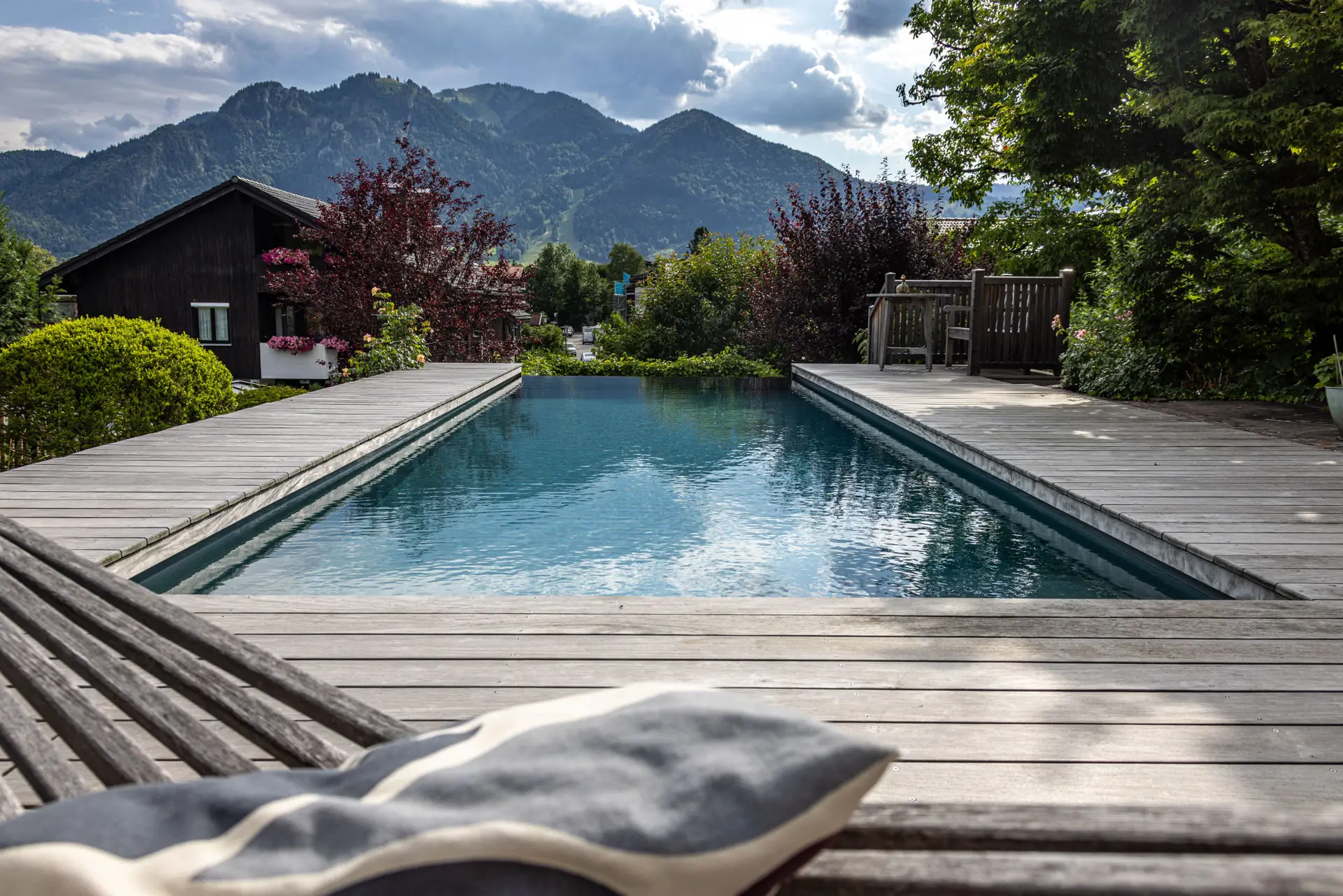
Living Pool
Water: biofilter and phosphate filter. The look of a pool, crystal clear, entirely without chlorine.
Discover the Living Pool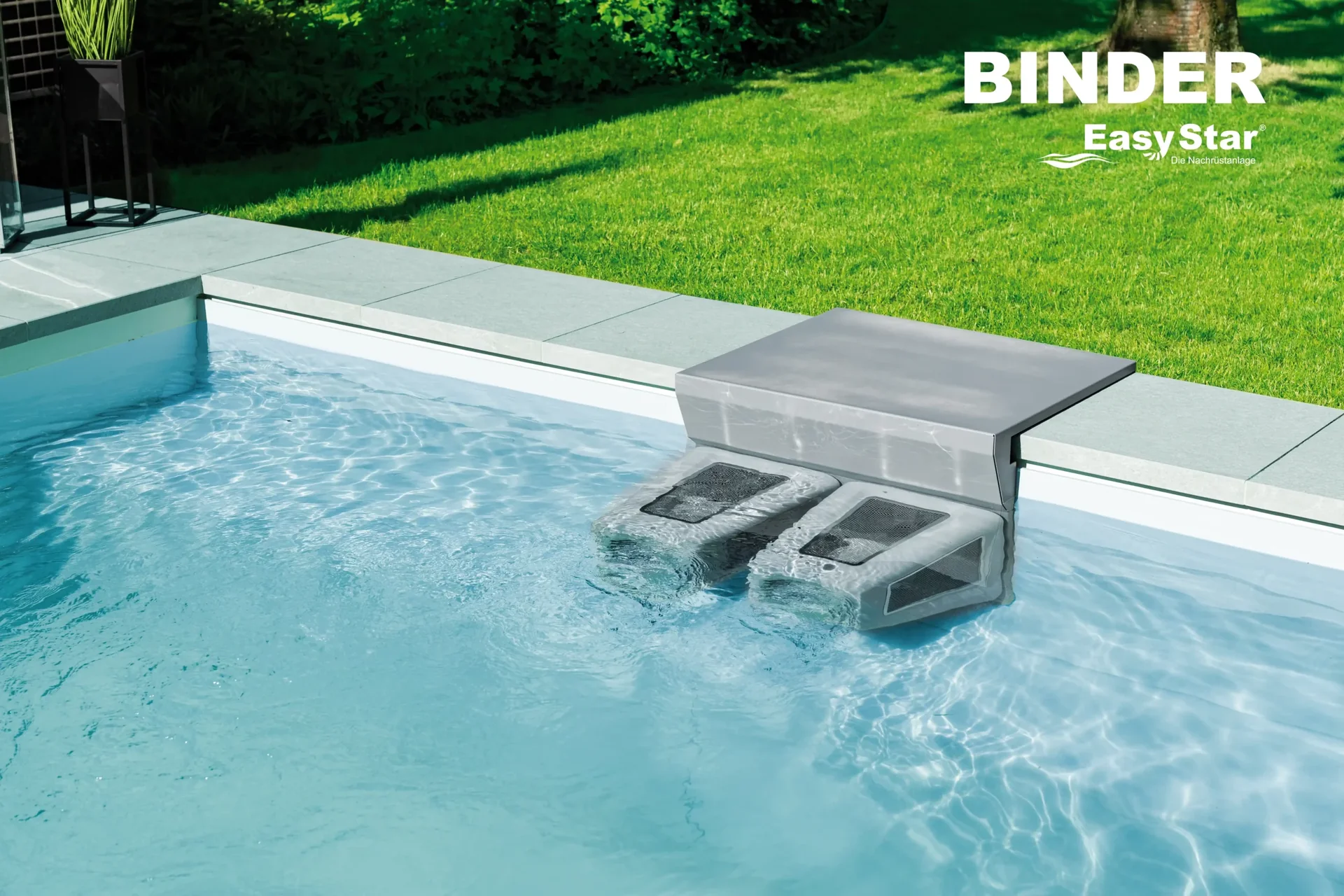
Salt water pool
Water: salt electrolysis – the chlorine is produced from salt. Softer to the touch, same technology.
Discover the salt water pool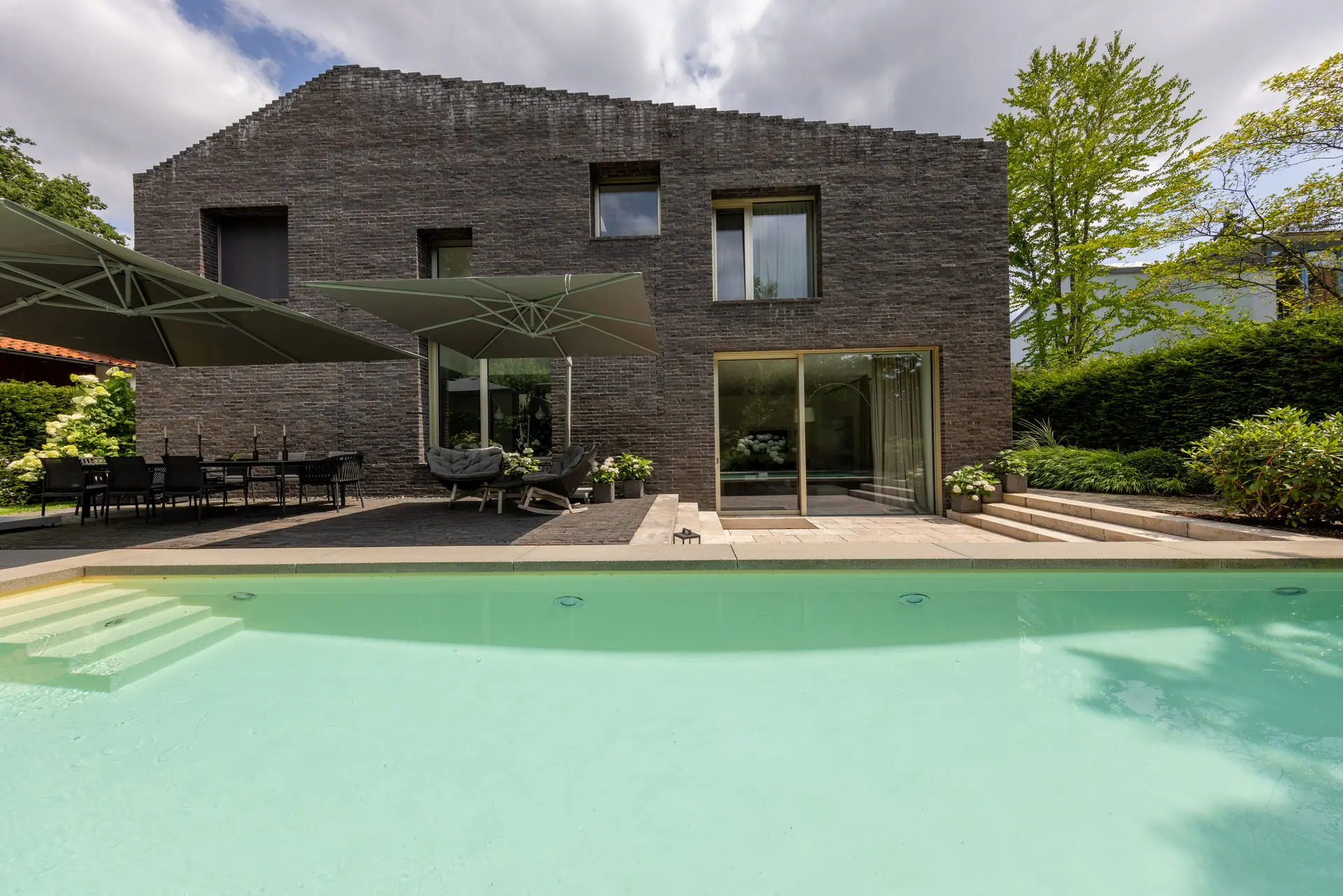
Chlorinated pool
Water: classic chlorine technology. Freely adjustable, even above 28 °C.
Discover the chlorinated poolFour routes to the water – exactly the four from the table. What the basin is built from is the second question and independent of the first: concrete, masonry with liner, stainless steel or a prefabricated pool. You'll find that below under Construction methods.
How the water stays clean
The question we are asked most often – and the simplest answer: it isn't about killing germs. It's about taking away the algae's food.
Algae need phosphorus. A chlorinated pool fights the symptom, a biologically cleaned pool tackles the cause: where there is hardly any phosphorus in the water, nothing grows to cloud it. That is why the principle is called nutrient management and not disinfection – and why a bag of lawn fertiliser at the edge of a pond is more dangerous than a thunderstorm.
Two routes lead there, and they look very different:
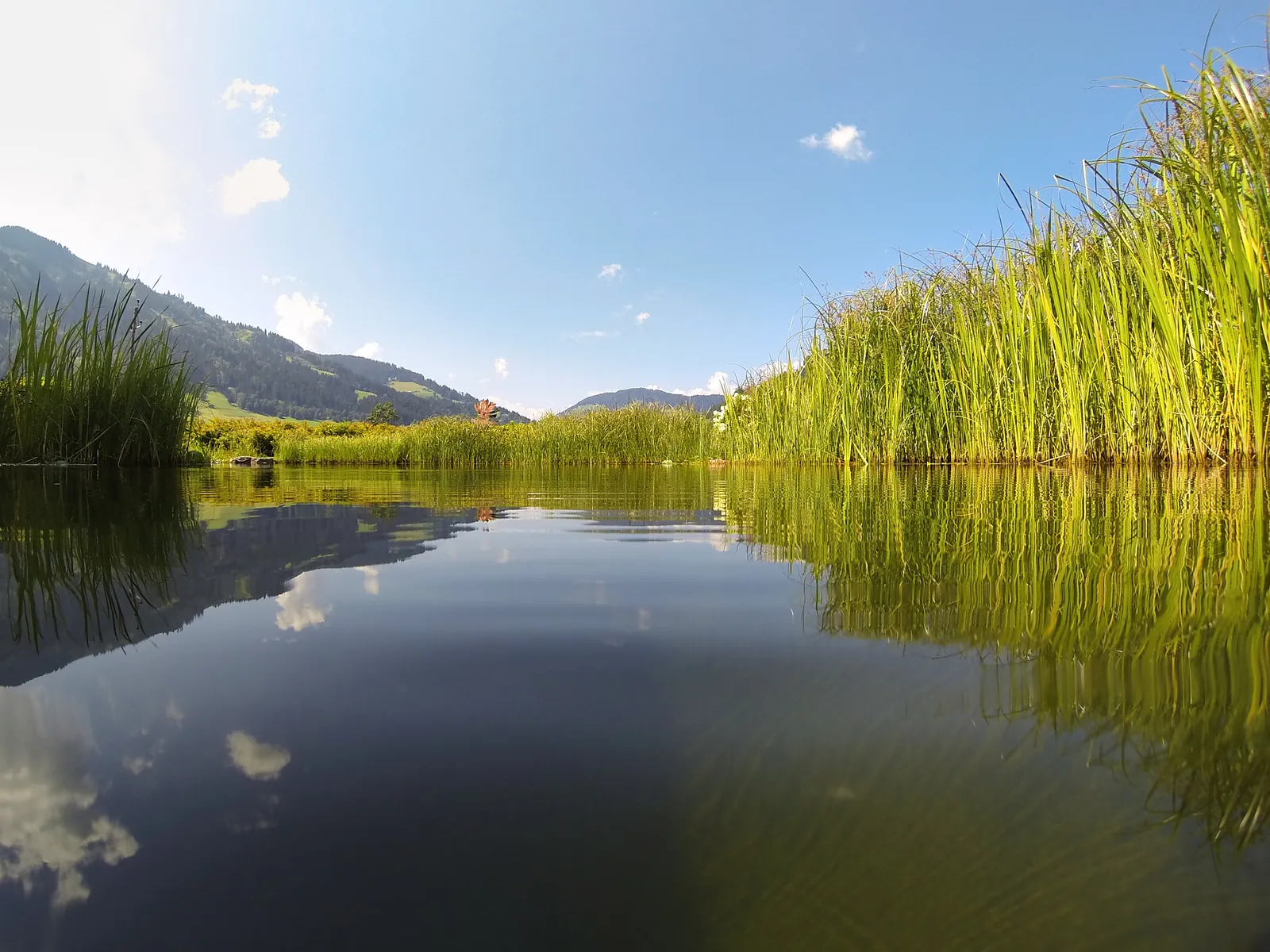
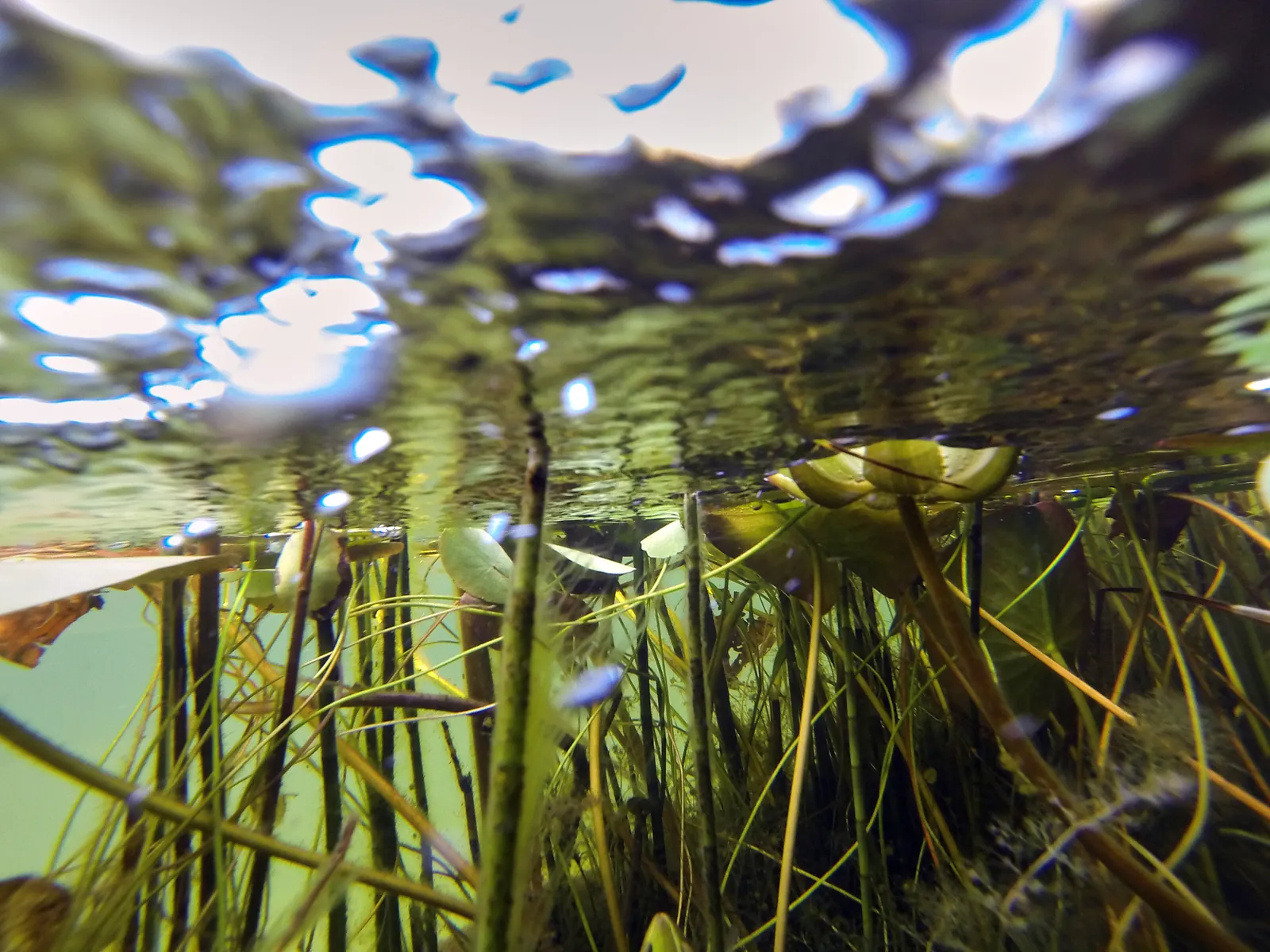
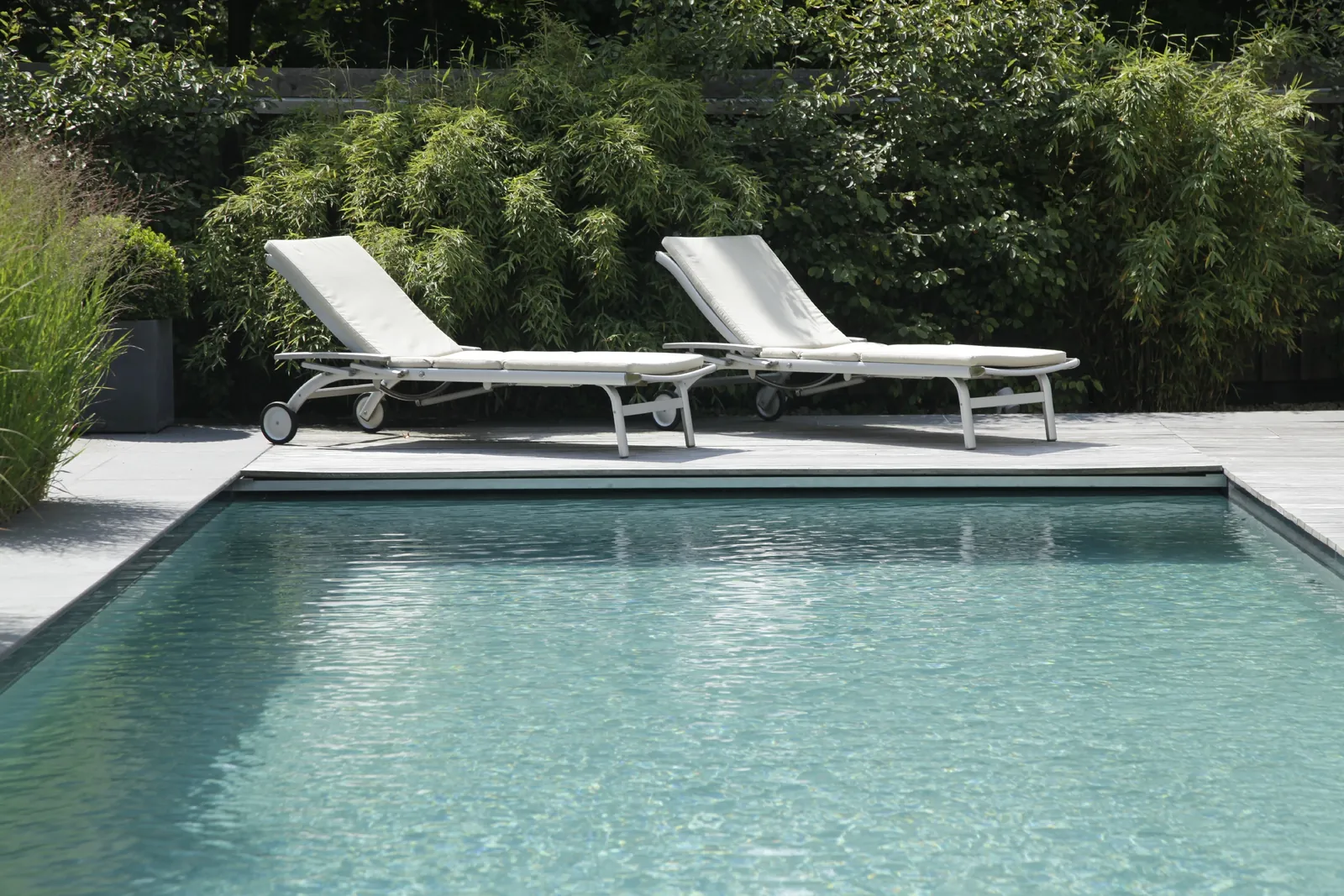
Photos of our installations in Tirol and Grünwald.
Swimming pond: the regeneration zone
A shallow, planted area next to the swimming area. Aquatic plants and microorganisms in the substrate remove nutrients from the water, and zooplankton eats any algae that still appear. The result looks like a mountain lake – and lives like one too. More under Swimming pond.
Living Pool: biofilter and phosphate filter
Here technology does what the plants do in a pond: an underground biofilter and a phosphate filter, called PhosTec Upstream by BIOTOP. No planted zone, no chemicals, but the clear look of a pool. More under Living Pool.
What you will notice
Soft water that doesn't sting your eyes and leaves no smell. No buying chlorine, no testing, no annual draining. In return, a short start-up period in spring while the biology gets going – and water that warms naturally to around 28 degrees, but no higher.
Why we build with BIOTOP
We didn't invent this technology ourselves – we have built it since 1993 as a partner of BIOTOP, the company that made the swimming pond big in Europe. Since 1985, BIOTOP has built around 9,500 bathing installations without chemicals; in that time we have built over 440 water features and were named Platinum Star Partner in 2023. In practice, that means we don't plan on instinct, but with a system whose limits we know – and we tell you in advance where they lie.
Over 30 years of water in the garden
From the first swimming pond in 1995 to today – and what you can learn from it for your own project.
over 440 installations
Completed and invoiced water features. The oldest in our records dates from 1995 – so we can see how our installations look after 30 years.
over 40,000 m² of water
That is how much water surface we have built – more than four hectares. From a spring basin in a terraced-house garden to an installation the size of a lake.
from 10 to over 2,000 m²
That is the range of individual installations. There is no minimum size with us – and at the upper end, it stops where your plot stops.
Biotop partner for over 30 years
Certified in the proven, chlorine-free Biotop system – with ongoing training and access to a mature technology.
Masonry construction predominates
In our records, masonry construction is by far the most common, followed by L-shaped elements. We rarely use earth-bank construction today – it needs the right ground.
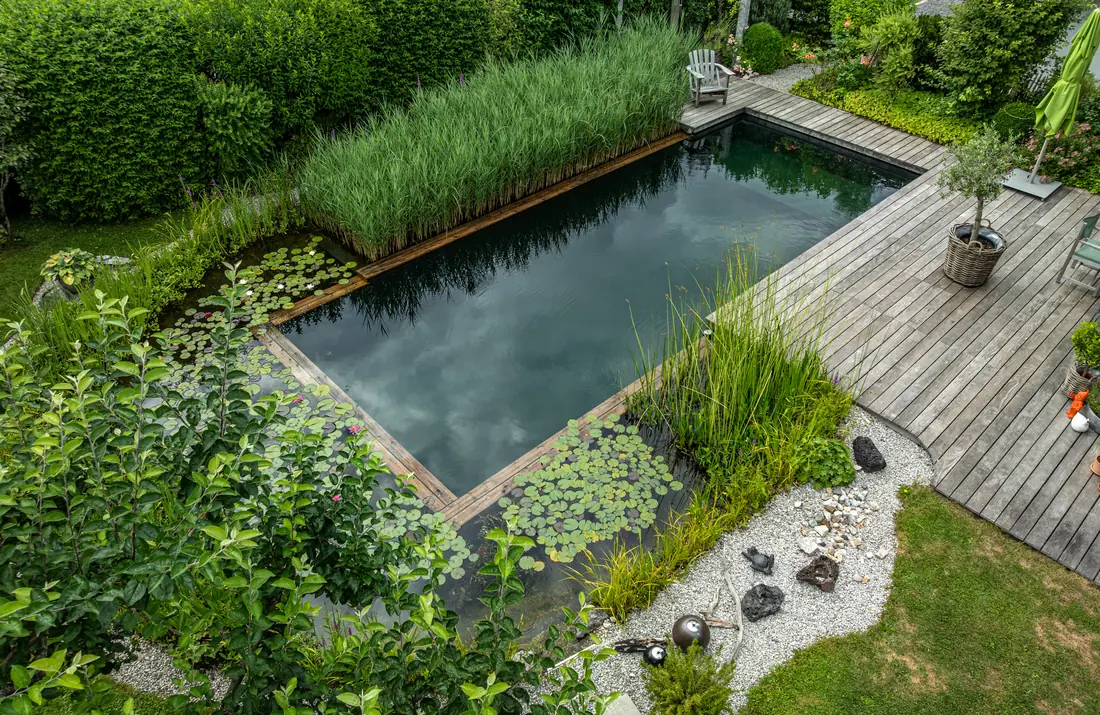
How big will yours be? A look at our figures
Swimming ponds and Living Pools differ clearly in size – that is down to the technology, not to taste. The swimming pond needs its regeneration zone, while the Living Pool cleans via biofilters and manages without one. In our installations from 2013 to 2020, it looks like this:
| Type | typical water surface | Range |
|---|---|---|
| Swimming pond | around 30 m² | 10 to 270 m² |
| Living Pool | around 30 m² | 14 to 66 m² |
The typical installation is a similar size for both. The difference is at the upper end: with swimming ponds we have built installations of up to 270 m², while for Living Pools the upper limit in our practice is around 66 m². Anyone who wants a large water surface will almost inevitably end up with a pond.
Public too: around 12,000 m² of bathing water
Not all of our installations are in private gardens. Around 12,000 m² of our water surface is open to the public – including two municipal natural outdoor swimming pools where you can swim yourself before deciding on a type of construction.
How a natural outdoor swimming pool works, what it means for a municipality and which facilities we have built are all explained in detail on the Natural outdoor swimming pools for municipalities page.
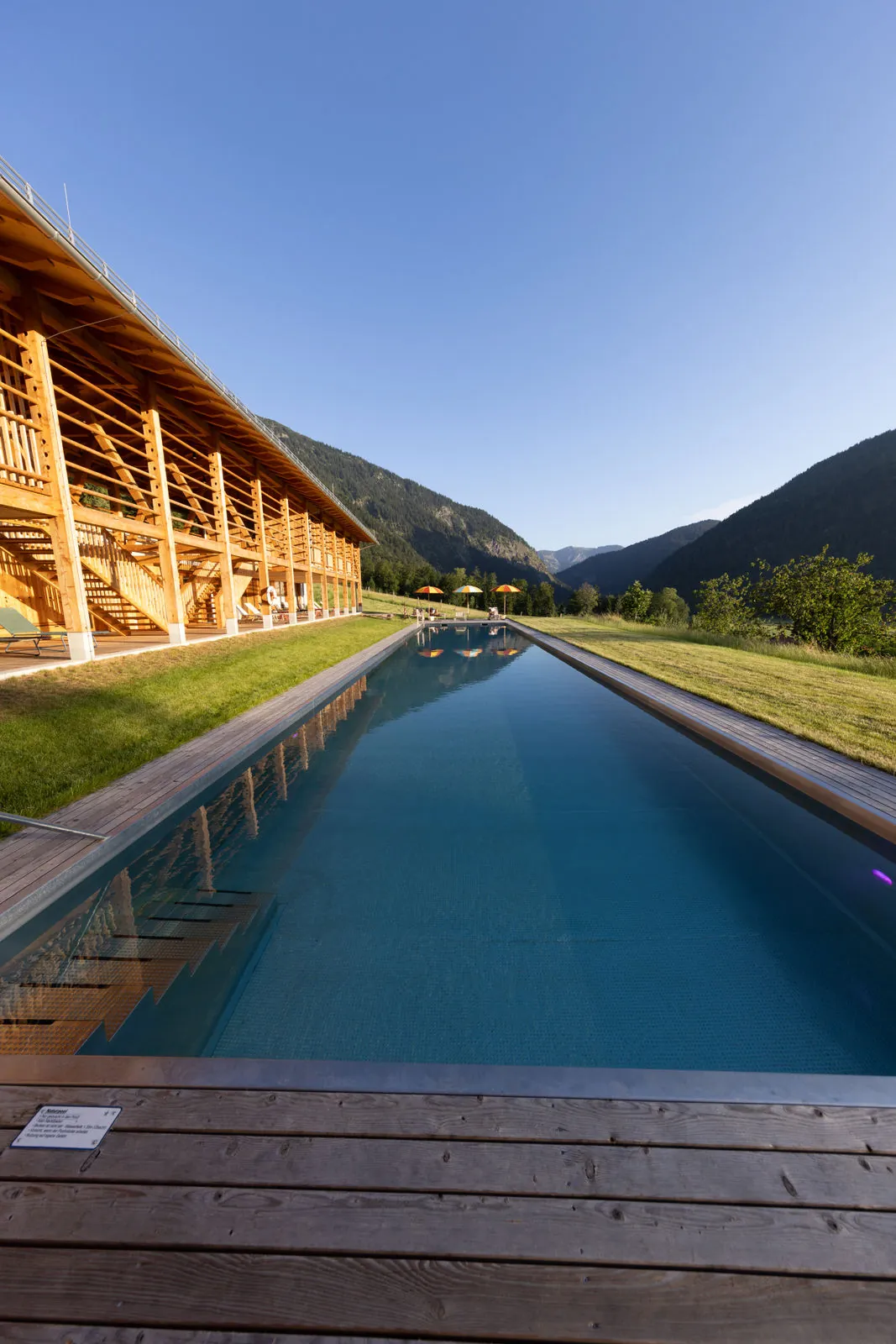
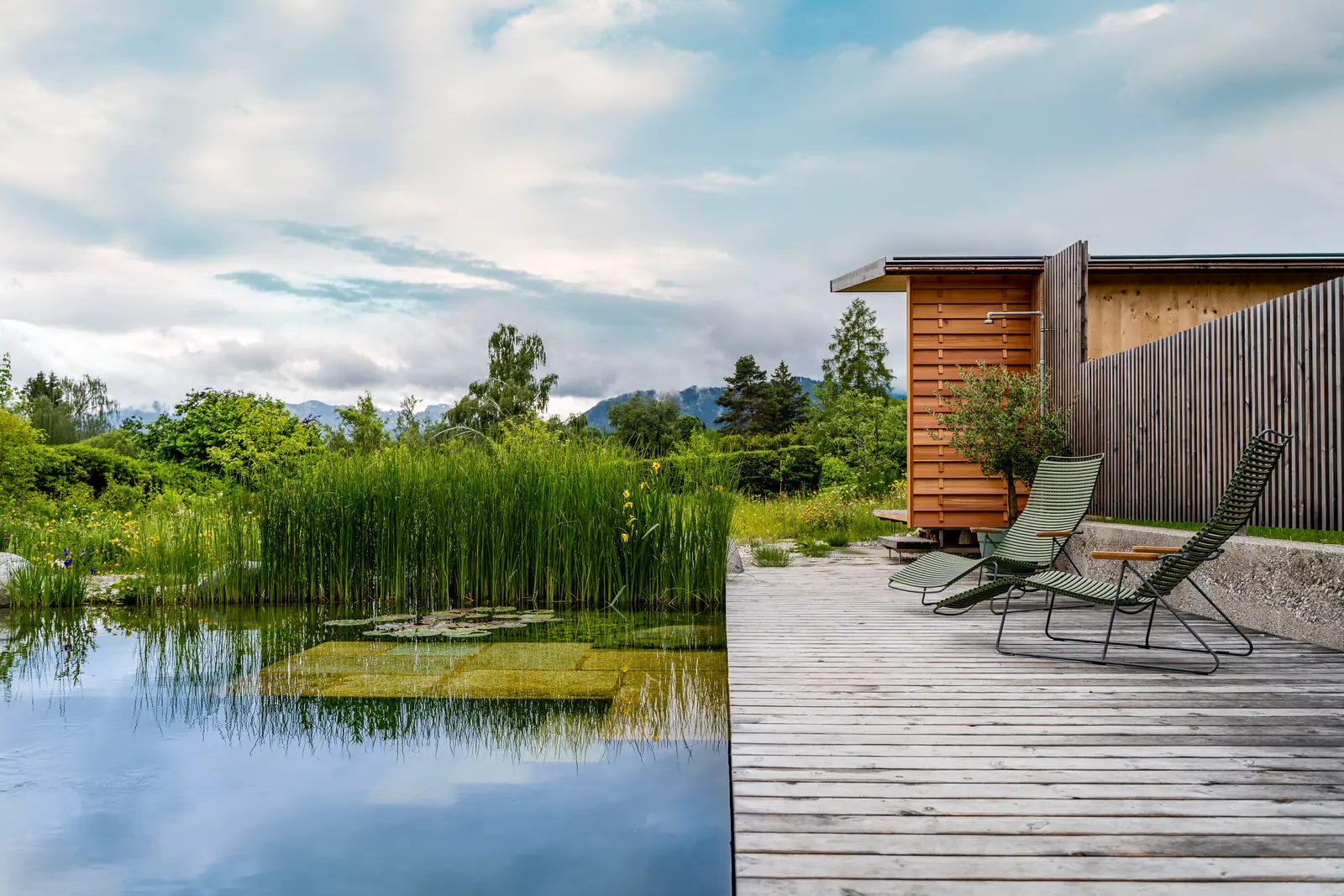
The images on this page show a classic Biotop swimming pond in Rottach-Egern on Lake Tegernsee – built in 2011, with a 15-metre swimming lane and continuously looked after by our pond service for fifteen years. The full story is on the project page “Bayrisches Badeglück am alten Apfelbaum”. Photos: Victor Liska photography. That a public pool can also inspire private wishes is shown by Thomas Huber’s swimming pond: without the natural pool at the Aschauerweiher, he says himself, he would never have thought of it.
Ice bath & plunge pool
Cold therapy in your own garden – the newest topic among water features, and one we now build often.
What cold water bathing offers – and what it needs
Cold water bathing is on trend – and demonstrably good for you: regular ice baths support recovery, boost circulation, can ease sore muscles and improve sleep and mood. As a partner of Winthera, we integrate high-quality ice baths seamlessly into your garden – on their own or as an invigorating contrast to a sauna and natural pool.
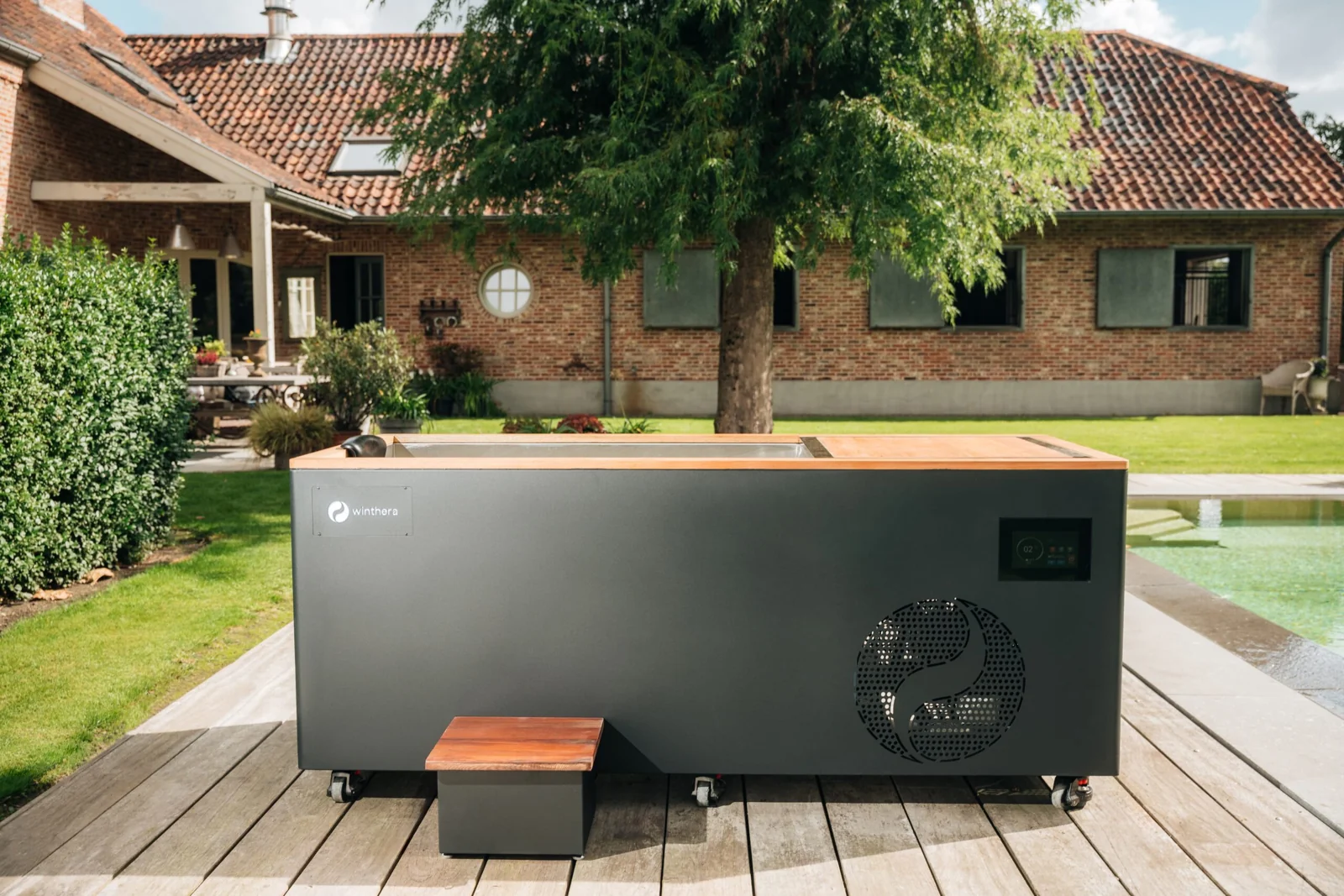
More about the ice bath & Winthera
One day, three ponds, open garden gates
On a day in June 2017, three owners of swimming ponds we built opened their gardens – for people considering building one themselves. Three installations, three completely different answers to the same question.
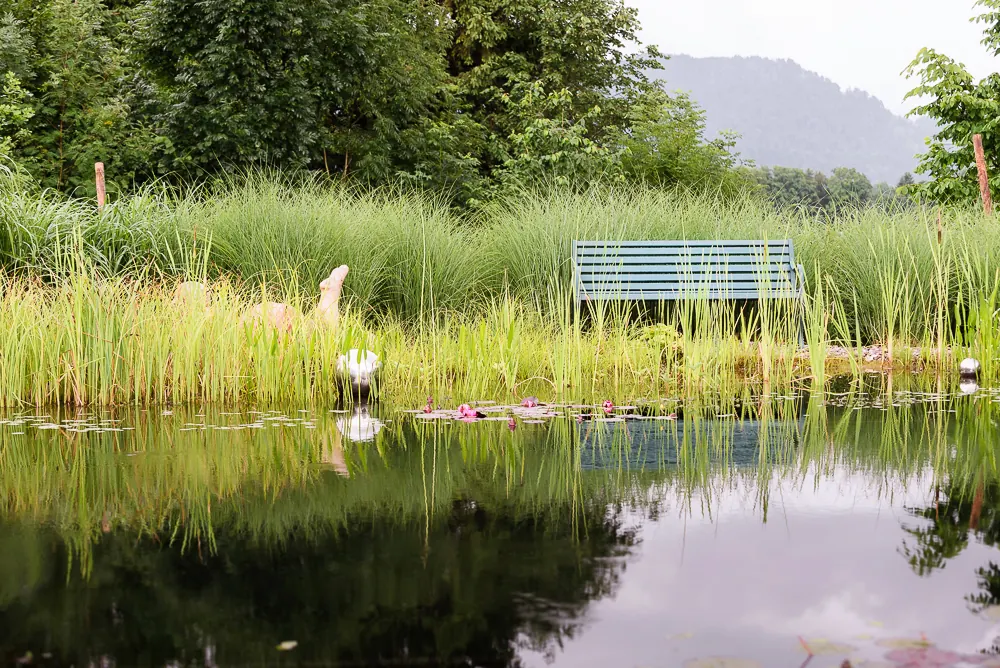
Reeds, water lilies, a bench on the bank – a pond that looks as if it had always been there. If you want this kind, you need to love plants, not just water.
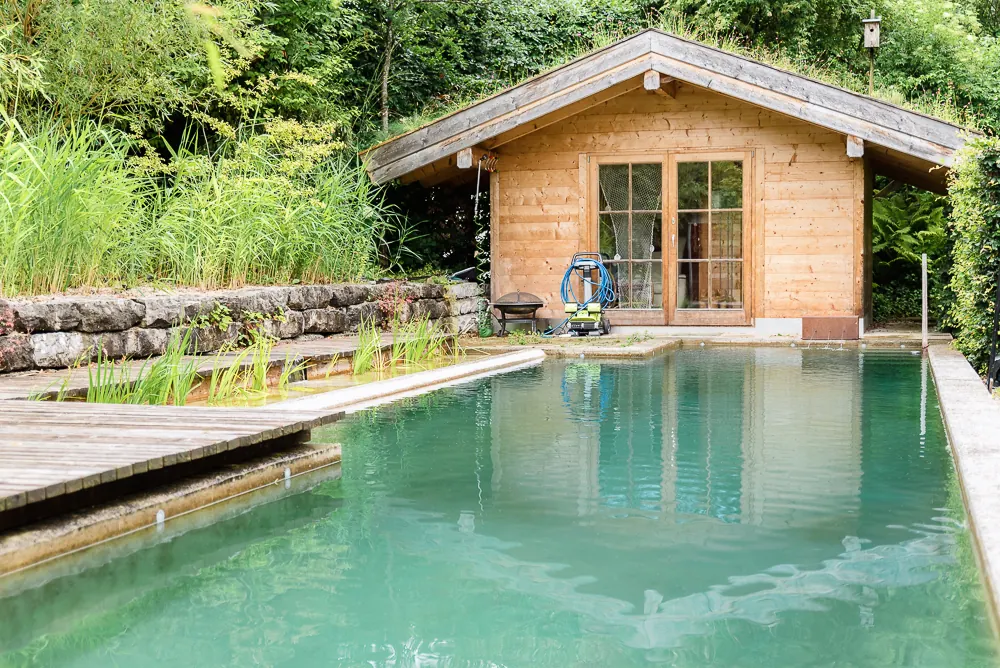
A rectangular concrete basin, clean edges, a bathhouse alongside. The same biological filtration, but with the form of architecture. It belongs to a fellow company and can still be viewed today by arrangement.
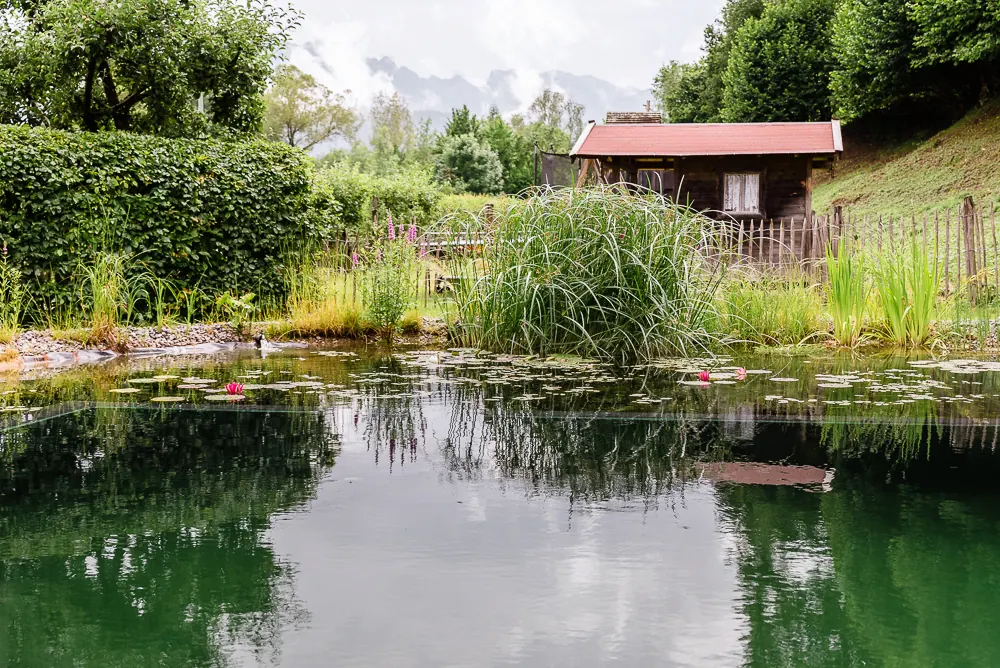
The pond at the Landhaus Benediktenhof – in operation for decades, with hotel guests instead of one family. The toughest proof that a system like this lasts.
What we learned that day: no photo and no consultation can replace standing at the water’s edge and putting your hand in the water. That is why we still do it this way today – see below.
Photos: Klas Stöver.
Installations you can visit
Liner or concrete, swimming pond or natural pool – it all looks good in photos. The difference shows when you sit at the pool edge. That is why we show you finished installations before you decide – always by appointment.
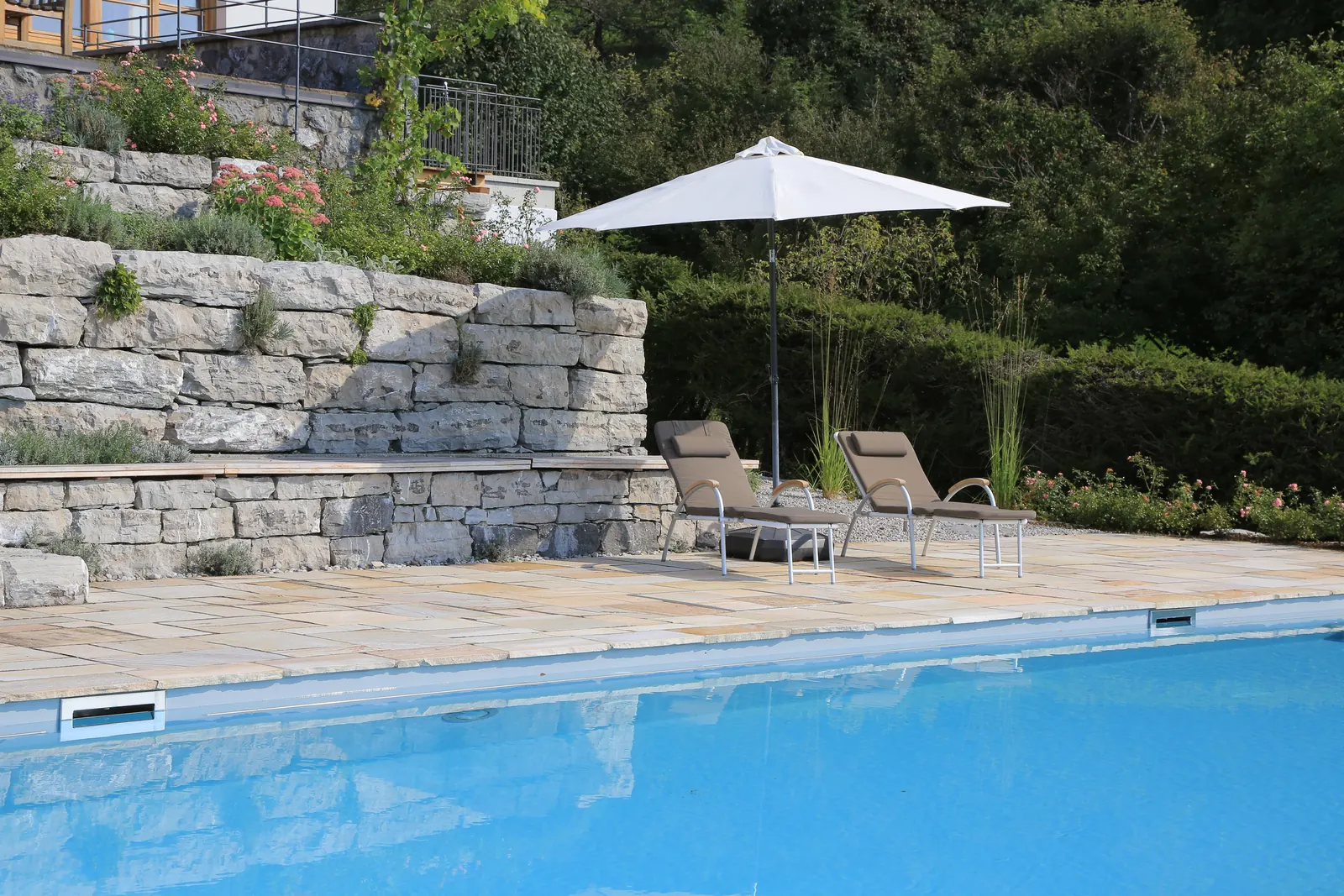
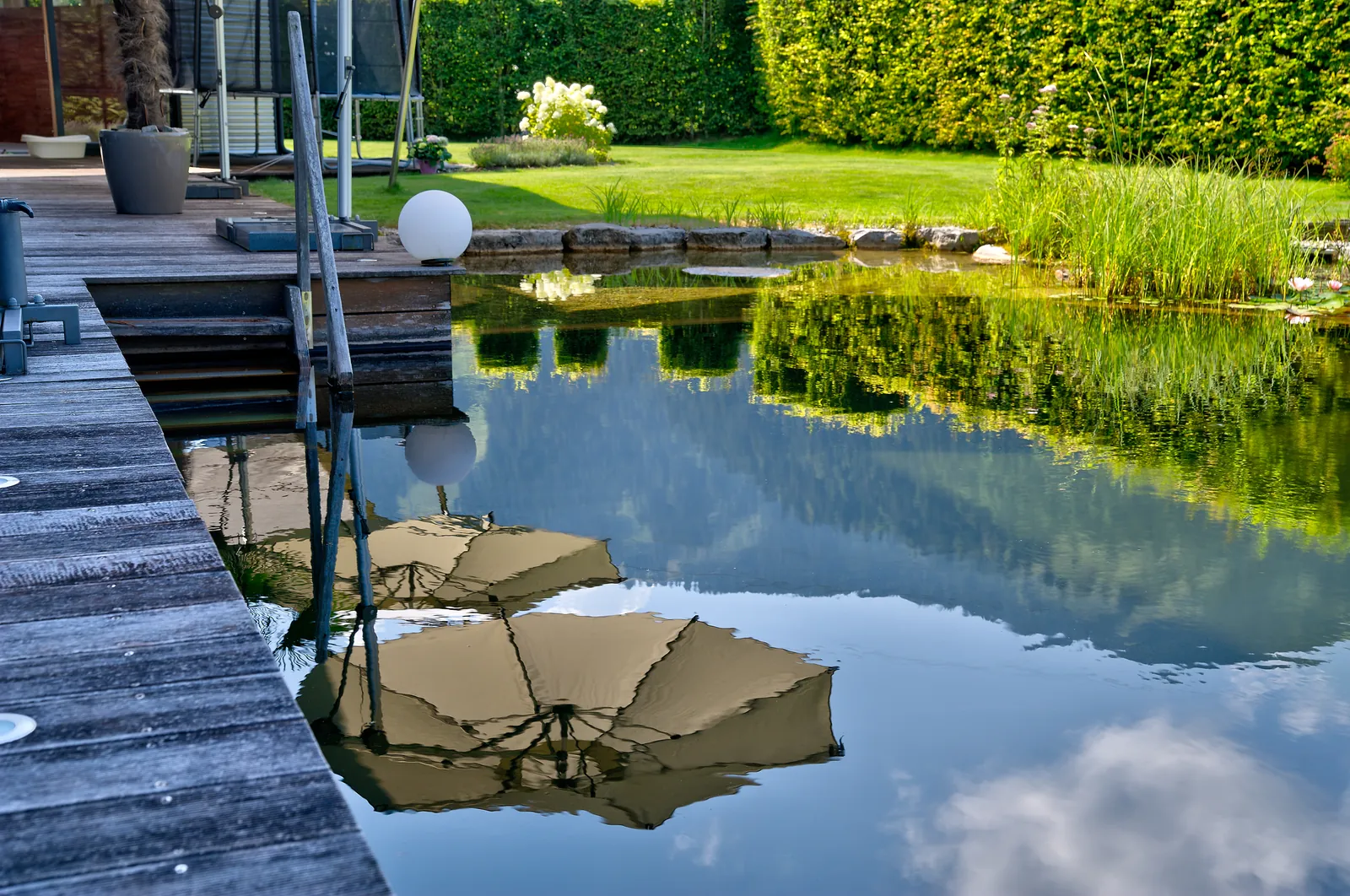
Living Pool with liner
At our office in Lenggries, Schlegldorf 91a. A short walk: look at the plan inside, then step into the finished installation right outside the door. More about the Living Pool.
Living Pool with concrete basin
At a fellow company in the region. If you want to know how a concrete basin feels and looks compared with a liner, you can compare both in one day.
Swimming pond in a hotel
At the Landhaus Benediktenhof in Arzbach – one of our oldest swimming ponds, in operation for decades. There is no better place to see how such a system works in continuous use. Our hotel projects.
We arrange visits with the owners – so they are by appointment only, never spontaneous. Tell us briefly what you would like to compare and we will suggest the right installation: Request an appointment.
What your pool is built from
Whether swimming pond, Living Pool or chlorinated pool – the question of construction method is a second, independent decision. It depends on the ground, the shape you want, the construction time and the budget. We regularly build in four ways:
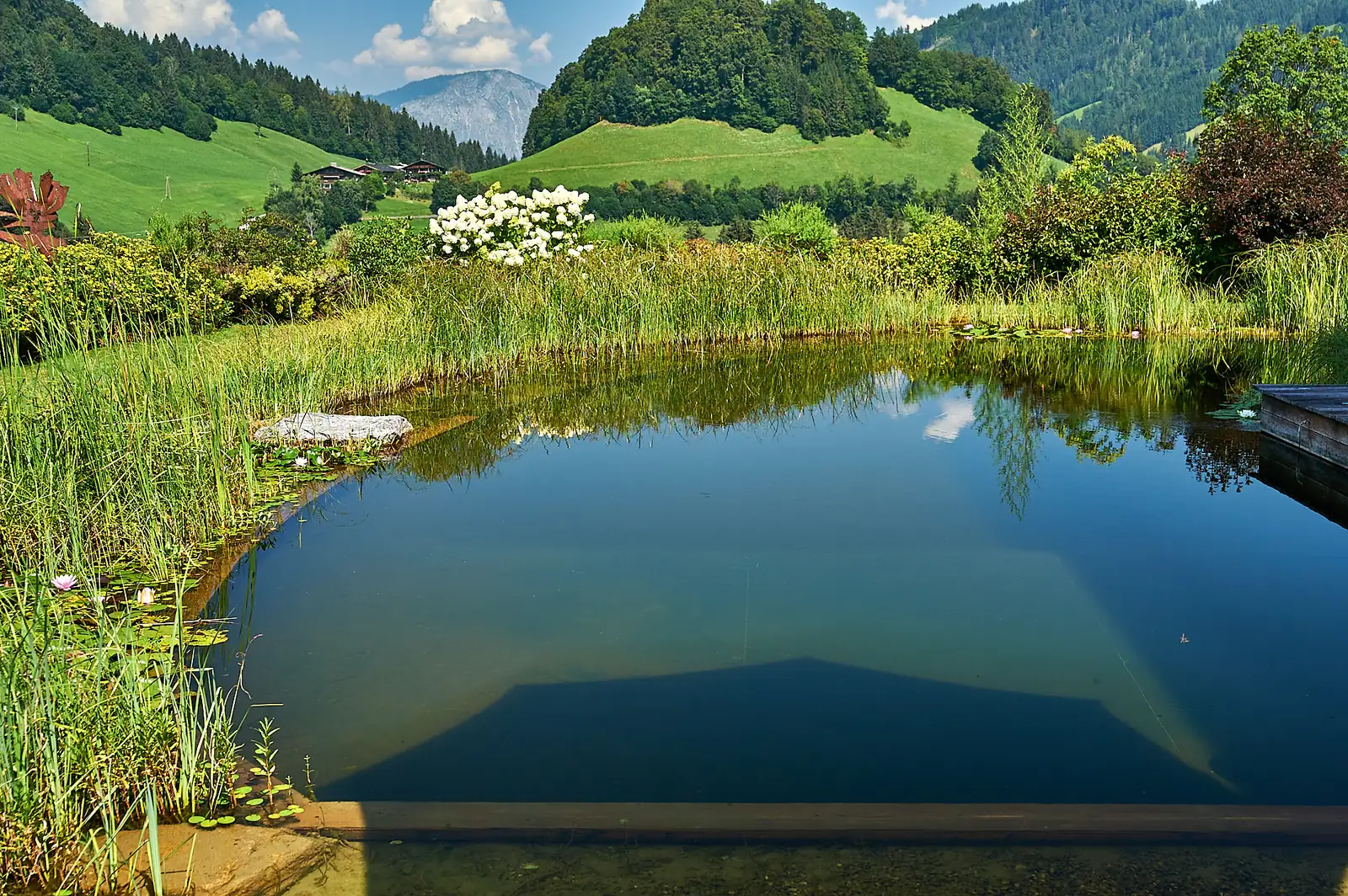
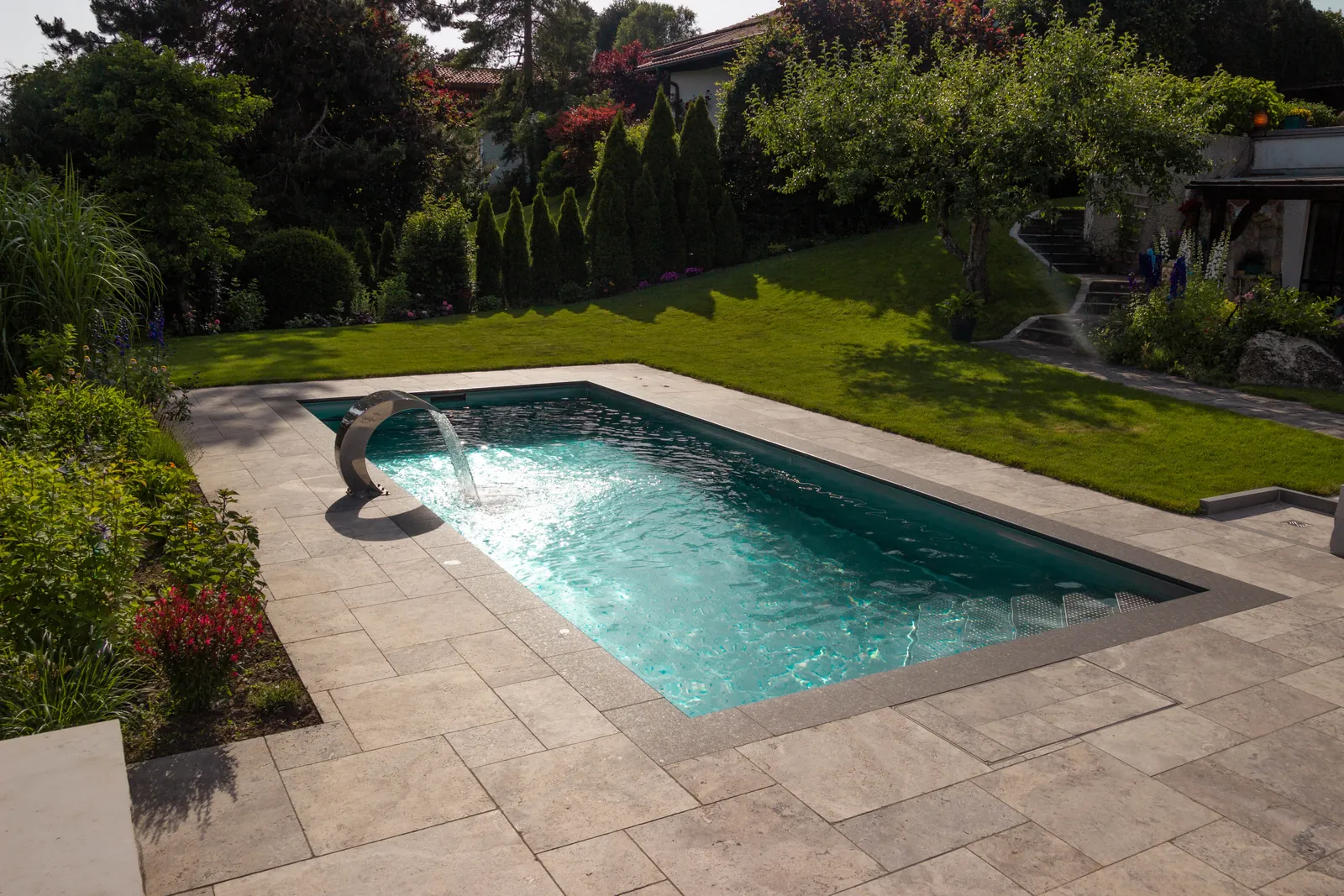
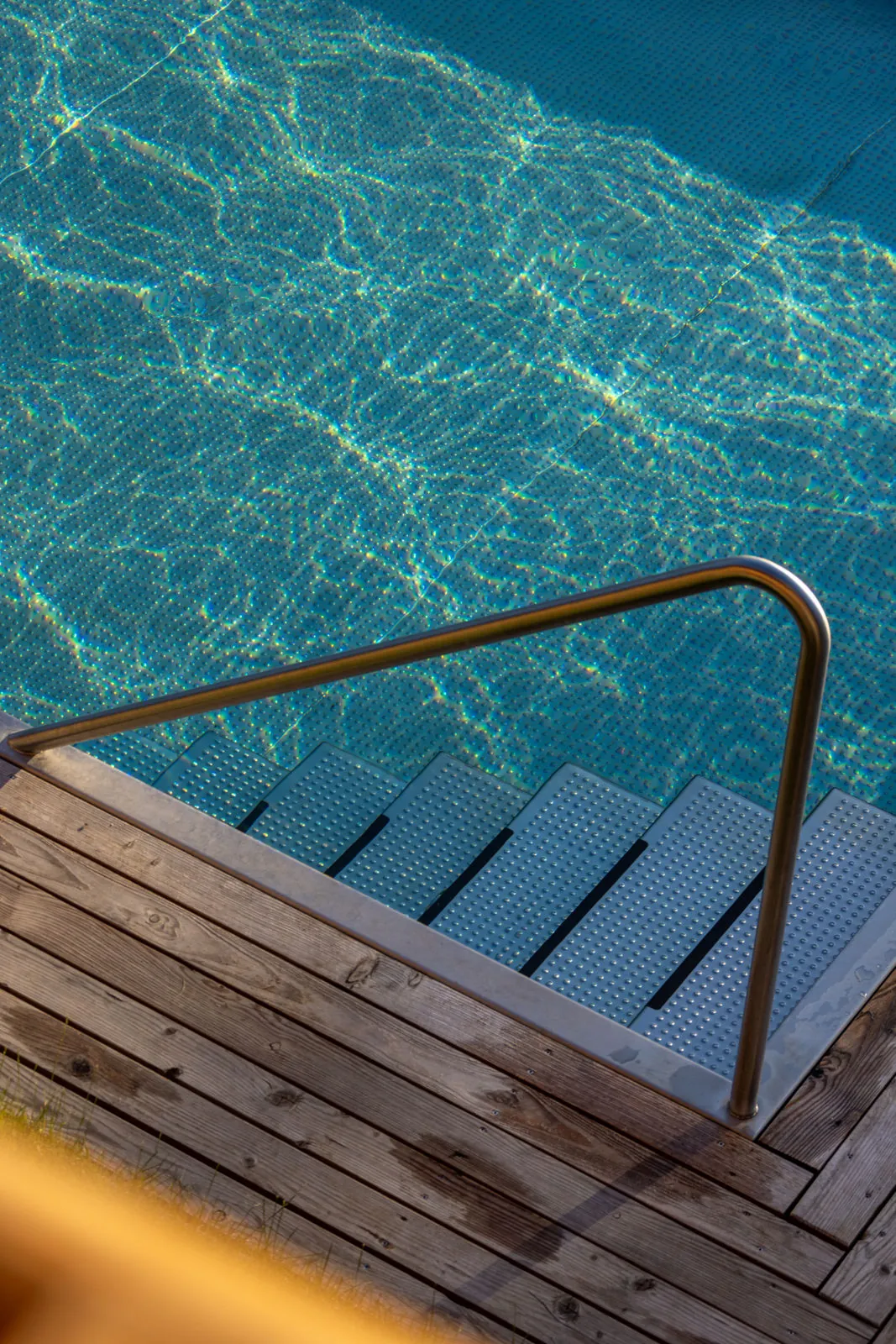
Three construction methods from our projects – the same question, three answers.
Masonry with liner
The method we use most often. The basin is built in masonry or from angled elements, and the liner is welded in and adapts to any shape. Robust, repairable and economical even for large areas – which is why it clearly predominates in our installation records.
Concrete basin
A monolithic basin of reinforced concrete, on request as exposed concrete with visible formwork texture. Slim walls, sharp edges, long-lasting. It needs more lead time and structural planning – but the look is unmistakable. You can see a Living Pool in a concrete basin at our colleague Hans Rampf’s.
Stainless steel basin
We realise these with specialist pool builders – the basins are prefabricated and welded on site. Very thin walls, precise edges, practically unlimited lifespan. One example stands in the Naturhotel Tannerhof in Bayrischzell, built with Berndorf Bäderbau.
Prefabricated pool
A basin made in the factory, delivered complete and installed – this considerably shortens the building time on site. We work with several manufacturers; which system suits is decided project by project. More about the prefabricated pool
Then there is the special case of the Kusserpool: a pool made from a single block of granite. And the pond itself has its own construction methods – angle, earth embankment and wall construction are explained on the swimming pond page.
What you can add to your pool
Much of this has to be decided before the first spade goes in, because conduits, shafts and supports belong in the structural work. Retrofitting later is expensive.
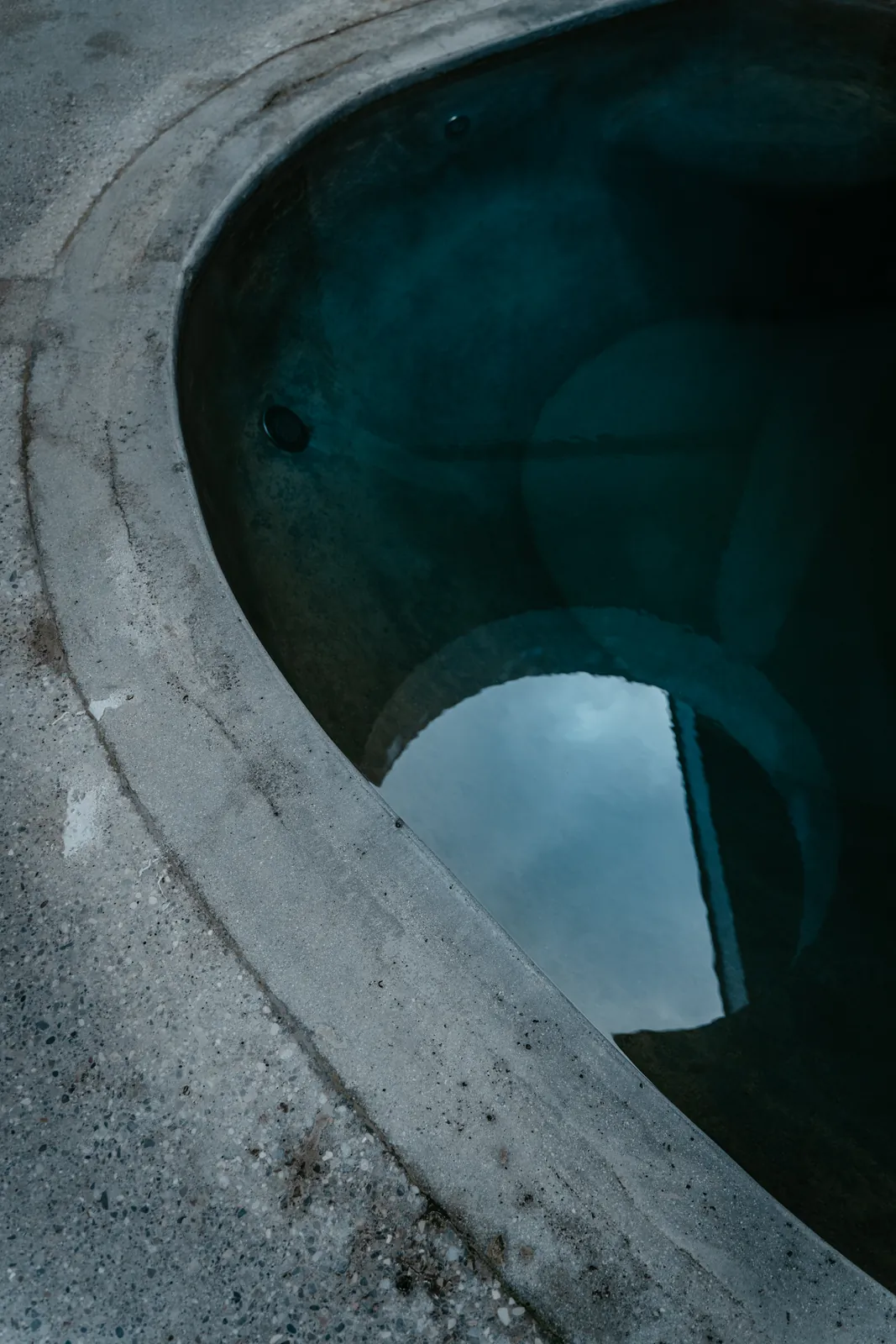
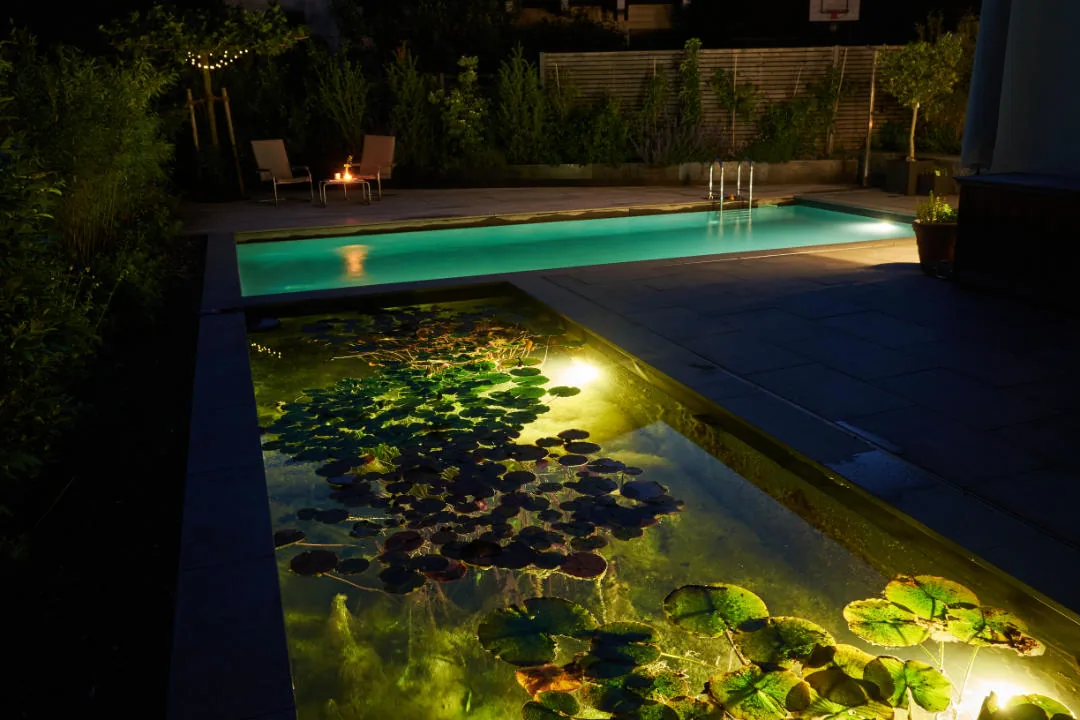
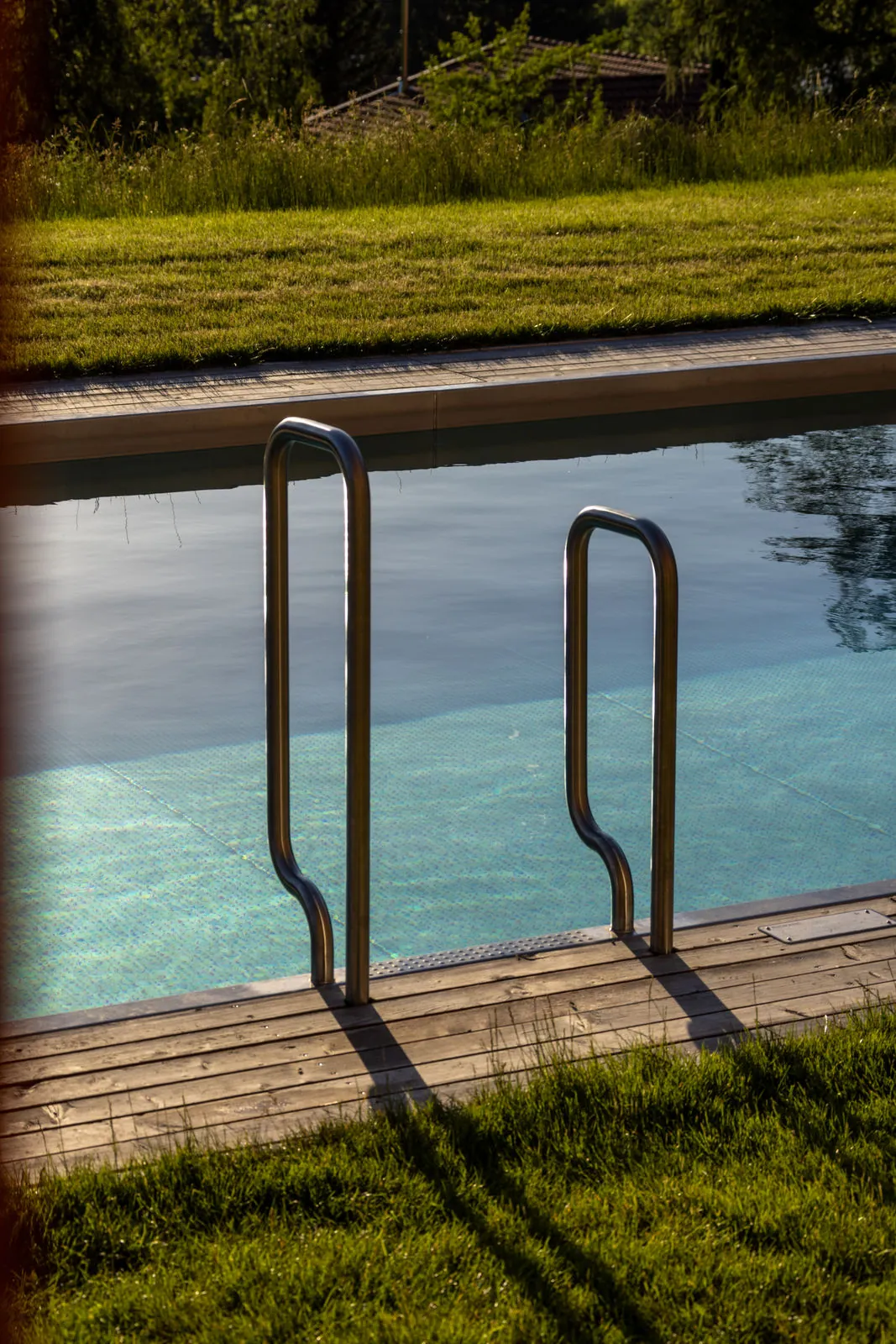
Equipment details from installations in Bad Tölz, Bayrischzell and Wackersberg.
Roller cover
A slatted cover runs across the water surface, keeping leaves out and warmth in. It either runs visibly on the pool edge or disappears into a shaft under the terrace – this shaft must be planned in from the start. A floating roller cover does not count as fall protection for children; that requires a load-bearing cover fixed at the edges.
For this we mainly install profiles from Rollo Solar in Bad Tölz – a good ten kilometres from us, a family business with production in Germany. The slats come in polycarbonate, also as a solar version, or in PVC, each made to measure and in over 50 RAL colours.
A terrace that slides over the water
The most elegant solution: a timber terrace is moved on rails over the pool. Closed, it is a terrace; open, it is a pool. We build the decking in our own joinery so that the type of wood, joint pattern and fittings match the rest of the garden. Our joinery
Counter-current swimming system
This turns even a short pool into a swimming lane. We work with the HydroStar turbine swimming system from BINDER – a current across the full width of the pool instead of a single jet. Try a swim with us
Lighting in and around the water
Underwater spotlights, illuminated boulders, lit steps. Our electricians lay the cables while the excavation is open. Garden lighting
Steps, bench, lounging area
Roman steps, a bench at water level, a shallow sunbathing ledge – all shapes built into the pool structure and therefore part of the planning, not the construction phase.
Heating
A heat pump or solar absorber raises the water temperature. With a Living Pool and a swimming pond, there is an upper limit: water that is too warm throws the biological cleaning out of balance. If you want a constant temperature above 28 °C, a technically filtered pool is the right choice.
HydroStar turbine swimming system by BINDER
We are a partner of BINDER. Their turbine systems create a current across the full width of the pool rather than a single jet – so you swim in a flowing stream, not against a hose. With one or two turbines, adjustable, with RGB lighting, for any type of pool.
And you can try it out before you decide. Two ways:
At our premises. A system is permanently installed in our company pool – for exactly this purpose. You can arrange a trial swim: bring your swimming trunks, turn up the current and see for yourself whether it's right for you.
Or at your home. We have a mobile loan unit. If you already have a pool or a pond, we will bring it round on loan and you can test it in your own water. Just get in touch.
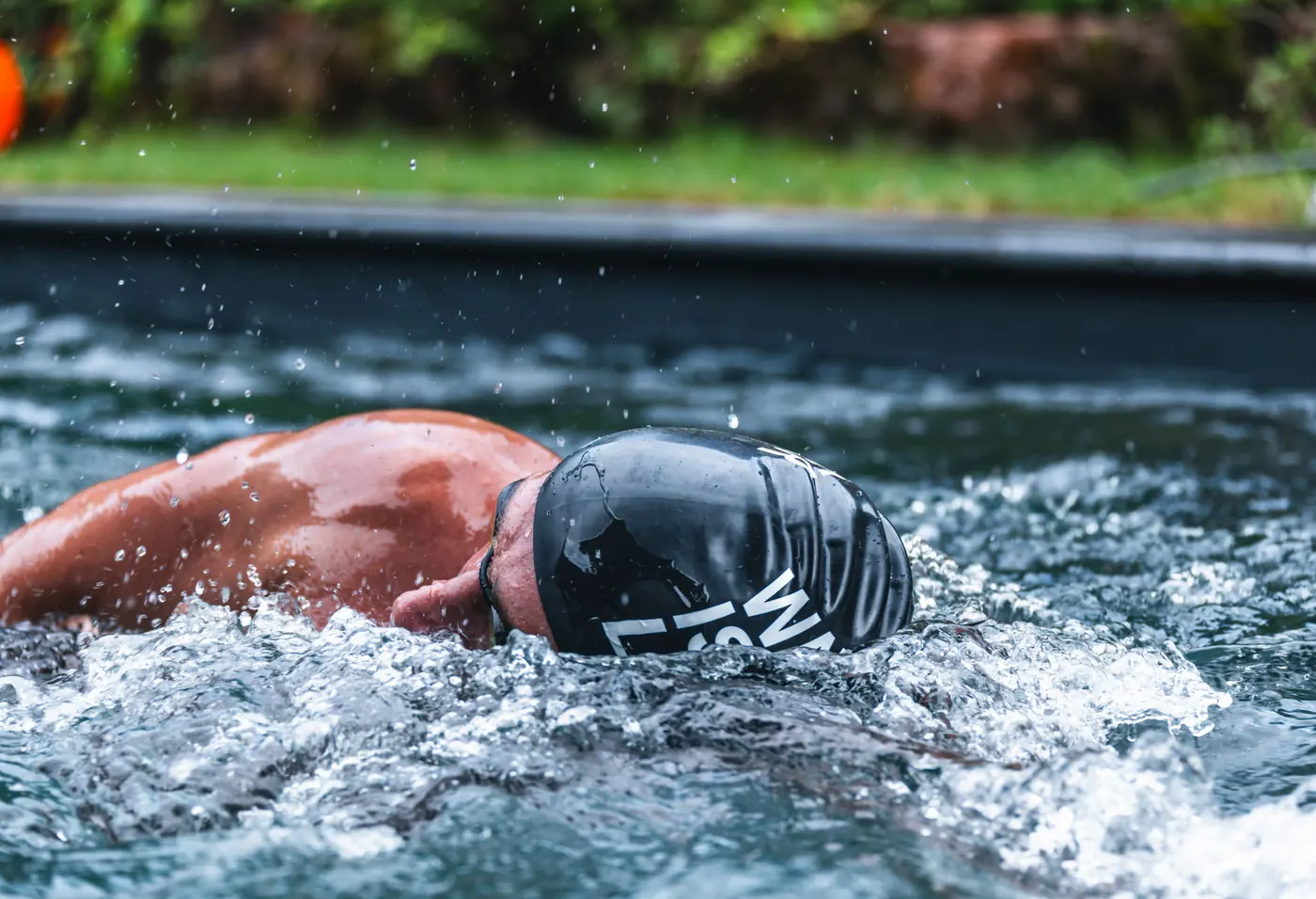
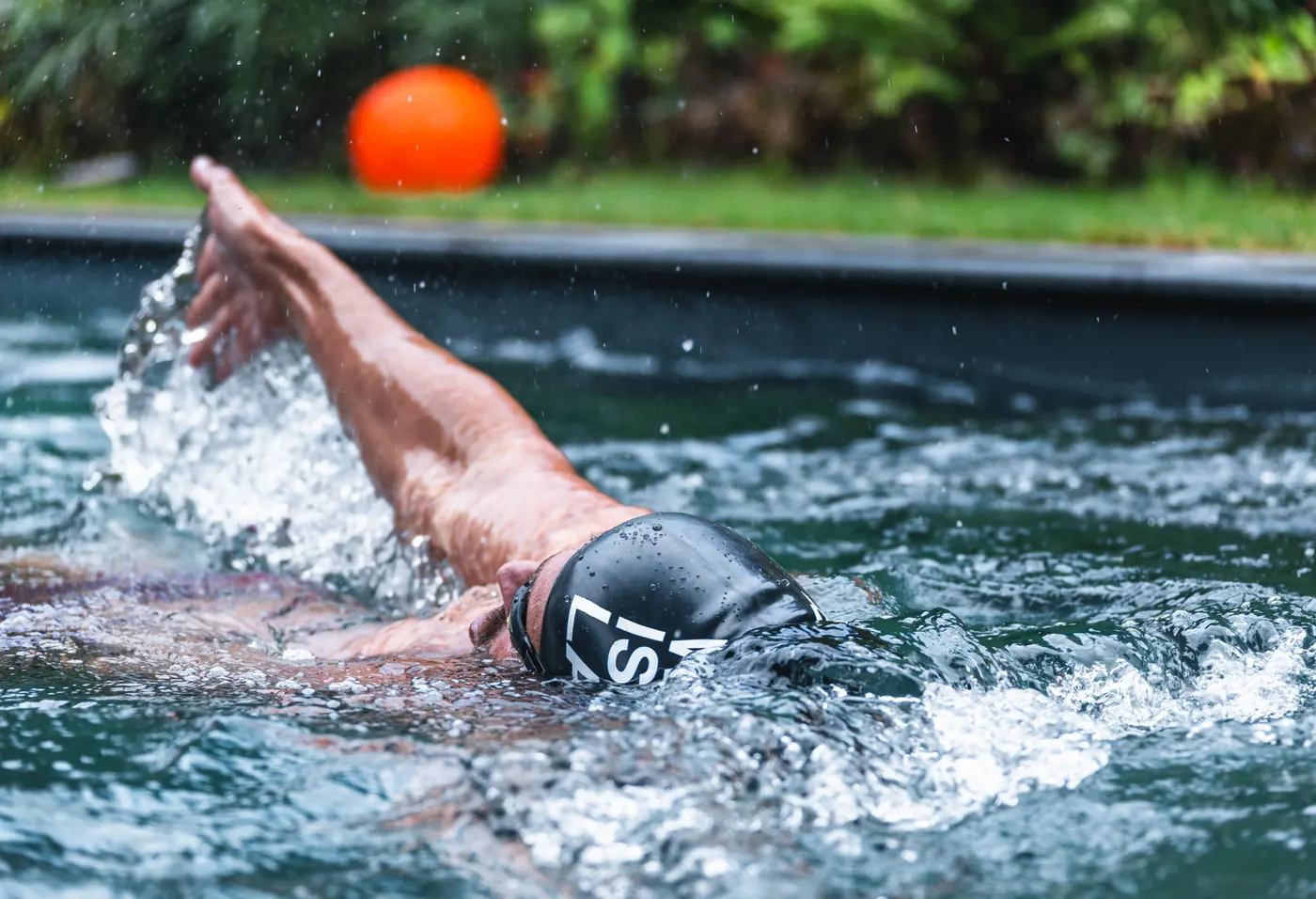
A trial swim in our company pool, filmed on one of our garden days. In the water: Thomas, a certified swimming coach from schwimmen an land – when a coach says the current is even, that counts for more than our own opinion.
You only see the colour of the cover once it's on the water
A slatted cover is a large surface, and its colour changes the look of the pool more than most people expect – after all, it sits on the water, not beside it. That's why we have the Rollo Solar colour sample stand at our premises: the profiles to touch, side by side, in daylight rather than on a screen.
And we go one step further: in our company pool, the cover is deliberately installed in several colours. So you don't just hold a sample in your hand, you see the slats installed and lying on the water, and can compare them. That makes the decision easier – and it is made before the shell construction, while the cover housing can still be planned. Arrange an appointment
Water you don't swim in
A garden doesn't need a swimming pool to come alive with water. The small features are often the ones you notice most – because they sit right by the terrace and you hear them before you see them.
Stream
Water that travels a distance. A stream needs a gradient, a watertight bed and stones laid so that they sound right – it's handcrafted and can't be drawn, only set up on site. At the end it flows into a basin or a pond and is pumped back from there.
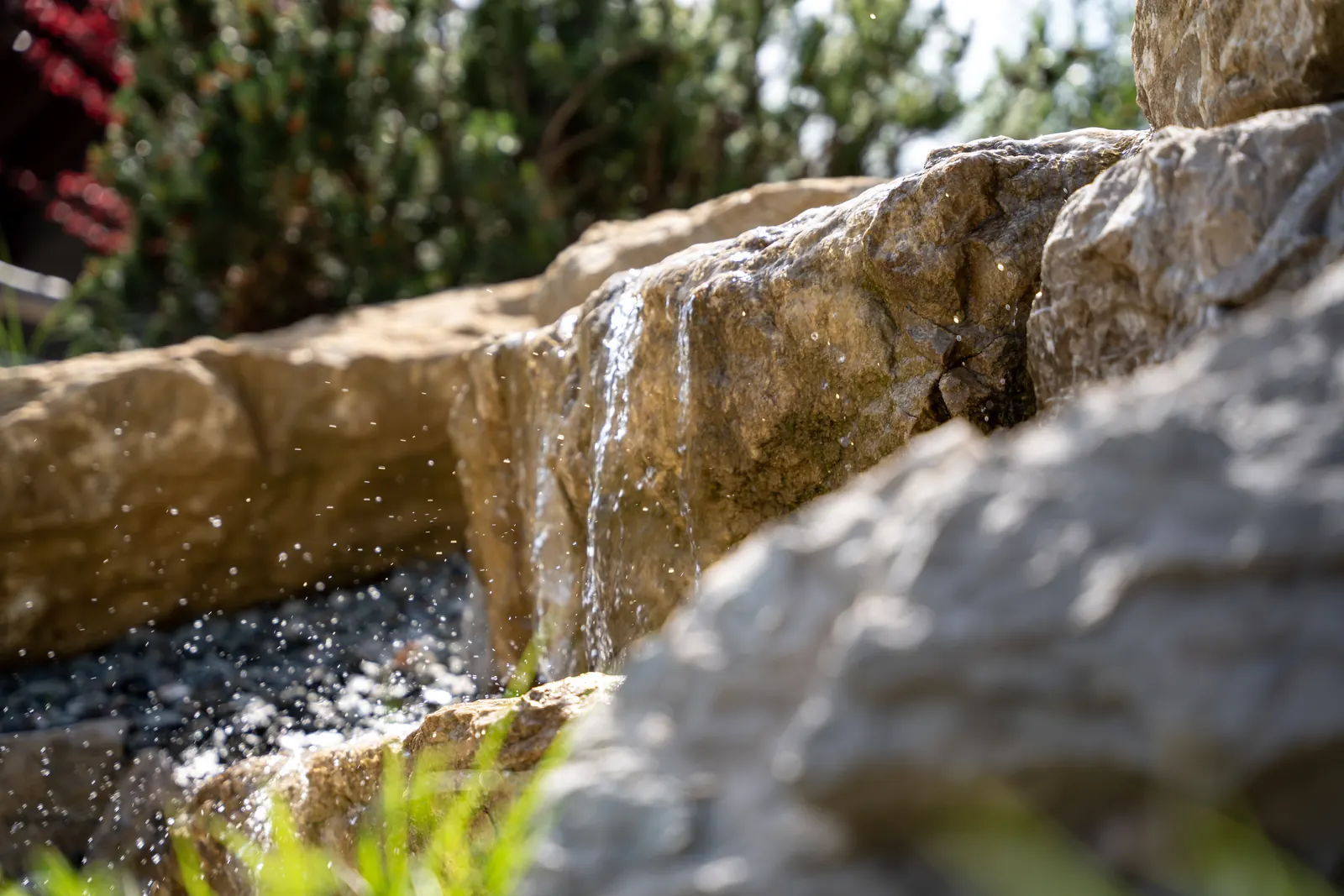
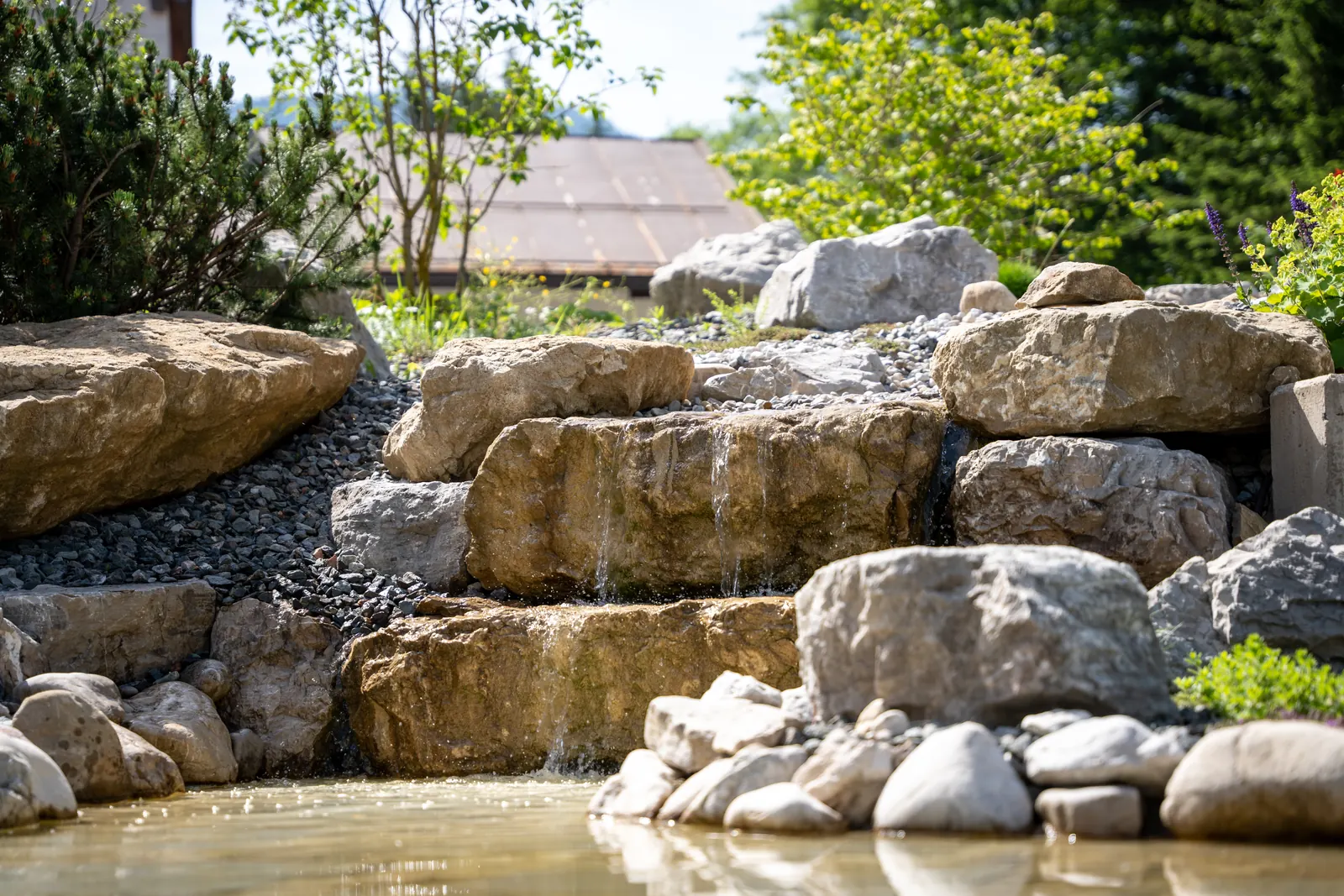
Stream and bank zone in Ruhpolding.
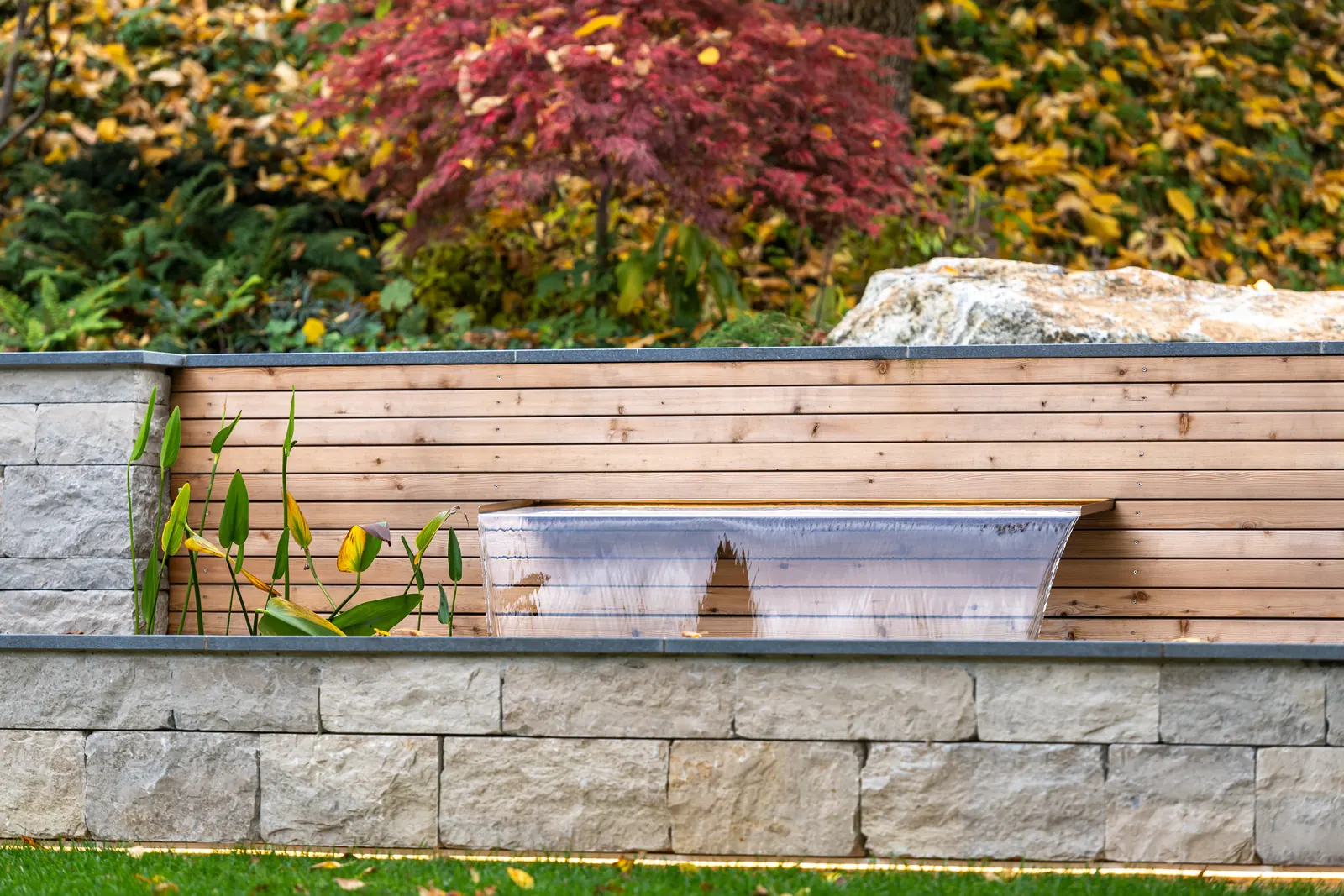
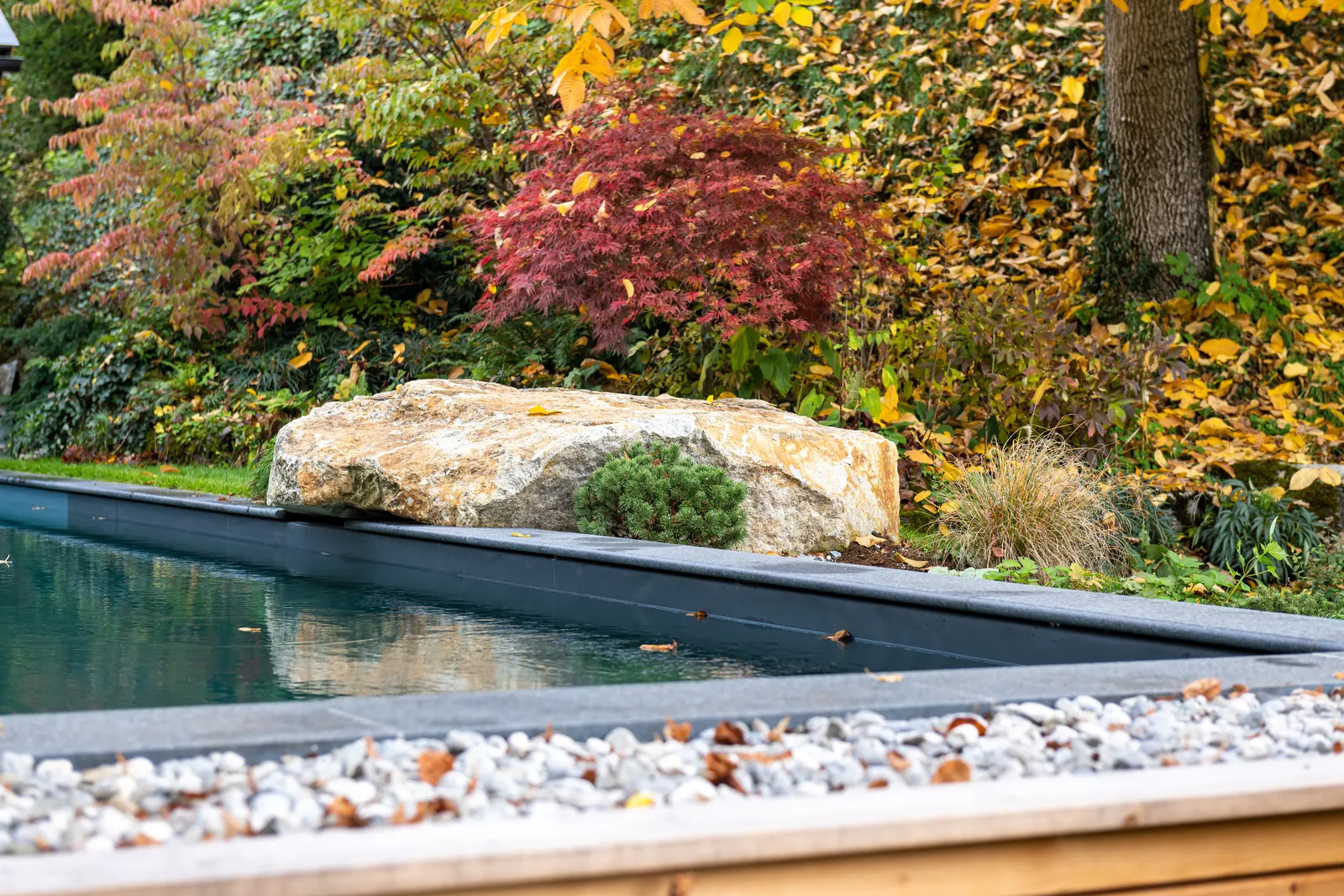
Water chute and ornamental basin in autumn. Photo: Thorsten Scherz.<
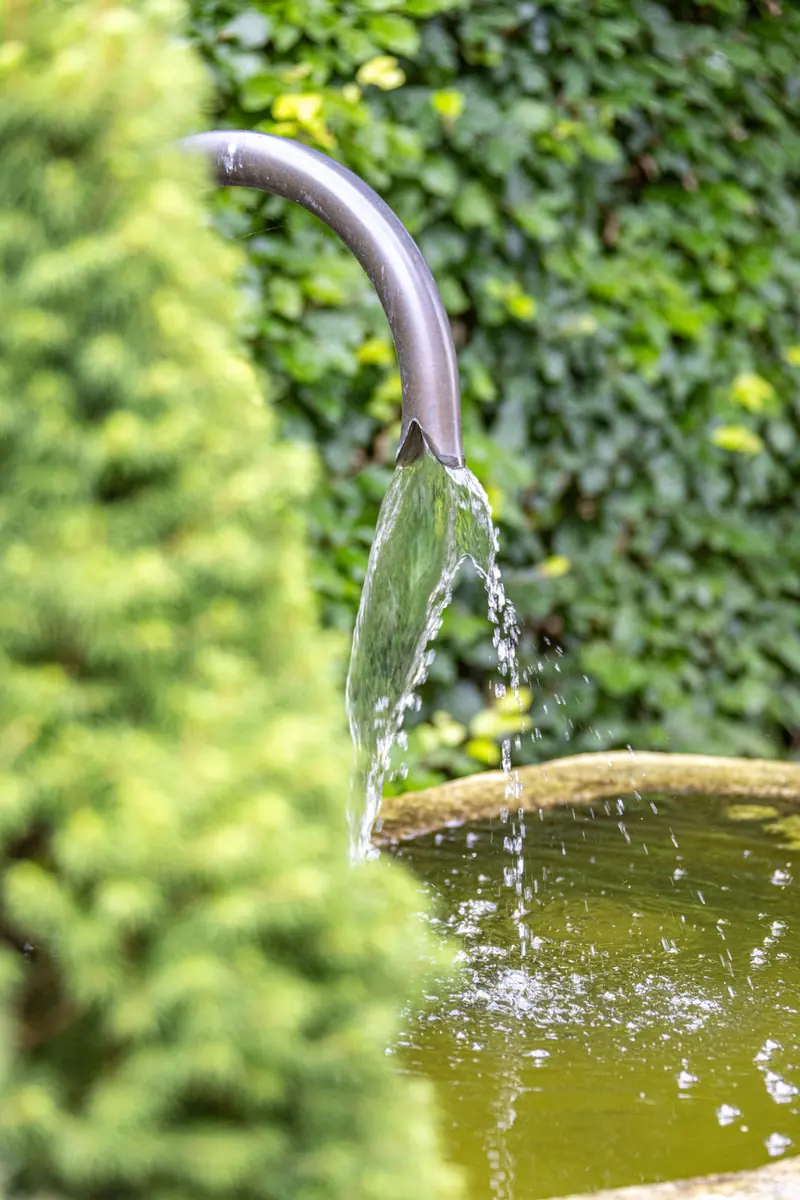
Fountains & bubble stones
The smallest way into the world of water: a drilled boulder or a stone bowl from which water bubbles up and runs back over the surface. No open water, so no concern with small children, and easy to switch off in winter.
Water jets
Fountains, bubblers and jets set into a paved area. Mostly used where water should be visible but no space can be lost – for example at an entrance or on business premises.
Water wall
A sheet of water running down a wall of natural stone, exposed concrete or Corten steel. It works even in very small spaces and courtyards, because it runs vertically rather than horizontally. A popular focal point opposite the seating area.
Ornamental pond
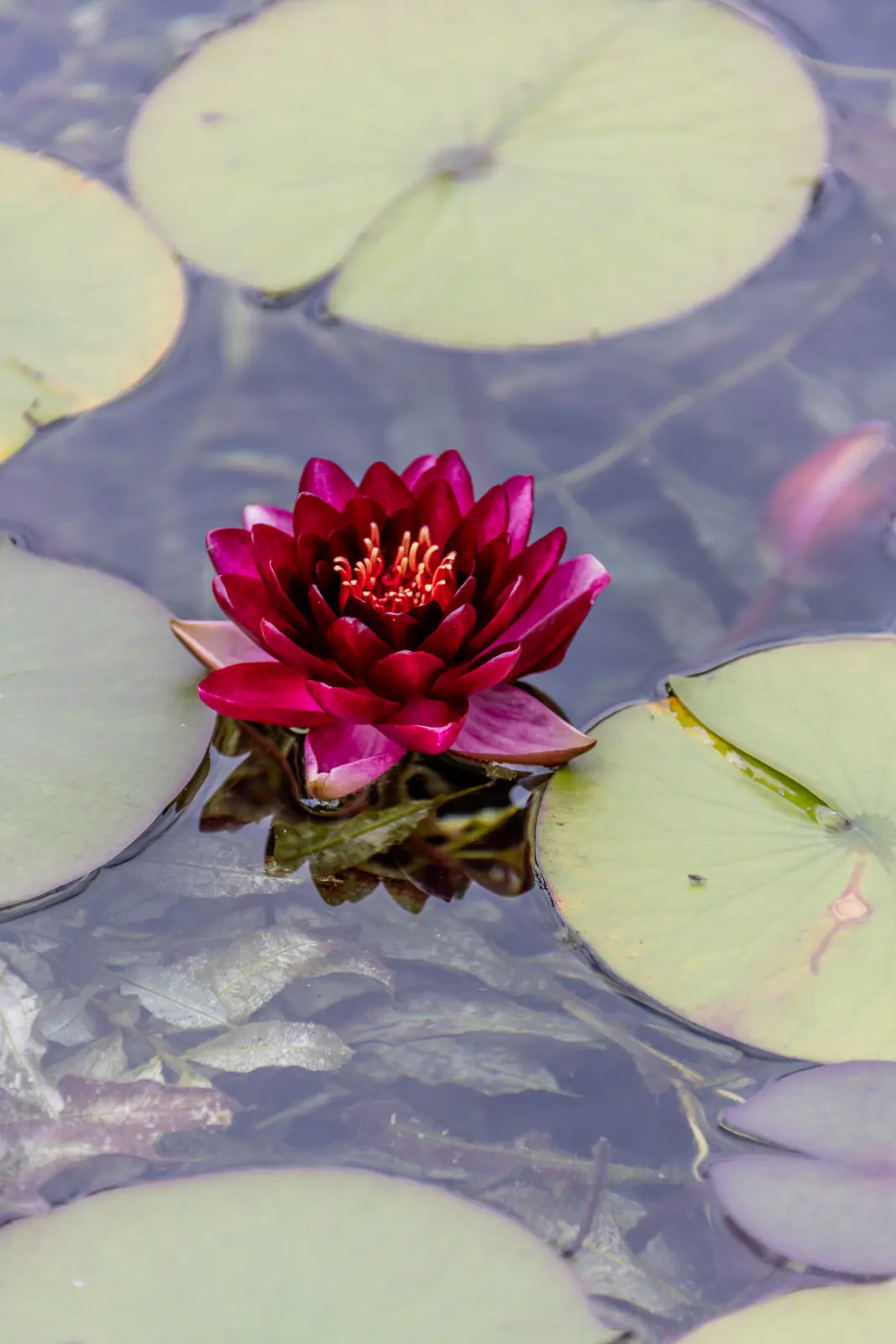
A pond not meant for swimming, but with room for water lilies and dragonflies – often with a fountain in the middle that moves the water and adds oxygen. For anyone who wants water in the garden but not a swimming pond. Easier to look after than its reputation suggests – how it is cared for through the year is explained in the care guide.
Fish pond
We're happy to build one – just not as the same pond you swim in. Fish eat the zooplankton that keeps the water clear, stir up the bottom and release phosphorus, whereas a swimming pond is deliberately kept low in nutrients. Planned separately, both work very well; in the same basin, they don't. If you'd like koi or native fish, you get a separate pond with the depth and technology fish need.
Conversion & renovation
Many of our projects are not new builds. Old ponds are enlarged, leaking liners replaced, outdated technology renewed, or a chlorinated pool converted to biological cleaning. For “Conversion & renovation” we won second place at the Design-Froschkönig in 2017.
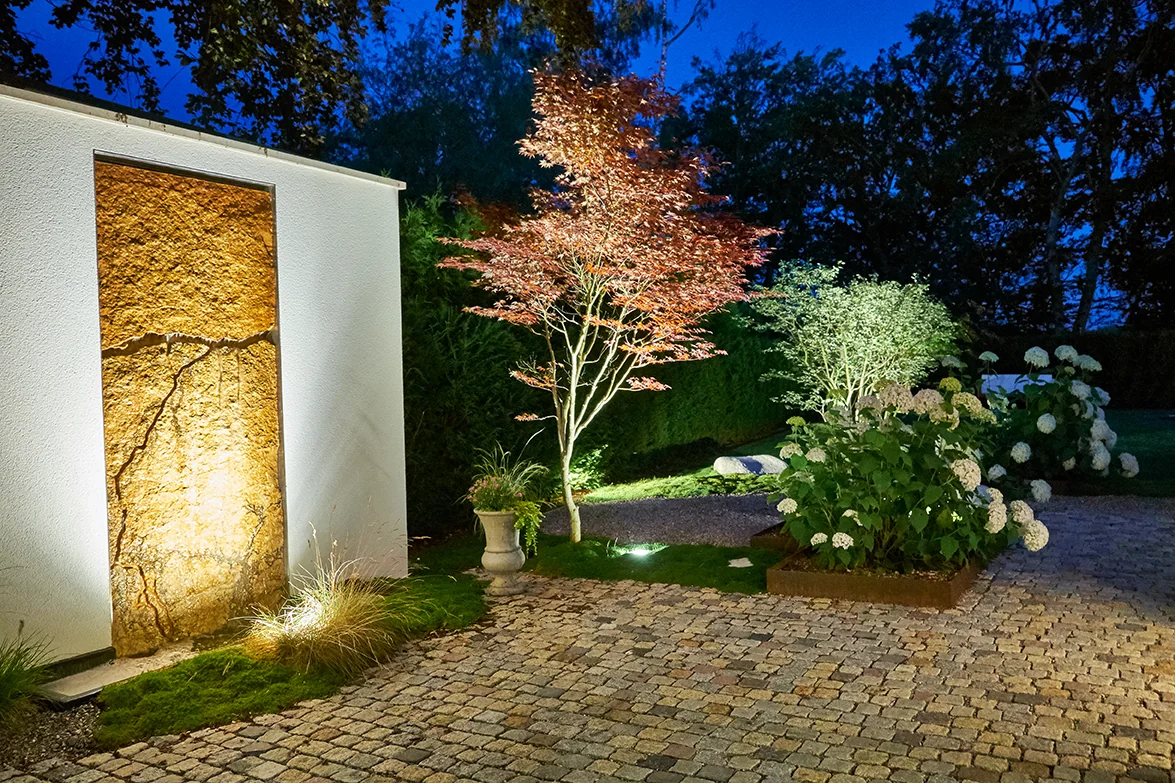
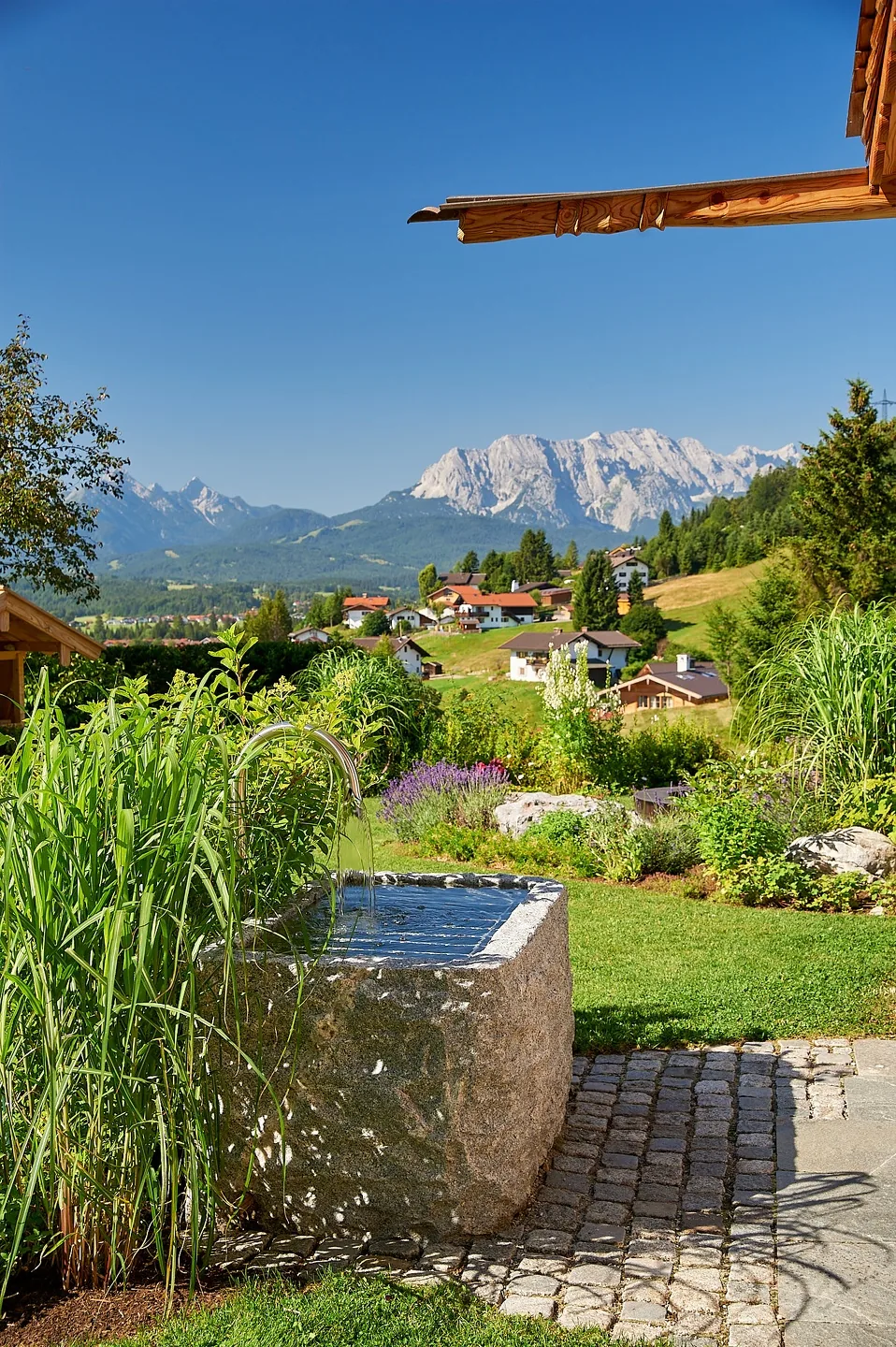
On the left, a natural stone water wall, lit in the evening. On the right, a fountain made from a single block of granite.
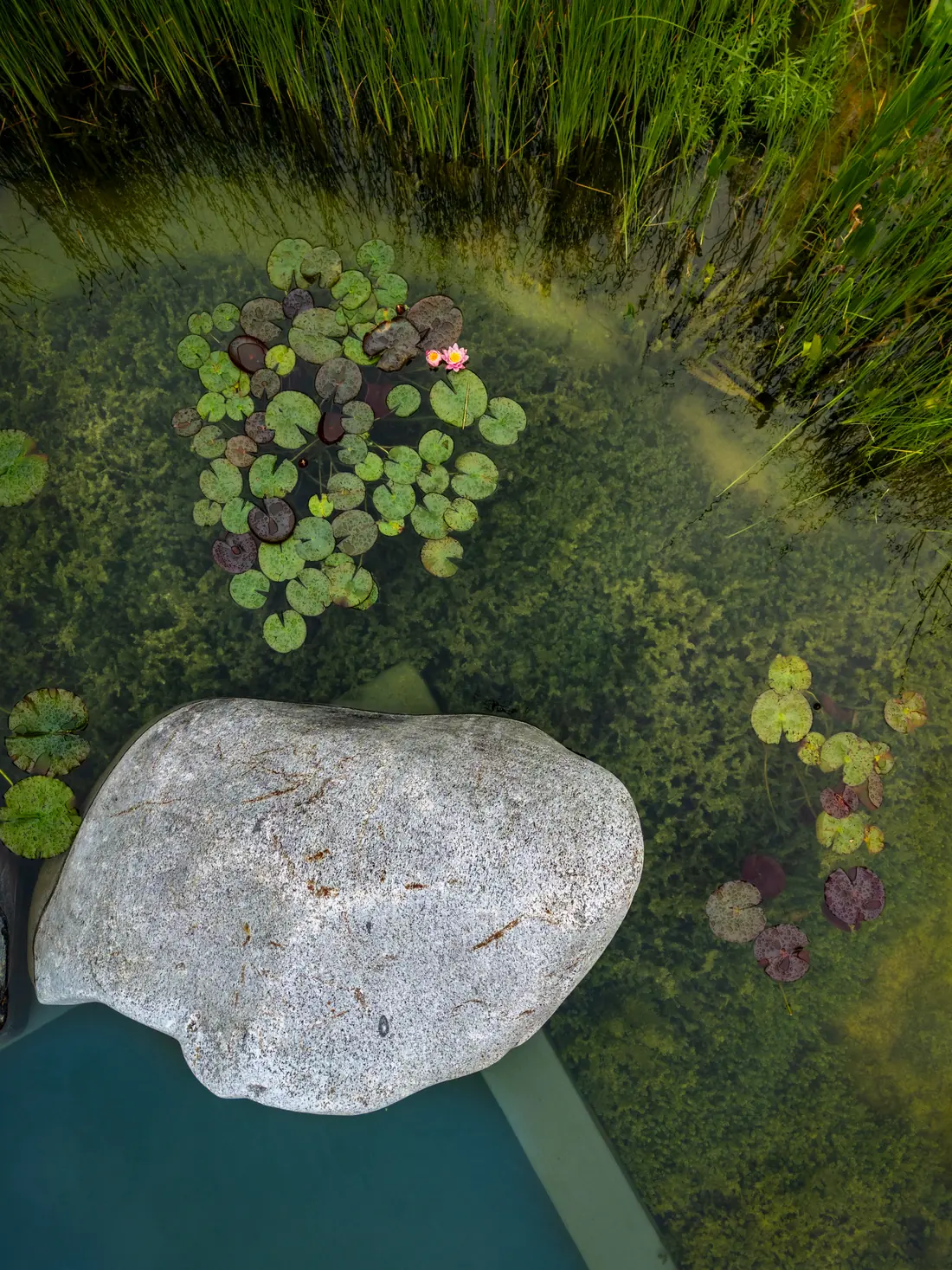
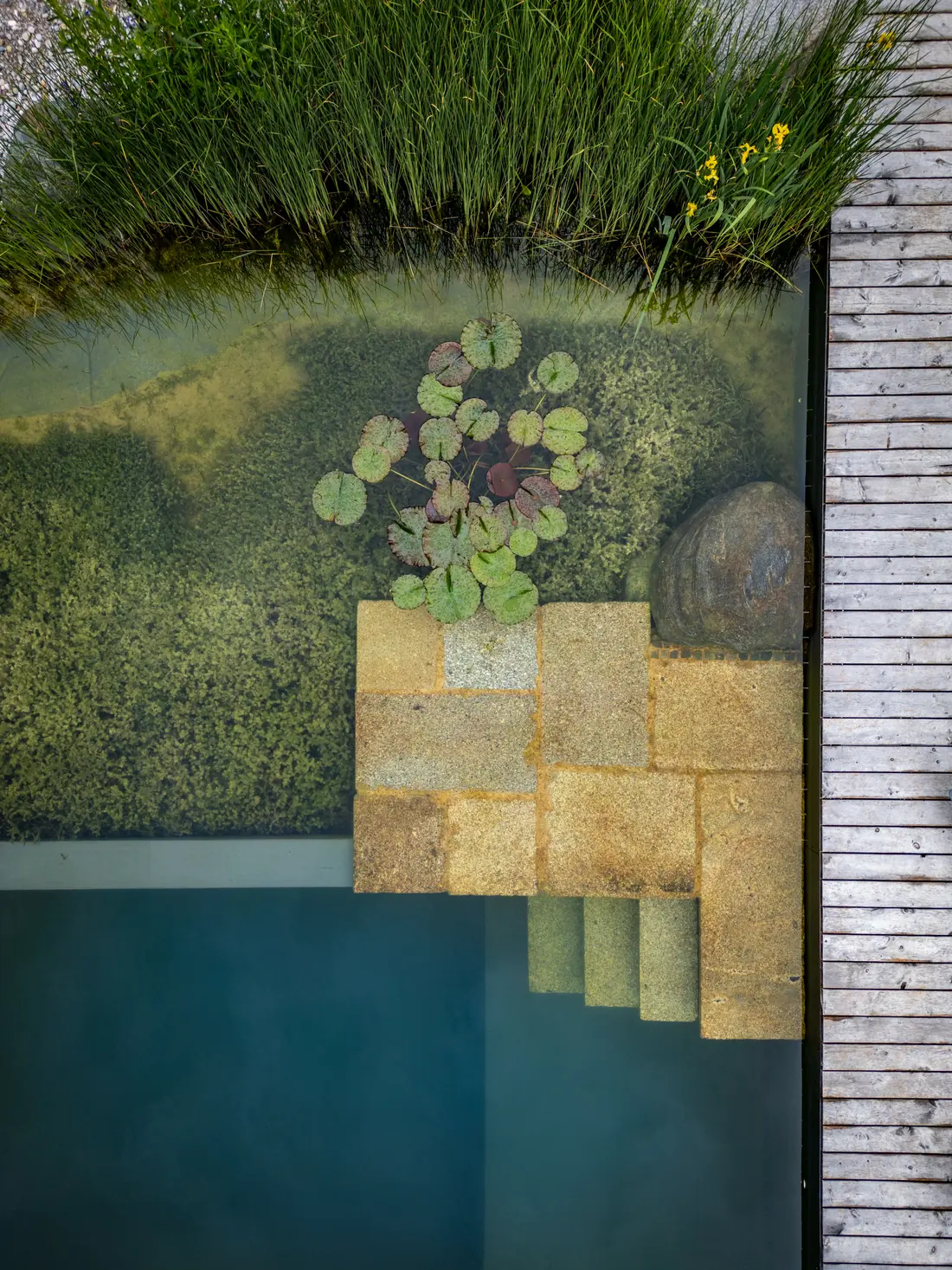
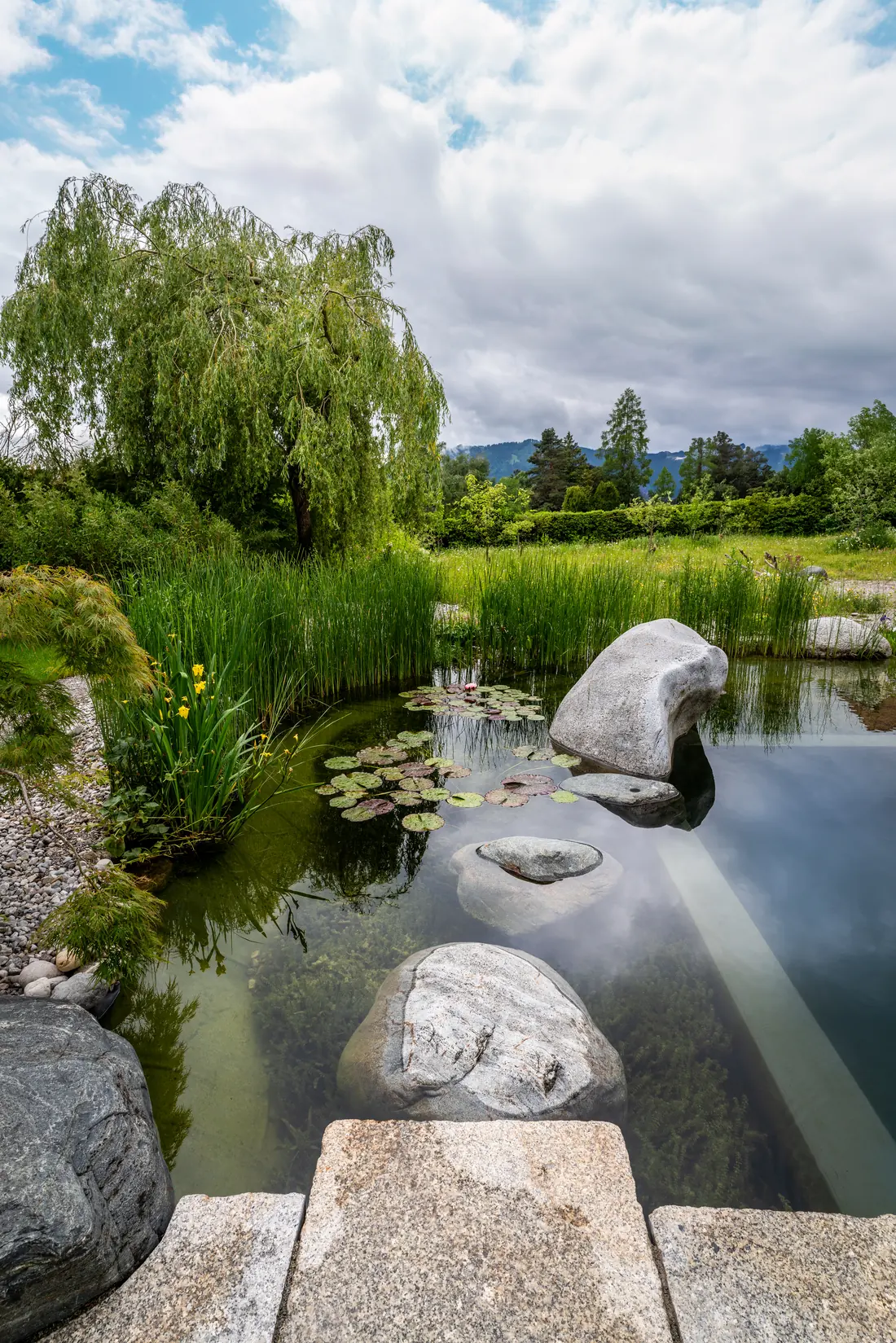
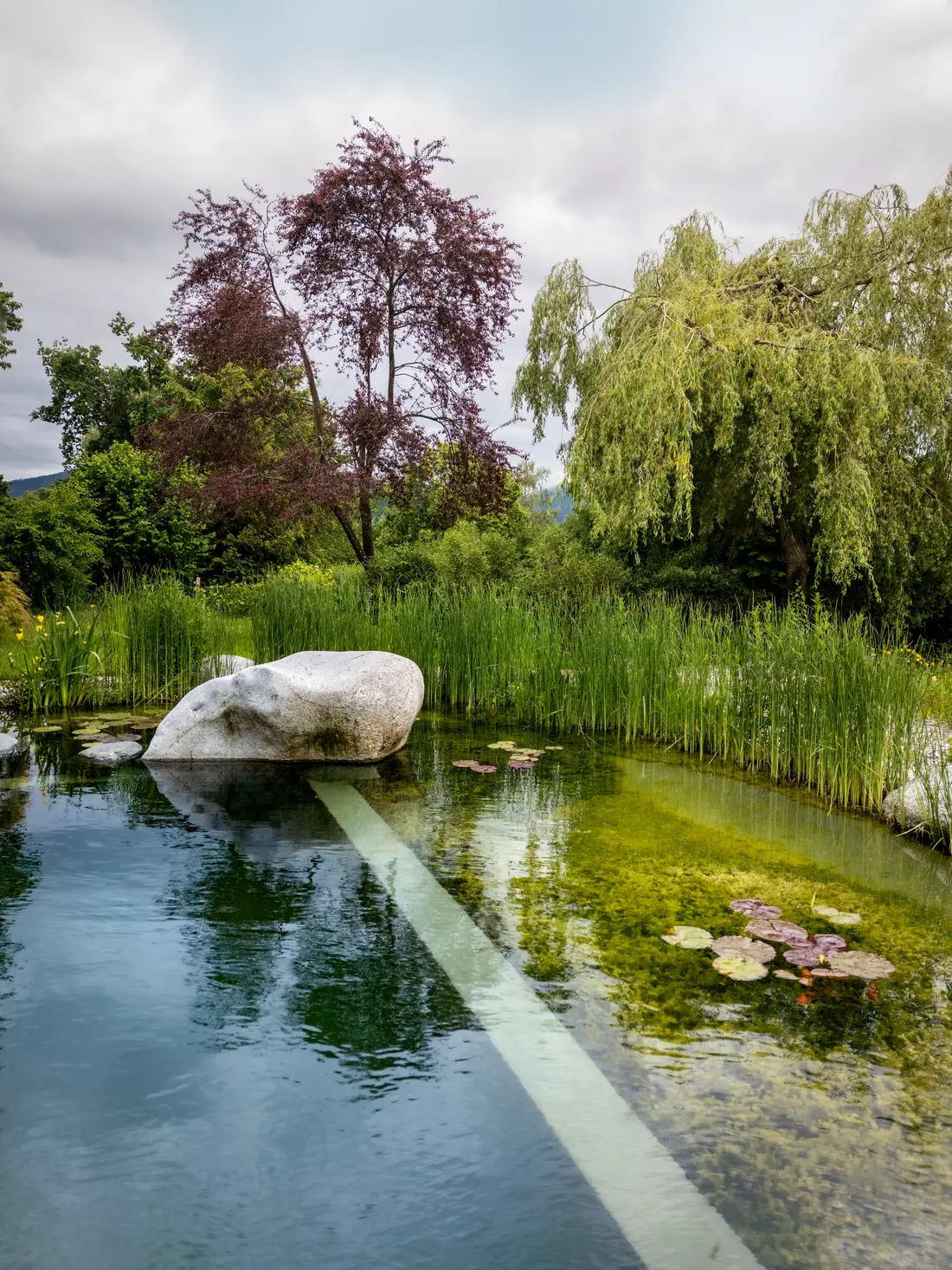
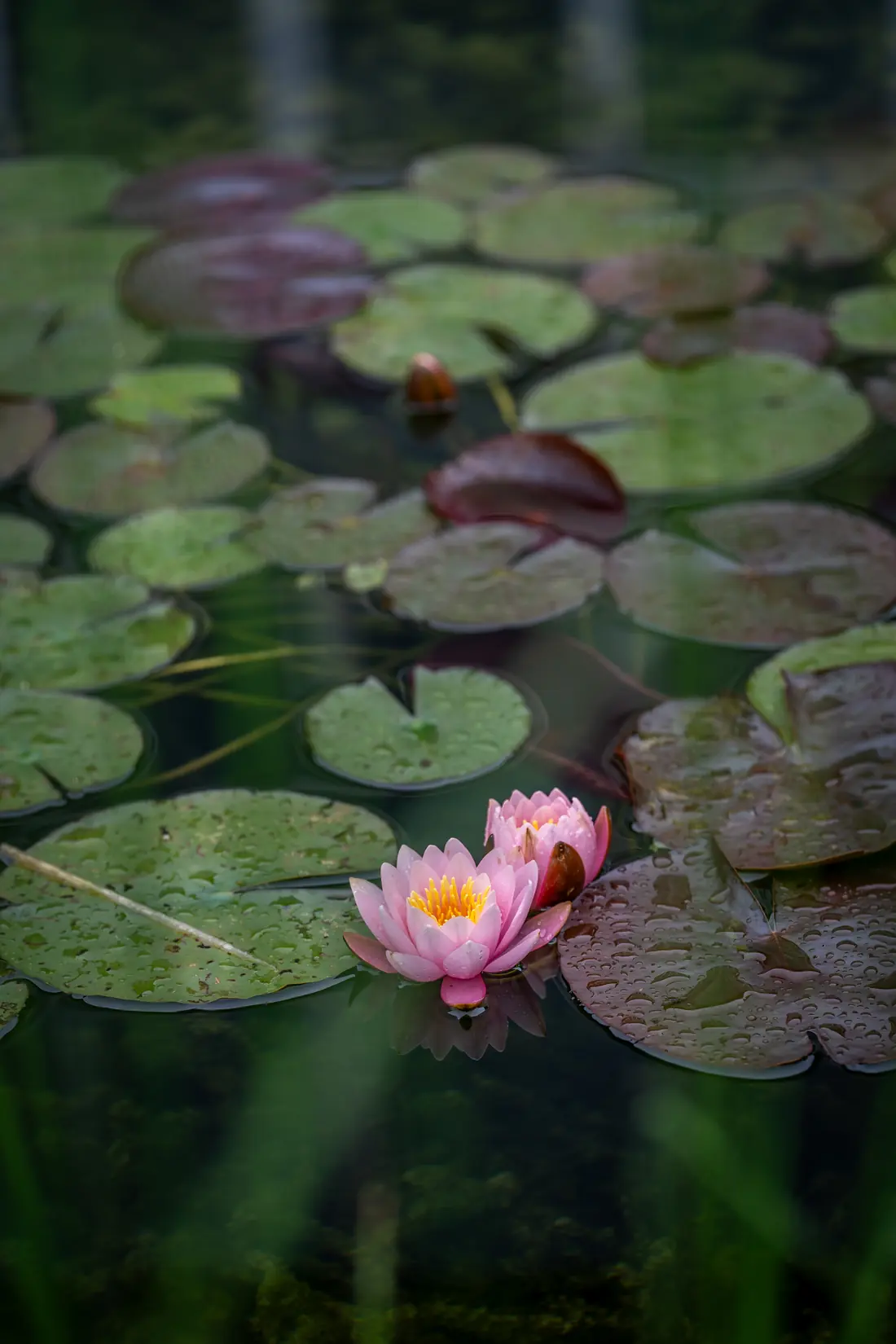
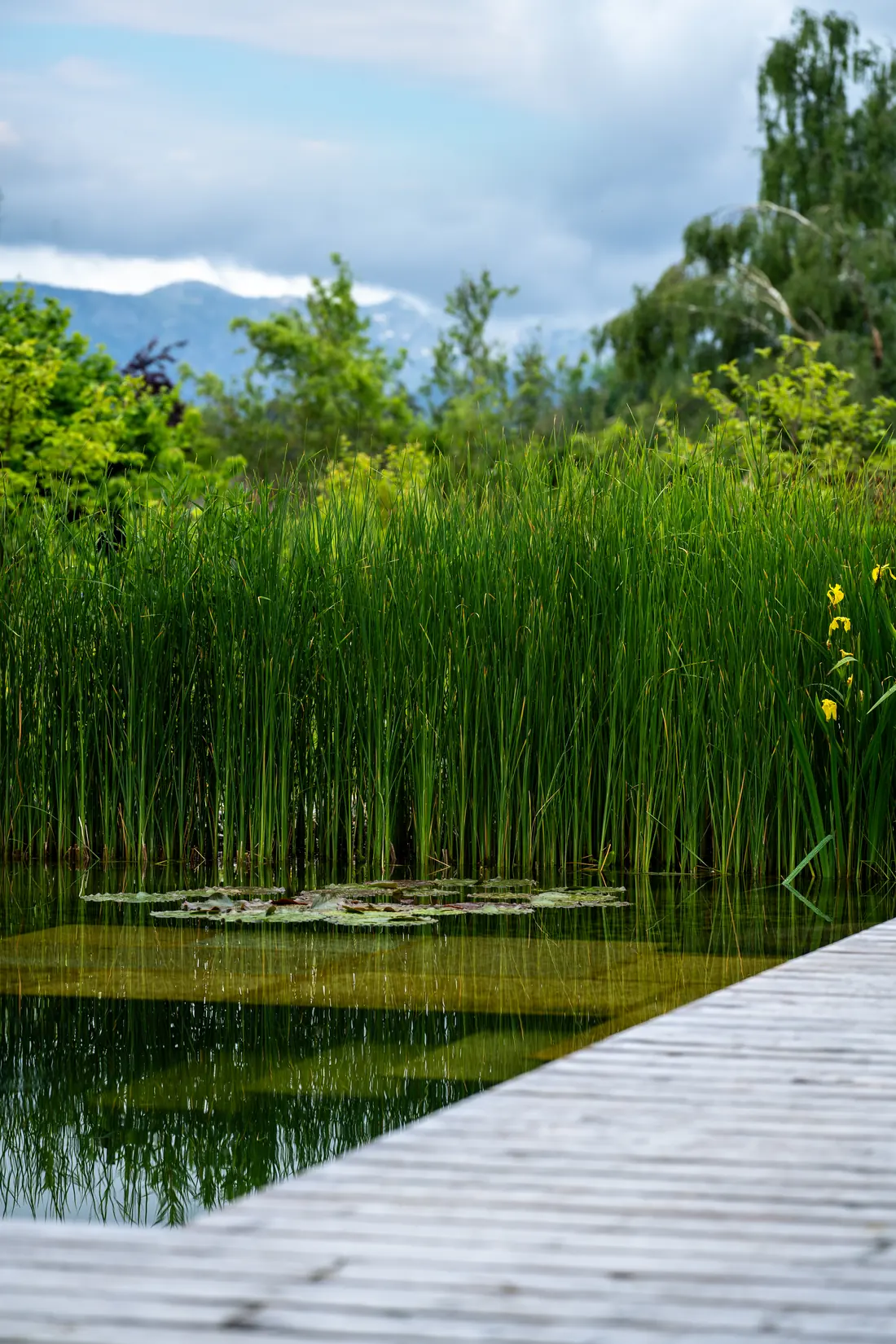
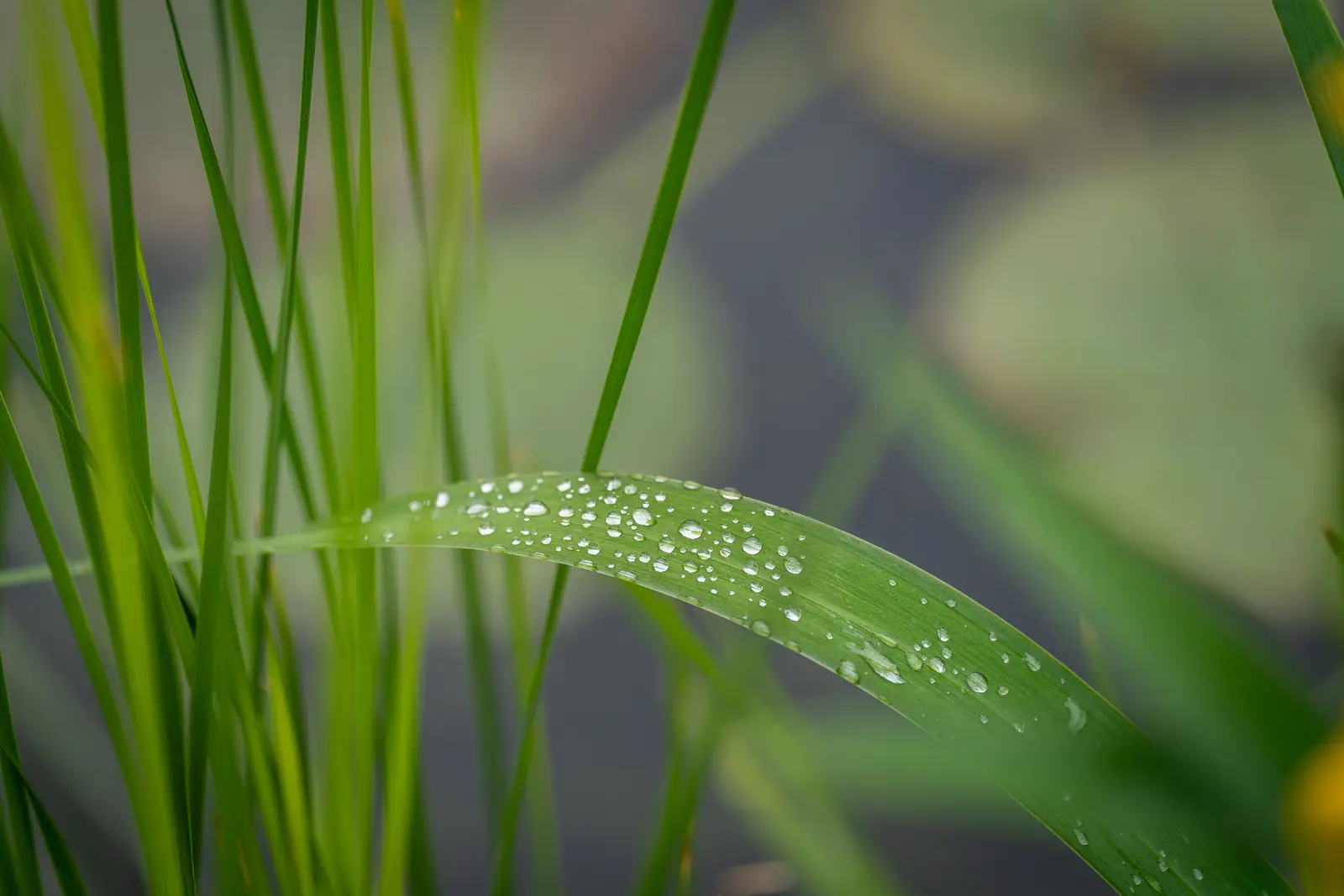
More impressions: swimming ponds & pools
Answers about swimming ponds & pools
What is the difference between a swimming pond and a natural pool?
How big does a swimming pond or natural pool need to be to be worthwhile?
How does the water stay clean and clear without chlorine?
Will I get algae in a swimming pond?
Do swimming ponds attract mosquitoes?
Is the water suitable for allergy sufferers and children?
Can a natural pool be heated?
How much maintenance does a natural pool really need?
Does a natural pool have to be drained in winter?
Can I have my chlorinated pool converted?
What are the running costs?
Do you also build public pools and special projects?
How many water features have you built?
Can I try out a swim system beforehand?
Related reading
Every Thursday, we answer a question from the garden here – often one that our customers ask us.
Let's talk about your project
We are happy to advise you in person, with no obligation.
Request a consultation