
What does a garden cost? The key price factors
What garden design costs depends on several factors. We explain what determines the price – and what funding is available.
By Ludwig Fuchs · Managing Director · Dipl.-Ing. (FH) Architecture · technically reviewed by Fuchs baut Gärten · updated 15 June 2026
Why there is no flat price
Every garden is different – so the price cannot be quoted as a flat rate. These factors affect the cost most:
| Price factor | What determines it |
|---|---|
| Size & terrain | Area, slope and access have a significant effect on the effort involved. |
| Materials | Natural stone, timber, ceramic or concrete – quality and origin make the difference. |
| Water | Swimming pond, natural pool or pool are separate budget items, including technical equipment. |
| Features | Lighting, irrigation, outdoor kitchen, furniture. |
| Maintenance | Ongoing maintenance as an optional follow-on item. |
How to arrive at a reliable budget
At Fuchs baut Gärten, a sound price is reached in three steps: in the free initial consultation we clarify your wishes, the plot and the framework. Next comes the garden design – its fee depends on size and complexity, and the result is a standalone, reliable concept. On this basis we calculate the quote, in which every element is precisely defined – with no nasty surprises.
If the budget is limited, we plan in stages: the garden takes shape step by step without losing the overall picture.
The cost drivers nobody has on their list
Everyone thinks about materials and size. What really makes quotes diverge are usually five less obvious points:
Access. Can an excavator get onto the plot, or is the work done by hand? Weeks lie between the two. In extreme cases we lift machinery over the house with a crane – we have done that before, but it then appears in the quote too.
Excavation and disposal. Soil is heavy, and taking it away costs money. We have our own lever for this: our Erdenwerk in Reichersbeuern turns excavated material back into planting soil – what is recycled there does not have to go to landfill.
The ground. In our area the soil changes over short distances between glacial gravel and boggy pockets. On one, a wall almost needs no foundation work; on the other, it takes real effort. Looking at the ground before planning is therefore no formality.
The gradient. A slope is a gift in terms of design and a cost item in terms of calculation: every level needs a wall or embankment to hold it. See how this becomes an advantage in our sloping gardens.
Existing features. The cheapest item is the one that stays: established trees, sound surfaces, a wall that only needs new joints. Good planning starts by deciding what does not need to be new.
Where saving is smart – and where it gets expensive
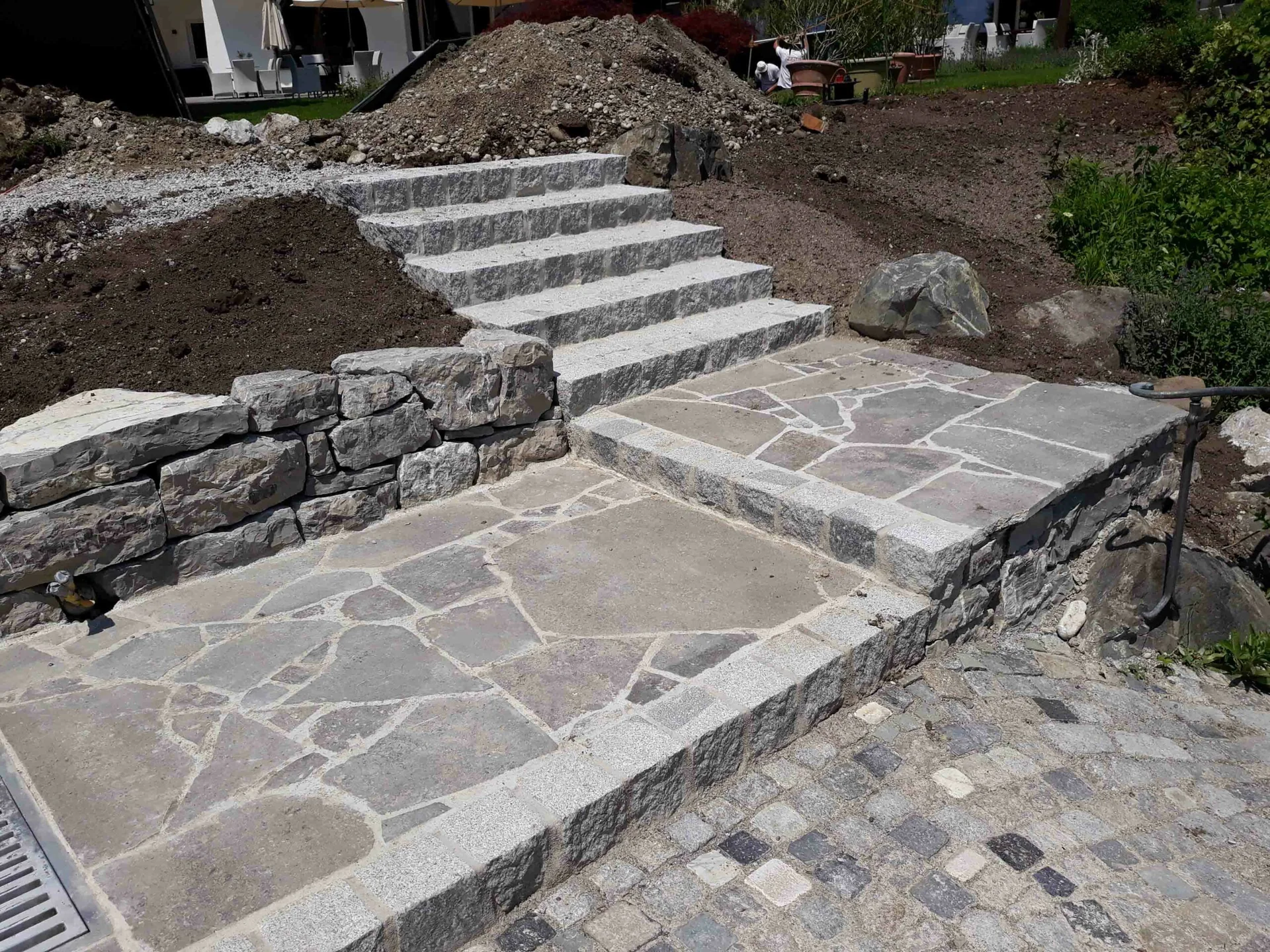
Save smart: build in stages. Choose smaller plant sizes – a young tree that establishes well often overtakes one planted too large within a few years. Use reclaimed natural stone where it fits: at the Zehenthof in Kirchheim, the large boulders and crusted slabs are reclaimed granite – more beautiful than new, because they look as if they had always been there. And use simpler surfacing for secondary areas than for the terrace.
Never save on: the sub-base, waterproofing and drainage, or the soil for planting. None of it shows in photos – but all of it decides how the garden looks in ten years. The most expensive thing in garden building is building twice.
And the order: structure comes first – earthworks, walls, surfaces; this is the expensive part and can hardly be corrected later. Plants come afterwards: comparatively inexpensive, with the greatest impact. Features such as lighting or irrigation can wait – but their empty conduits cannot. They cost almost nothing during construction and save digging things up later.
Planning creates cost certainty
We start with a design that remains calculable regardless of later construction. That way you see a reliable budget early, before any building begins.
Funding & tax benefit
Under § 35a EStG, private individuals can deduct 20% of tradesperson services from their tax (up to €1,200 per year) as well as 20% of household-related services such as ongoing garden maintenance (up to €4,000 per year).
Two points where the bonus fails in practice – not with us: it applies only to labour, travel and machinery costs, not to materials – which is why we show labour costs separately on the invoice. And it requires an invoice plus bank transfer; the tax office does not accept cash payment.
We calculate the specific price for your project in the free initial consultation.
Answers about: What does a garden cost?
What does a garden cost per square metre?
Why is there no flat price for garden design?
What does garden design cost?
How can I save money on garden design?
Why doesn't Fuchs baut Gärten list price ranges online?
Does a landscaped garden increase the value of a property?
More garden knowledge
You will find even more practical knowledge in our maintenance library with detailed maintenance guides – or simply ask us directly.
Let's talk about your project
We are happy to advise you in person, with no obligation.
Request a consultation