

Privacy Screening & Hedges
Privacy screening with plants: from the classic hedge and hedge elements for instant effect to the tall hedge against overlooking from above.
Not being seen – without walling yourself in
Privacy is the most common wish in our initial consultations. A concrete wall solves that too – but the garden feels smaller afterwards. Plants screen just as effectively, take up less space visually, cool the air in summer and get better with every year instead of worse.
Which hedge suits your garden?
The choice determines the maintenance effort and the effect – not the price alone:
- Yew (Taxus baccata) – evergreen, exceptionally tolerant of pruning, and copes well in shade. The first choice for formal, permanently dense hedges. Please note: all parts are poisonous.
- Hornbeam (Carpinus betulus) – deciduous, very robust and tolerant of pruning, forgiving of mistakes. If you want to keep the foliage over winter, choose European beech: it holds its russet leaves until the new growth appears.
- Privet – fast-growing and inexpensive; in return, it needs more trimming.
- Cherry laurel – evergreen, large-leaved, quickly dense. Looks bolder and less delicate than yew.
- Thuja (arborvitae) and false cypress – dense and affordable, but with a significant drawback: after a hard cut back they do not shoot again. A thuja hedge that has lost its shape or gone bare therefore cannot be rejuvenated – it has to be replaced. This is different with yew, hornbeam and most other species.
- Bamboo – fast-growing and elegant, but without exception belongs behind a rhizome barrier.
We no longer plant box – here is the replacement
Box tree moth and the fungal disease box dieback have turned box into a constant worry. In existing gardens, our maintenance team fights for every plant – against the moth, among other things, with nematodes that are watered in and sprayed. It works, but it is a hard fight. That is why our recommendation is clear: we no longer plant new box and advise you against it too.
For low edging, balls and topiary there are good alternatives – each with its own character:
- Ilex crenata (Japanese holly) – looks almost identical to box and can be clipped in just the same way. Wants evenly moist, rather acidic soil.
- Yew – the longest-lived solution: shoots again even from old wood and also suits larger shapes. Grows more slowly at first.
- Bloombux (dwarf rhododendron) – box-like foliage and pink flowers on top in early summer.
- Euonymus (spindle) – small-leaved, evergreen varieties for low edges, very tolerant of pruning.
- Lonicera nitida (shrubby honeysuckle) – fine foliage and quickly dense, but needs more frequent trimming.
Which alternative fits depends on the location – soil, water, light. We advise you on this and also replace existing box edging in sections, so the garden never looks completely bare. We continue to care for affected plants – you can find out more under garden maintenance.

When you want it dense straight away
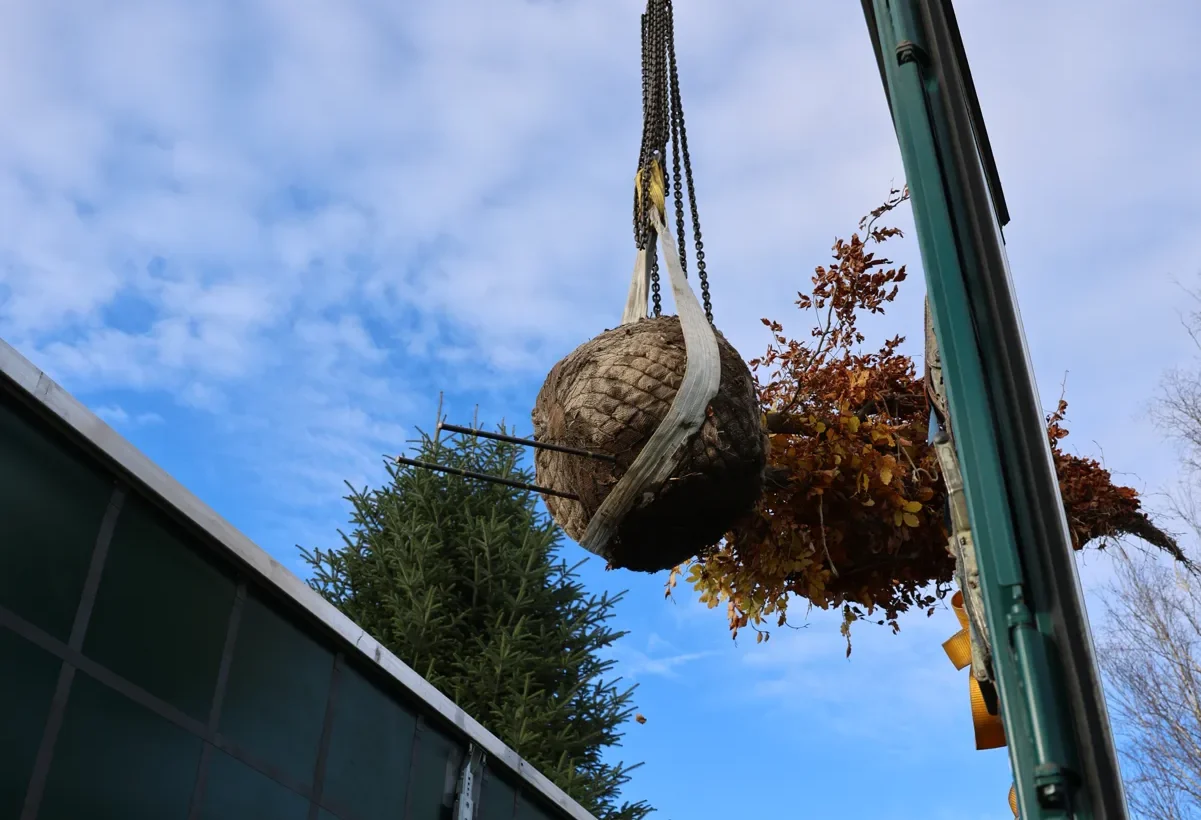
A young hedge takes years. If you don't want to wait, there are hedge elements – pre-grown hedges that have already grown on a frame or trellis and, element by element, form a closed wall straight after planting. There are also trellises and the tree wall: trees with a raised, flat-trained crown.
These solutions cost more than young plants – but they work from day one. In the initial consultation we will tell you honestly where it is worth it and where patience is the cheaper choice.
Privacy at height – the underestimated problem
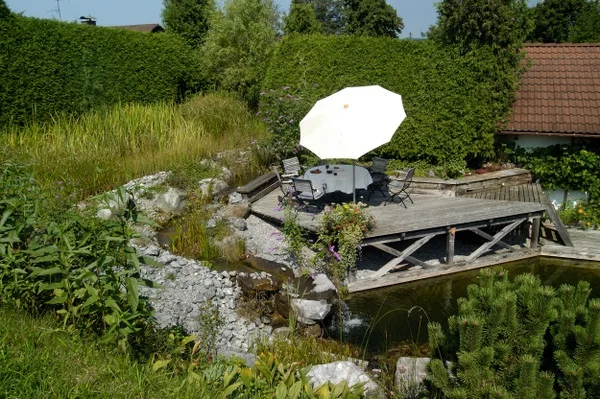
Often the hedge has long been in place, and yet someone can still see in: from the balcony of the new house next door, from an upper floor, from the higher road. A 2 m hedge won't help against being overlooked from above – a tall hedge, a tree wall or a carefully placed specimen tree whose crown sits exactly where the line of sight comes from will.
This is planning work: we check on site where people can actually see in from, and place the planting where it works – instead of planting all the way around.

Two rules you should know about
Boundary distance (Bavaria). Under Art. 47 of the Bavarian Implementing Act to the German Civil Code (BGB), a neighbour can require that trees, shrubs and hedges stand at least 0.50 m from the boundary up to 2 m in height and at least 2 m from the boundary over 2 m in height. For hedges, the distance is measured from the centre of the shoots closest to the boundary. If the planting is more than 2 m from the boundary, there is no height limit. From the start, we plan the distances so that they never lead to a dispute.
Trimming periods (nationwide). Under § 39 para. 5 of the Federal Nature Conservation Act (Bundesnaturschutzgesetz), hedges, trees and shrubs may not be cut back or cut down to the stump from 1 March to 30 September – to protect nesting birds. Gentle shaping and maintenance trims remain permitted. Violations are administrative offences and can be expensive. We therefore schedule major cutting back and clearing for the winter months.
Where our plants come from
For trees, hedges and shaped shrubs we work mainly with the Lorenz von Ehren nursery – founded in Hamburg in 1865, with around 600 hectares under cultivation and a range of about 2,000 genera, species and varieties in around 8,000 forms and sizes. For topiary and evergreen specimens, there is a dedicated branch in Bad Zwischenahn.
For you, this means: we don't pick your plant from a catalogue, but draw on a range in which the right specimen genuinely exists – right down to the individual specimen tree with character. One joint project is our show garden in Gilching, created in collaboration with Lorenz von Ehren.
When we trim – and in what shape
Deciduous hedges such as hornbeam and privet are trimmed during dormancy, ideally from mid-January to mid-March. A second cut at the end of June – the Midsummer cut – makes use of the short growth pause: the cuts heal neatly, and the hedge quickly looks uniform again. Evergreens such as yew are cut shortly before the first new growth; a winter cut can cause frost damage, and on hot days the cut surfaces risk sunburn. Flowering hedges are not cut into shape at all, but thinned out every three to five years.
The most common mistake is the shape: with a rectangular box cut, the lower parts get too little light and turn bare. A trapezoidal or oval cross-section lets light reach them too and keeps the hedge dense right down to the ground – this follows horticultural best practice and is the reason professionally trimmed hedges don't fall apart at the bottom.
You’ll find all the details in our guide Trimming hedges – free of charge and also available as a PDF. If you wish, our maintenance team can take care of the trimming on an ongoing basis, either as part of year-round maintenance or as one-off hedge trimming. For box, yew cones and garden bonsai, there is also our guide Topiary.
Also worth a look: Trees & large trees, Walls & fences as structural privacy screening, and the perennial planting in front of them.
Answers about privacy screening & hedges
Which hedge is the easiest to maintain?
How quickly does a hedge grow dense?
What distance from the property boundary do I have to keep?
When am I allowed to trim my hedge?
What helps against being overlooked from a taller neighbouring building?
Do you also plant just the hedge, without doing the whole garden?
Related reading
Every Thursday, we answer a question from the garden here – often one that our customers ask us.
Let's talk about your project
We are happy to advise you in person, with no obligation.
Request a consultation