
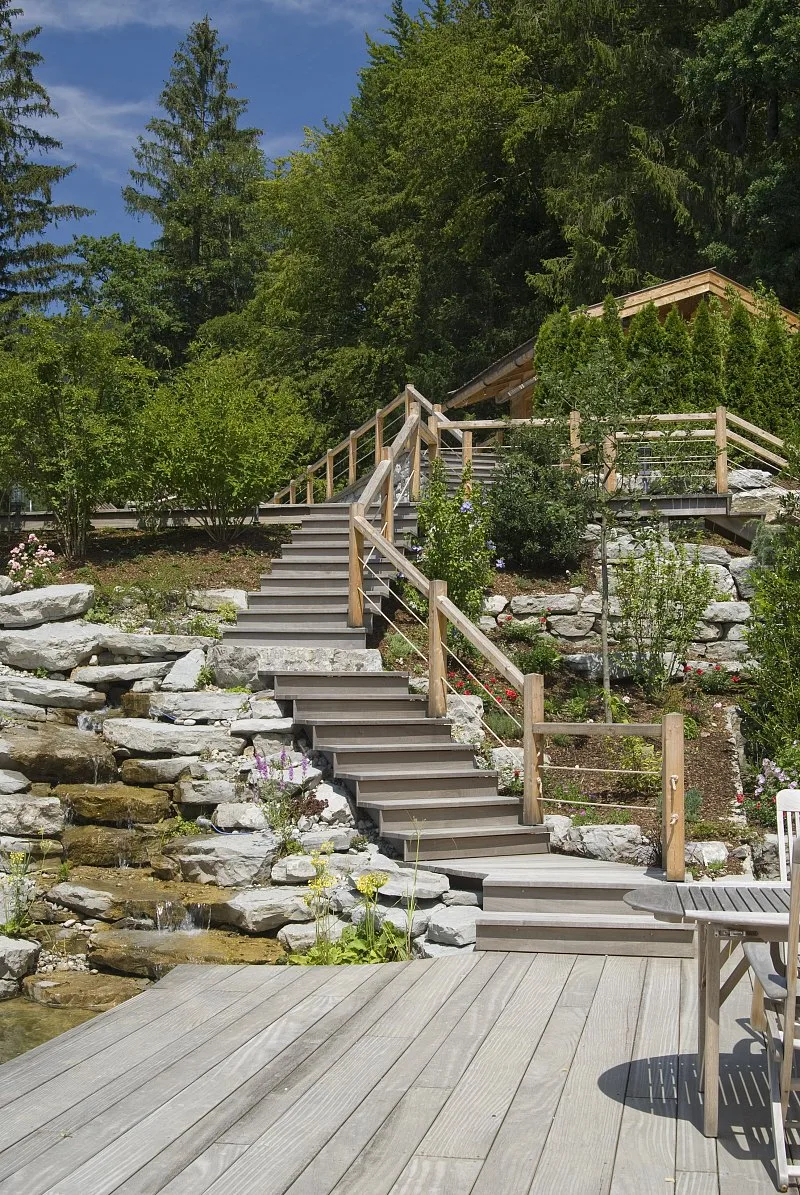
Caring for timber in the garden
Caring properly for terraces, fences and timber features
Compiled by our master gardeners · Last updated: July 2026
To print and file away – free to download.
Timber is a living, natural building material – pleasant to use and strikingly beautiful. Its structure, properties and appearance change with the weather and environmental conditions, though. With the right handling, cleaning and care, you can enjoy your terrace, fence and other timber features for years to come.
Silvering, cracks and more – what is normal
Untreated timber usually turns silver-grey. This natural process is caused by UV radiation, which breaks down the lignin in the surface of the wood. Many people appreciate this patina and deliberately choose not to treat the surface. With changing moisture and temperature fluctuations, timber also develops slight cracks and minor changes in shape over time – typical reactions that do not affect the quality of the construction. Depending on the type of wood and location, fungi and insects may settle in; resistant wood species or wood preservatives protect against this.
Leave a gap – the best structural protection
The most important rule when working with timber: avoid contact points. Where a planter stands on the terrace or a climbing plant rests against the privacy screen, ventilation is restricted and water drains away more slowly. A few centimetres of space are usually enough:
- Place thin wooden battens or spacers under planters.
- For climbing plants, use rope, rod, trellis or netting systems set away from the wall or fence.
- Plant at a distance from the timber or cut plants back regularly.
Where contact points cannot be avoided, move the objects around regularly. This lets the wood dry out and prevents patchy differences in colour caused by uneven UV exposure.
Regular cleaning
Sweep away leaves and small stones regularly with a soft plastic, straw or natural-bristle broom – always along the grain. This prevents moisture build-up and reduces stains, moss and algae growth, and fungal attack. Rinse the surface with water now and then to loosen encrusted dirt and wash away particles.
If needed, an intensive clean helps: so-called wood brighteners bring back much of the original colour of the wood, and special soap solutions loosen stubborn dirt. The products are worked in with a stiff broom or cleaning machine and rinsed off with clean water. Please note: varnished and stained surfaces can be damaged this way – it is better to clean these by hand with gentle products and soft bristles. Cut off any raised wood fibres close to the surface with a sharp knife.
Oiling and staining
The best time to renew the wood protection is after an intensive clean. The right treatment depends on how heavily the wood is used:
- Oils (pigmented or unpigmented) are recommended for heavily used surfaces such as timber terraces. They soak in and form an open-pored, water- and dirt-repellent protective layer, intensify the colour and reduce cracking. Pigmented oils offer better protection against UV radiation. Renew the protective layer about once a year.
- Open-pored thin-layer stains are suitable for timber elements that are only lightly used. The grain stays visible, and the wood is protected against water, stains and UV. Renew occasionally by painting over.
- Thick-layer stains are used mainly on dimensionally stable components such as window frames. If the layer cracks, the wood needs to be sanded back completely and recoated.
Chemical protection and resistant timbers
Many garden timbers are already industrially impregnated – this protection does not need renewing at all, or only after many years. If you apply a treatment, use only products with the RAL quality mark for wood preservatives or a registration number from the German Environment Agency; for load-bearing components, the product needs building-authority approval. Many outdoor timbers are naturally resistant to fungi and insects, so chemical protection can be left out. If insects or fungi take hold, a specialist company can help identify and treat the problem.
Answers about timber in the garden
Why is my timber deck turning grey?
How often do I need to oil my timber deck?
Can I clean timber with a pressure washer?
Are cracks in the decking boards a defect?
Can I refresh silvered timber?
Let's talk about your project
We are happy to advise you in person, with no obligation.
Request a consultation