
Soil aeration with compressed air
Compacted soil starves trees and lawns of air. We loosen it at depth with compressed air – without digging, for private gardens and municipalities.
When the soil has no air left
Healthy soil is almost half pores filled with air and water. When these are squeezed together, roots and soil life suffocate – often invisibly, over years.
Compaction happens faster than you might think: construction vehicles while the house is being built, cars parked over the root zone, heavy use of lawns and open spaces – or naturally heavy clay soil. The effects only show later: after rain, water stands on the surface, moss spreads, tree crowns thin out, and new plantings struggle to get going.
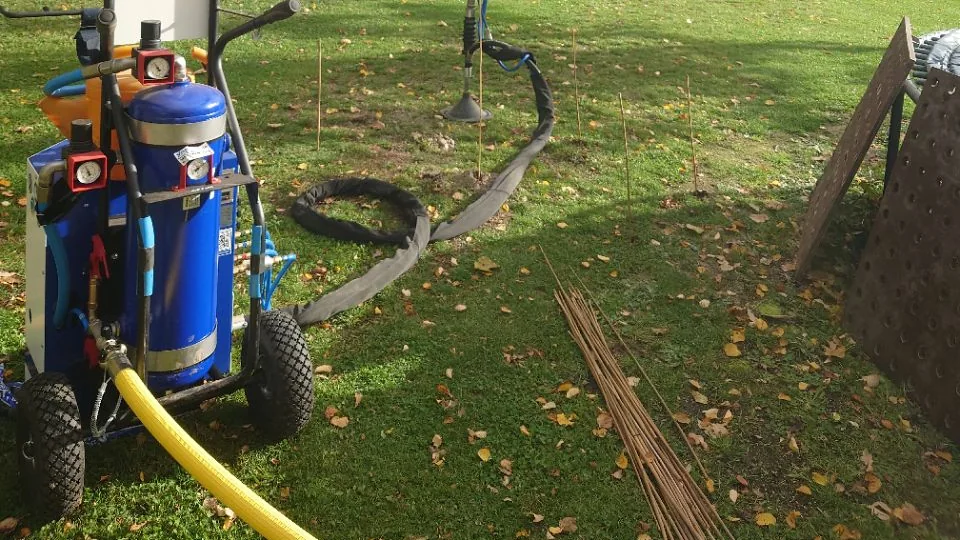
Our answer is soil aeration with compressed air: a lance fires powerful bursts of air into the compacted layer. The soil breaks open at depth, fine cracks and cavities form, and air and water reach the root zone again. There is no digging – lawn, paving and roots remain practically undamaged, and the area can be used again immediately.
Working across the area, point by point
First we look at the soil: what type is it, where is the compaction, where do utility lines run? Then we mark out a grid – we place the injection points about one metre apart, the spacing recommended by research – and work through the points one after another.
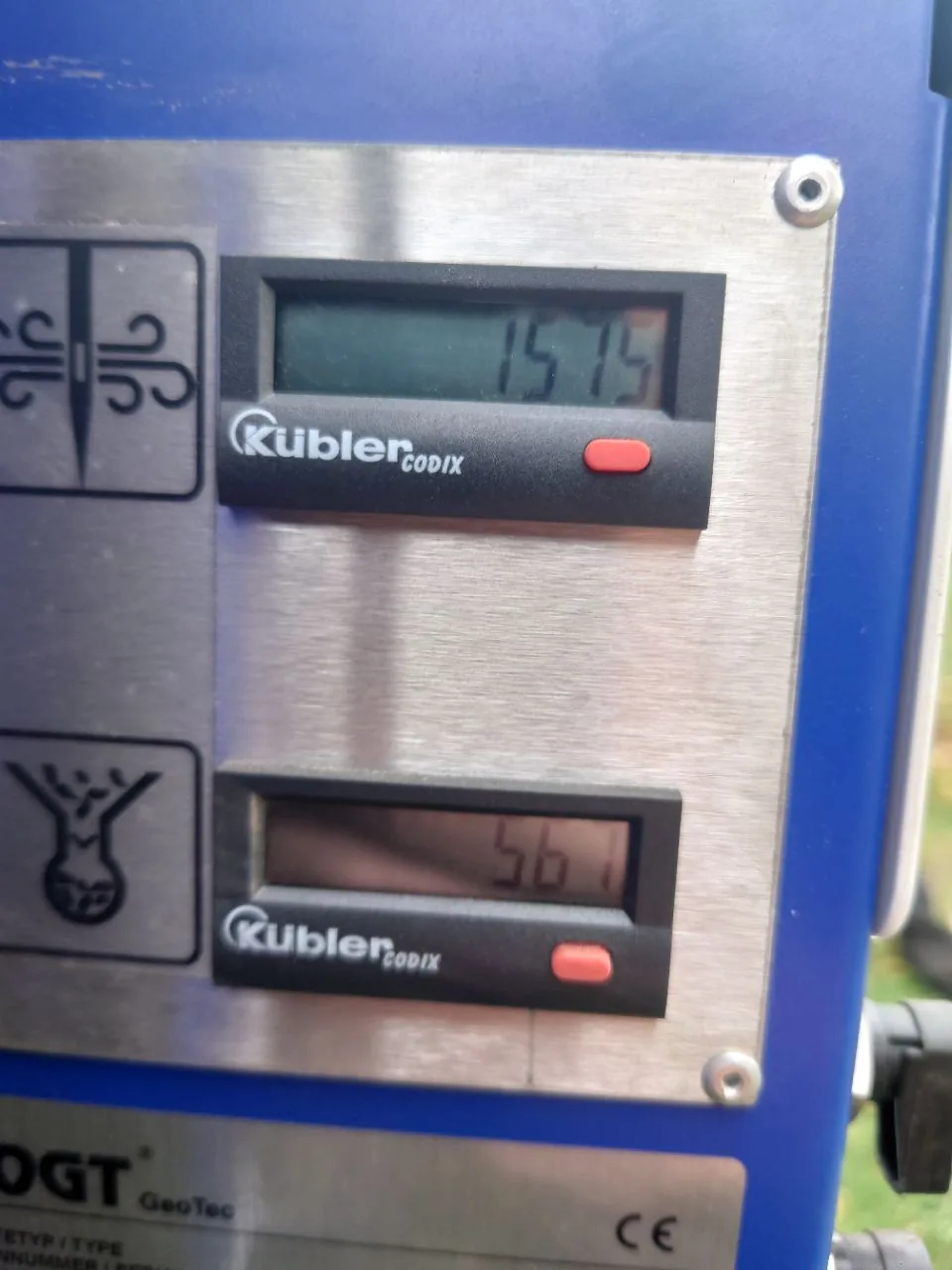
Into the freshly opened cracks we blow a supporting granulate, together with fertiliser if you wish. It keeps the new cavities open; otherwise they collapse again. A digital counter on the unit records every aeration and every injection – so you can see exactly what was done.
The machine behind it: a VOGT Geo Injector maxi, in use since summer 2026 at our maintenance company Fuchs Service, supplied by a large compressor delivering at least 2,500 litres of air per minute.
What it achieves – and what it doesn't
Soil loosening with compressed air is well researched, including in a research project by the Deutsche Bundesstiftung Umwelt. We tell every client three of its findings up front:
- The soil type decides. The method works best on sandy and silty soils, and noticeably less well on heavy clay. That is why we check the soil before recommending anything.
- Without granules, it doesn't last. Air alone achieves little – only the injected supporting granulate secures the effect.
- The effect is limited in time. After about a year, the effect could no longer be measured in the trials. To improve an area permanently, repeat the aeration regularly and also encourage soil life, for example with mulch and compost.
So that granules and fertiliser suit each soil, we have been trained by the manufacturer of the soil additives: since November 2026, Fuchs Service has been a certified terra fit Partner – after completing all qualification levels.
Air for trees along streets and in public spaces
No tree has it harder than one in a public space: around it, people drive, park, celebrate and build.
Many cities therefore improve their tree sites with compressed air – Nürnberg and Friedrichshafen, for example, loosen the root zone of their urban trees with the compressed-air lance and fill the channels created with granules and nutrients. For municipalities in the Oberland, we now offer this too, for example for:
- Trees along streets, in parking bays and in car parks
- Park, cemetery and schoolyard trees
- Festival meadows, playgrounds and busy public spaces
- Young trees that have not grown for years
For public spaces, what matters most is this: nothing is dug up, no open soil is left behind, and the area can be used again immediately after the work. The counter on the unit also provides clear proof of the work carried out – for the municipal works depot and the council.
And in a private garden?
The same technique helps wherever a garden is still suffering from past building work: a lawn prone to waterlogging, a tree by the house that has been struggling since the renovation, a bed on the builders' former access track. Soil aeration fits easily into a regular visit from our garden maintenance team; if large trees are involved, you will find more under Trees & large trees.
Photos on this page: Michael Fischhaber and Theresa Berghammer, Fuchs Service – taken during a job in the Oberland in October 2026.
Answers about soil aeration
What is soil aeration with compressed air?
Does it help with waterlogging in lawns?
How often does the aeration need to be repeated?
Is the lawn damaged in the process?
Do you also work for towns and municipalities?
How does this differ from aerating a lawn?
Let's talk about your project
We are happy to advise you in person, with no obligation.
- Reply within 24 hours
- Free, no-obligation initial consultation
- One point of contact from design to maintenance
Prefer to talk right away? +49 8042 91454-0
Mon–Thu 8 am–5 pm, Fri 8 am–12 pm