
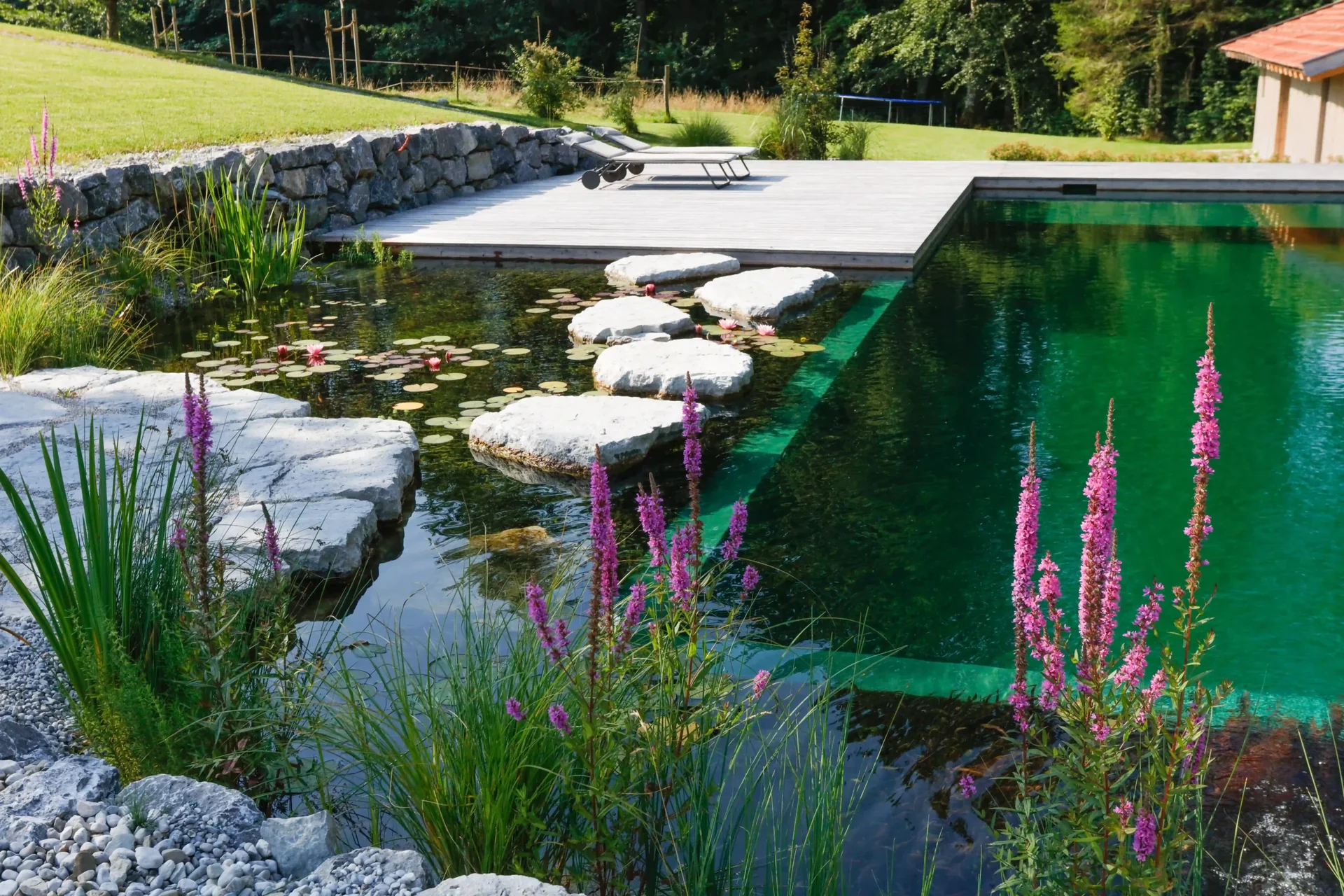
Caring for your swimming pond and natural pool
Care for bathing water that stays clear
Compiled by our master gardeners · Last updated: July 2026
To print and file away – free to download.
Swimming ponds and natural pools are sensitive ecological systems. The top priority of all care measures is to keep the nutrient level in the water low – this is the only way to preserve the natural self-cleaning powers and, with them, long-term water quality.
Why the pond cleans itself
In a swimming pond, the law of the minimum applies: the scarcest nutrient limits growth – for algae, that is phosphorus. The pond is also a nutrient trap – whatever falls in stays in. Care therefore means removing dead material and with it phosphorus. Target values: below about 20 µg/l phosphorus in the pond water, fill water below 10 µg/l (fill water analysis), pH usually 7.8–8.2.
The cleaning is done by the pond’s inhabitants: water fleas filter all of the water up to 1.7 times a day, while microorganisms break down suspended particles and destroy disease-causing germs.
Spring clean: the most important date of the year
The skimmer only captures part of the dust, leaves and insects; the rest sinks to the bottom and settles as sediment. In spring, the pool walls are therefore cleaned by hand or with a motorised brush and the bottom is vacuumed with an underwater vacuum – ideally before the plants start to shoot. Below a water temperature of 12 °C, the phosphorus lies on the bottom and is largely removed when vacuuming. Only then is the lost water replaced with fresh water.
After the last frosty nights, dead plant material in the regeneration zone is cut off and removed. This reduces nutrient build-up and prevents algae growth.
A green tinge or filamentous algae in early spring is no cause for concern: the algae-eating small organisms only develop two to three weeks after the algae – the green phase usually clears up by itself; please only get in touch if the water stays cloudy. Remove algae with a net and encourage the aquatic plants with a special fertiliser, following the manufacturer’s instructions. Never use ordinary fertilisers – they release their nutrients into the water all at once and make the problem worse.
Equipment and cleaning during the season
In spring, the pond equipment is put back into operation: remove the frost-protection compensation bodies and ice pressure pads, clean the skimmer box and insert the strainer, and switch on the pumps and filter systems.
- Clean the skimmer continuously depending on the amount of leaves and dirt, possibly daily
- Rinse pressurised phosphorus filters regularly; other filters sometimes need backwashing; flush gravel filters through after winter, depending on their construction
- Wet filters (biofilters) should have water flowing through them without interruption; dry filters (trickle filters) can run dry, and intermittent operation of about five hours a day is enough
The floor of the swimming zone should also be cleaned two to three times a year. A pool robot is very helpful here – in use daily for lasting results. However, it only works in pools with straight walls, a concrete base and a liner laid without creases.
In a natural pool, in addition to the skimmer circuit, a biofilter circuit cleans the water via filter mats with a microorganism biofilm; the mats are washed out once a year. The iron-based phosphate filter granules are saturated after about three to five years and are replaced. The UVC lamp runs for only about 48 hours a week, against green algae after a sudden input of nutrients.
Cutting aquatic plants correctly
Once they have been established for two to three years, the aquatic plants in the regeneration zone are harvested close to the bottom with an underwater scythe to remove the nutrients they have absorbed – ideally between July and August, and never all at once, but at most half. Some evergreen species are left standing: they supply oxygen in winter and compete with the algae in spring. Marsh and reed plants stay standing over winter to secure gas exchange between water and air; they are cut back in spring before they start to shoot.
Autumn service and winterising
Autumn is the gentlest time for a major pond service, as most animals are in their winter quarters and the aquatic plants are dormant. After three to five years, the sediment layer in the regeneration zone is usually deep enough that rot endangers the balance: the zone is pumped empty, the sediment is rinsed off and the substrate layer is topped up with fresh material. For the plant filter, the top 5 cm of the material are replaced. Before the first frosty nights, all the equipment is winterised; pumps must always spend the winter frost-free, unless a frost-free pump chamber is available. The natural pool stays full all year round: only the skimmer circuit is winterised, while the biofilter circuit keeps running and prevents a closed sheet of ice; the UVC lamp is removed if there is a risk of frost.
With dense tree cover, a leaf protection net over the pond is worthwhile during leaf fall in September and October; it is removed at the start of winter. With a pool cover on the natural pool, no additional net is needed.
Water loss, topping up and safety
Every water feature loses water – usually not through a leak, but through evaporation caused by sun, wind, plants and stones that protrude above the surface. In favourable conditions, the water level can drop by 12 mm a day or more. When topping up with tap water, phosphate may be introduced depending on your supplier – ask about the values or mix with unpolluted rainwater. Fertilising around the water should be avoided.
Swimmers also introduce phosphorus through skin, sweat and hair – so take a quick shower before you swim.
As the owner, you are responsible for the safety of your pond – including for children from the neighbourhood. Steel mesh just below the water surface or temporary fencing are suitable ways to secure it; we advise against DIY solutions, as the right mesh size, among other things, is crucial.
Answers about swimming ponds and natural pools
Why is my swimming pond losing water – is it a leak?
What can I do about algae in the swimming pond?
When do the aquatic plants in the swimming pond need cutting?
Does a natural pool need a leaf protection net?
How often does the regeneration zone need to be renovated?
Do water fleas bite in a swimming pond?
Is a swimming pond a breeding ground for mosquitoes?
Why shouldn’t fish be kept in a swimming pond?
Why should you shower before swimming?
Why is my water lily flowering underwater?
Does the natural pool have to be emptied in winter?
Let's talk about your project
We are happy to advise you in person, with no obligation.
Request a consultation