
Pumpkins in the garden: growing, combining, spooky fun
Hokkaido, butternut or ornamental pumpkin? How to grow pumpkins in a Bavarian garden, what they have to do with asters – and which plants suit Halloween.
By Balbina Fuchs, landscape architect and owner · Fuchs baut Gärten, Lenggries · published 29 October 2026
Pumpkins grow well in Bavarian gardens too, provided they get warmth, humus-rich soil and enough water – and only go outdoors after the Ice Saints. Add asters, sedum and coneflower, and in October you have a bed you can both eat and admire. And for Halloween, the garden offers more spooky things than the carved pumpkin.
Which pumpkin for the home garden?
For the home garden, the Bavarian Garden Academy recommends, among others, the Hokkaido varieties 'Uchiki Kuri' and 'Red Kuri', plus 'Early Butternut', the musquée pumpkin 'Muscat de Provence' and the 'Bischofsmütze' (leaflet 2103). Hokkaido has the advantage that you can eat the skin, and it needs less space than the giant pumpkins.
If you want to store pumpkins, pay attention to the variety: in a trial by the Bavarian State Institute for Viticulture and Horticulture, after four months in storage 93 per cent of the 'Red Kuri' fruits were still in perfect condition, while other varieties failed completely ([LWG storage trial 2022](http://web.archive.org/web/20240330081935/https://www.lwg.bayern.de/mam/cms06/gartenbau/dateien/hokkaidok%C3%BCrbis_lagerversuch_2022.pdf)).
How to grow pumpkins here

Pumpkins love warmth. Young plants only go into the bed after the Ice Saints, so from mid-May – in the LWG trial they were planted on 17 May. On cool nights afterwards, fleece helps: it retains the warmth of the soil and protects down to about minus five degrees outside (leaflet 2107).
The soil should be loose, rich in humus and well supplied with compost – you can get compost and soil at our Erdenwerk. Because the fruits are almost entirely water, water regularly, ideally at the base of the plant rather than over the leaves. A mulch layer of slightly dried grass clippings keeps the soil moist; the Garden Academy specifically mentions pumpkins for this (leaflet 2201). The Hokkaido above grows in the vegetable garden created by Nikolaus Fuchs and now run by Angelika Fuchs – photographed while the plant was still in flower and the last fruit was waiting to be harvested.
Harvest and storage: A pumpkin is ripe when the skin is matt and hard, the colour typical of the variety and the stalk corky. Harvest before the first frost, with the stalk undamaged. Stored cool and dry at 10 to 15 degrees, a Hokkaido keeps for four to five months (BZfE).
Kitchen garden meets perennial bed

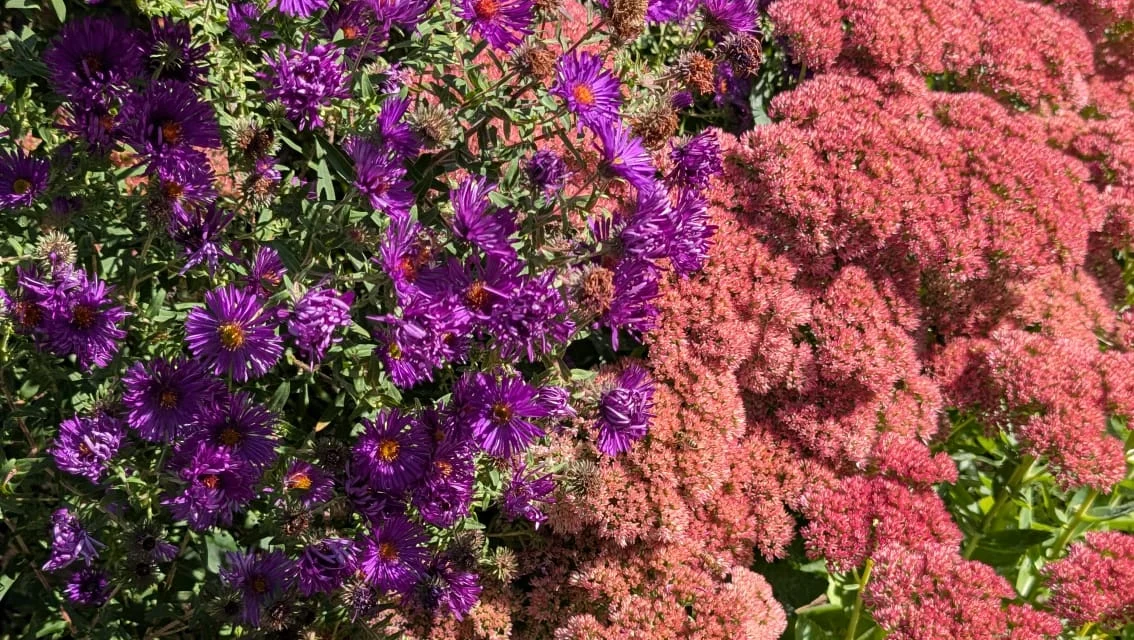
Pumpkins don't have to disappear into a remote corner of the vegetable patch. In autumn they go beautifully with the perennials that bloom then: purple asters, pink sedum and yellow coneflower combine with the orange fruits to create a picture that lasts until the first frost. The two Hokkaido pumpkins in the photo come from the same vegetable garden: freshly harvested and simply placed on the natural stone garden kitchen. Which perennials we plant for beds like this is described under perennial planting, and you can find out more about garden kitchens under garden furnishing.
A classic example of useful plants that help each other is the “Three Sisters”: maize gives the beans something to climb, the beans fix nitrogen, and the large pumpkin leaves shade the soil (Bundesverband der Kleingartenvereine). If you are short of space, you can also grow pumpkins in a raised bed.
Edible or ornamental pumpkin?
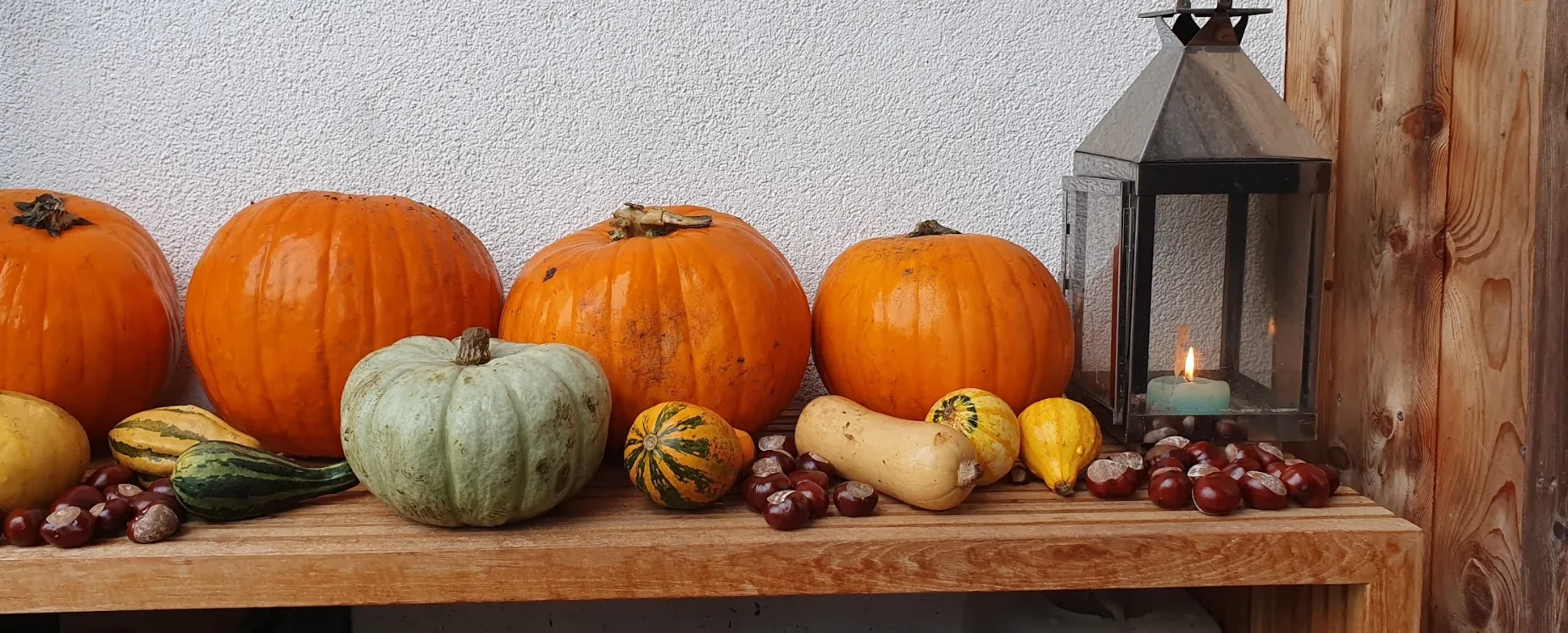
At home, autumn means both – the cover photo shows it: at the back the big pumpkins my children wanted to carve, in front butternut for the kitchen, colourful ornamental pumpkins for decoration and the chestnuts the children collected for crafts. After all, we don't just advise clients and plant at work – we also enjoy our own gardens at home.
Ornamental pumpkins are for decoration, not for the kitchen. Many contain bitter compounds called cucurbitacins, which irritate the stomach and bowel. So the rule is: taste a small raw piece – if it is bitter, spit it out and throw the fruit away. Cooking or baking does not destroy the bitter compounds (BZfE, BfR).
If ornamental pumpkins are growing nearby, you should not save your own seeds from courgettes and garden pumpkins: insects carry pollen far and wide, and the next generation can turn out bitter. Hokkaido, butternut and musquée pumpkins do not cross with ornamental pumpkins (BZfE).
Spooky plants for Halloween

The carved pumpkin is the classic – at our home combined with the last hydrangea flowers from the garden. This turns edible and ornamental plants into a decoration for the front door. If you look further, the garden and the countryside offer even more spooky things:
- Blue monkshood: The whole plant is highly poisonous, especially the tuber. Even skin contact can cause burning and numbness (BfR poison garden).
- Deadly nightshade: Its shiny black berries look like cherries – and, like the whole plant, are poisonous (BfR poison garden).
- Enchanter's nightshade: The botanical name Circaea goes back to the sorceress Circe from Greek legend.
- Devil's claw: This relative of rampion is named for its flower buds, which curve like claws.
Photos: Balbina Fuchs
Quick answers
When do you plant pumpkins in Bavaria?
How can I tell when a pumpkin is ripe?
Can you eat ornamental pumpkins?
Which plants go well with pumpkins in autumn?
What would you like to know?
Your question not answered here? Write to us – we reply personally. Sometimes we take up good questions in a new article, without your name, of course.
More from the garden guide
Every Thursday, we answer a question from the garden here – often one that our customers ask us.
Let's talk about your project
We are happy to advise you in person, with no obligation.
Request a consultation