
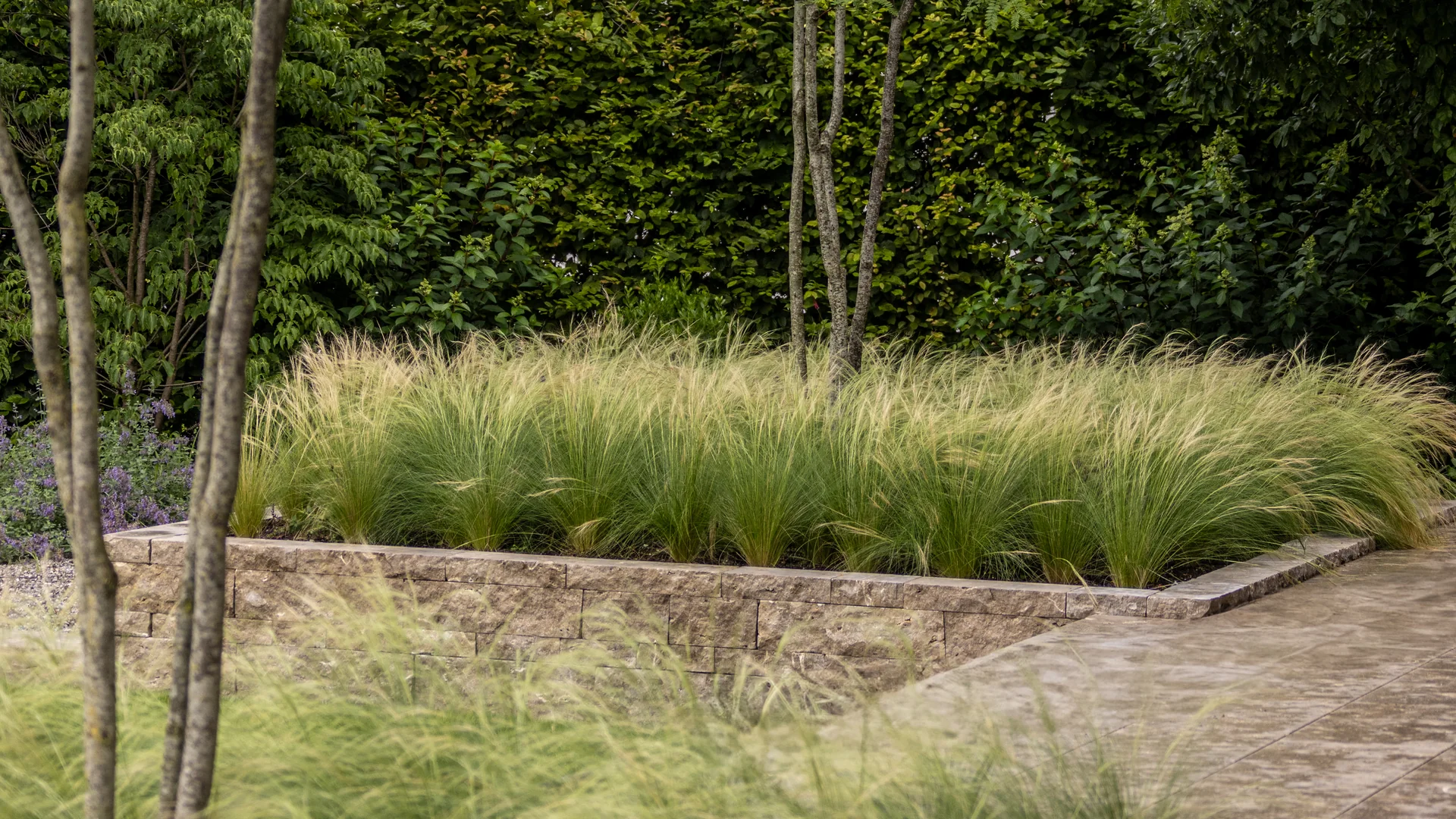
Plant of the month for November: ornamental grasses – beautiful well into winter
Why ornamental grasses stay standing in autumn: hoar frost, structure and winter shelter for insects. When to cut them back and which grasses work best.
By Balbina Fuchs, landscape architect and owner · Fuchs baut Gärten, Lenggries · published 18 November 2026
Simply leave ornamental grasses standing in autumn: with hoar frost or snow on the stems, Chinese silver grass, fountain grass and tufted hair grass make some of the loveliest sights in the winter garden, and the old stems protect the plant itself. Cut them back only in spring, shortly before the grass starts into new growth.
In November, when the perennials die back and the leaves have fallen, grasses really come into their own. That is why they are our Plant of the Month.
Three good reasons to leave the shears alone
Winter decoration. The Bavarian Garden Academy advises keeping the seed heads of grasses and perennials over winter, because they decorate the garden on snowy and frosty days – cutting back in autumn would lose exactly this effect. It names Chinese silver grass, tufted hair grass and fountain grass as particularly valuable (LWG leaflet “Der Garten im Herbst”).
Protection for the plant. The dried stems are not waste but a coat: they keep frost away from the heart of the clump and let in less wet, which could otherwise cause rot. More in our care guide Grasses.
Food and shelter for wildlife. In winter, the seeds of many grass species are food for birds such as the goldfinch, and insect larvae, ladybirds and lacewings overwinter in hollow stems. NABU therefore recommends leaving at least some of the old stems standing until spring (NABU Bremen). The Garden Academy explicitly names switch grass as a grass whose seed heads birds like to use (LWG).
Structure when everything else is asleep
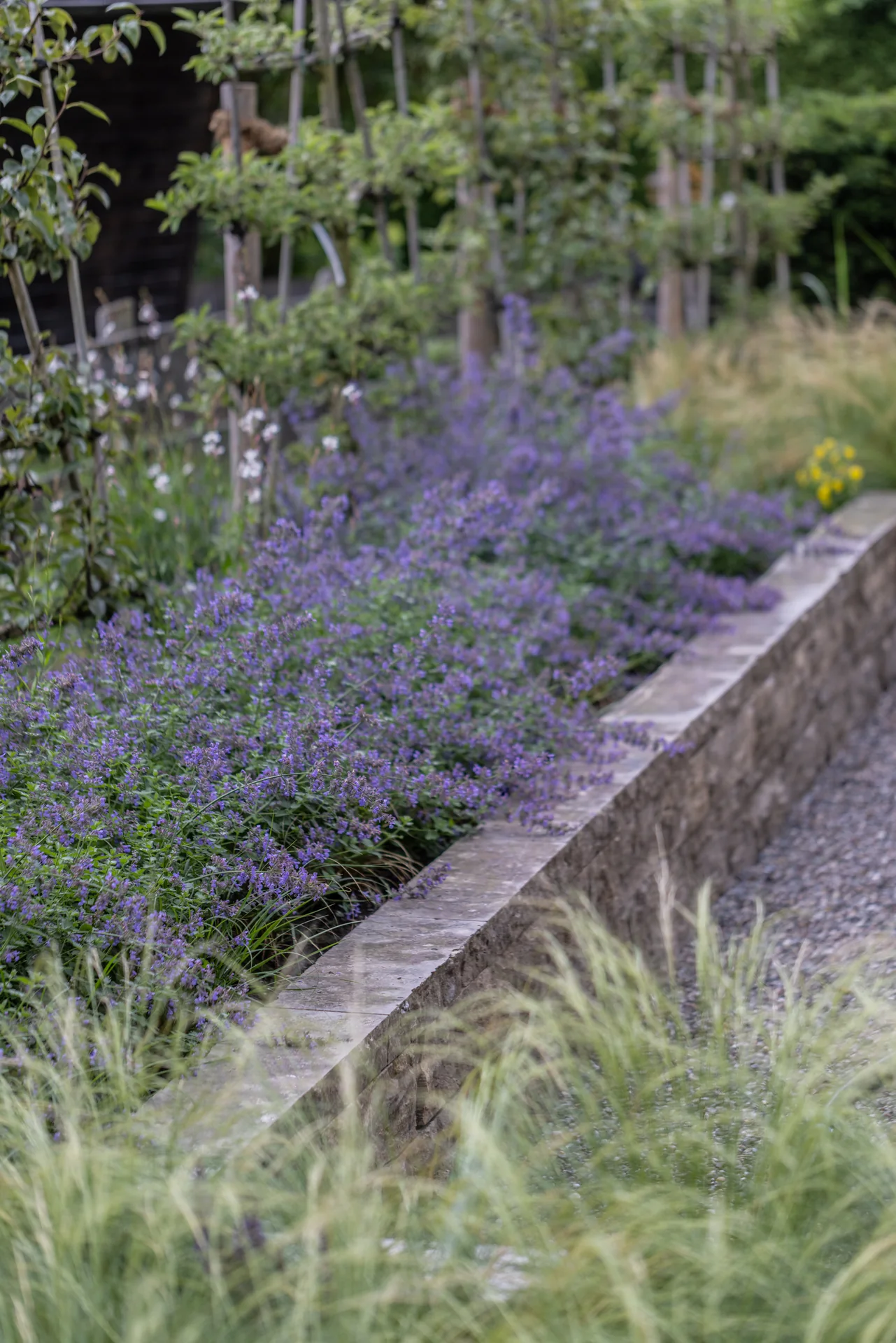
Grasses are the green frame of a perennial bed – and that frame is still standing long after the flowers have faded. In the garden “Gräser und Geometrie” in Unterwössen, a wall of Limes dolomite sets the clear form, and grasses soften its severity – delicate feather grass grows beneath a honey locust. In the project “Blumen statt Rasen” in Unterhaching, we deliberately placed fountain grass ‘Hameln’ and Chinese silver grass so that they stay standing over winter.
If you are planning a new bed, think about January too: where does your eye fall from the window, and where will hoar frost catch the morning sun? The page perennial planting shows how we combine grasses and perennials.
Grasses that work well in our region
For gardens in the Bavarian Oberland, we choose grasses that tolerate cold and snow and are given the right spot. According to the Garden Academy, the best winter protection is the right choice of location – and a sufficiently thick blanket of snow (LWG).
- Chinese silver grass (Miscanthus): especially impressive with hoar frost, and newer varieties stand quite firmly. It loves warmth, so we plant it in spring.
- Fountain grass (Pennisetum): decorative flower heads into winter. Also best planted in spring.
- Feather reed grass (Calamagrostis): with hoar frost or snow, it makes some of the loveliest winter pictures in the bed.
- Switch grass (Panicum): a prairie grass for rather dry spots; the seeds are food for birds.
- Tufted hair grass (Deschampsia): prefers it moister, for example near a pond.
- Evergreens such as giant sedge or blue oat grass stay green in winter and are only tidied up in spring.
The origin and water needs of each species are listed in the grasses care guide.
And when do you cut back?
Cut deciduous grasses back to just above the ground between February and April, before the new shoots appear. Until then: where a lot of snow falls, loosely tie tall clumps together in late autumn – this helps them bear the snow load and stops the wind from scattering old leaves around the garden. Don’t forget gloves – Chinese silver grass and pampas grass have sharp leaf edges. If you would rather not do the cutting back yourself, you can leave it to our garden maintenance team.
Photos: Benjamin Klopp / frames for good
Quick answers
Should you cut back ornamental grasses in autumn?
When is the right time to cut back grasses?
Which grasses look especially beautiful in winter?
Do you need to protect pampas grass in winter?
What would you like to know?
Your question not answered here? Write to us – we reply personally. Sometimes we take up good questions in a new article, without your name, of course.
More from the garden guide
Every Thursday, we answer a question from the garden here – often one that our customers ask us.



Let's talk about your project
We are happy to advise you in person, with no obligation.
Request a consultation