
Leaves in the garden: a treasure, not a burden
Leaves are fertiliser, frost protection and a home for hedgehogs. Where to put them, how to get on with your neighbours – and why evergreens give the garden structure in winter.
By Balbina Fuchs, landscape architect and owner · Fuchs baut Gärten, Lenggries · published 16 November 2026
In most gardens, leaves are not waste but material: they feed the soil, protect it and give animals a home. You only need to clear them where they get in the way – from the lawn, the pond and paths. And if you mainly experience leaves as a burden, further down you will find ways to design your garden so that they are less work.
Why leaves are so valuable in the garden
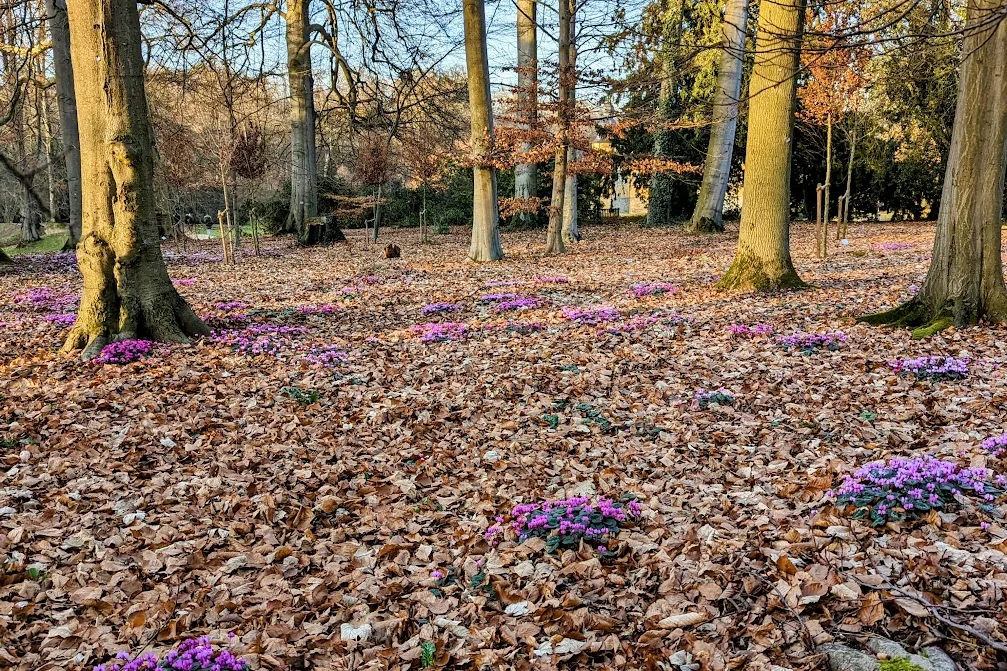
Earthworms, woodlice, springtails and mites turn leaves into humus and are themselves food for birds (LBV). As the leaves break down, they create organic matter and nutrients that benefit plants the following year. A blanket of leaves under trees and hedges also protects the soil from severe cold and drying out, and suppresses weeds (Bayerische Gartenakademie). Sweeping them into the organic waste bin takes fertiliser, mulch and winter protection away from the garden all at once – “too good for the brown bin”, says the Gartenakademie.
How to use leaves
As mulch. Leaves may stay between perennials in a layer about five centimetres thick; with low perennials, carefully pull off any thicker layer. On cleared vegetable beds they keep weeds down over winter, and in spring the remainder serves as mulch for roses and border perennials (LWG Gartenblog).
As winter protection. Perennials from regions with mild winters, such as the Japanese anemone, appreciate a light covering of leaves, especially when there is little snow. Tender shrubs in unfavourable locations benefit from a layer of dry leaves around 20 centimetres thick over the root zone (LWG-Merkblatt 4153). The base of potted plants and shrubs such as the fig can also be wrapped in dry leaves, secured with fir twigs so they do not blow away (LWG Gartencast).
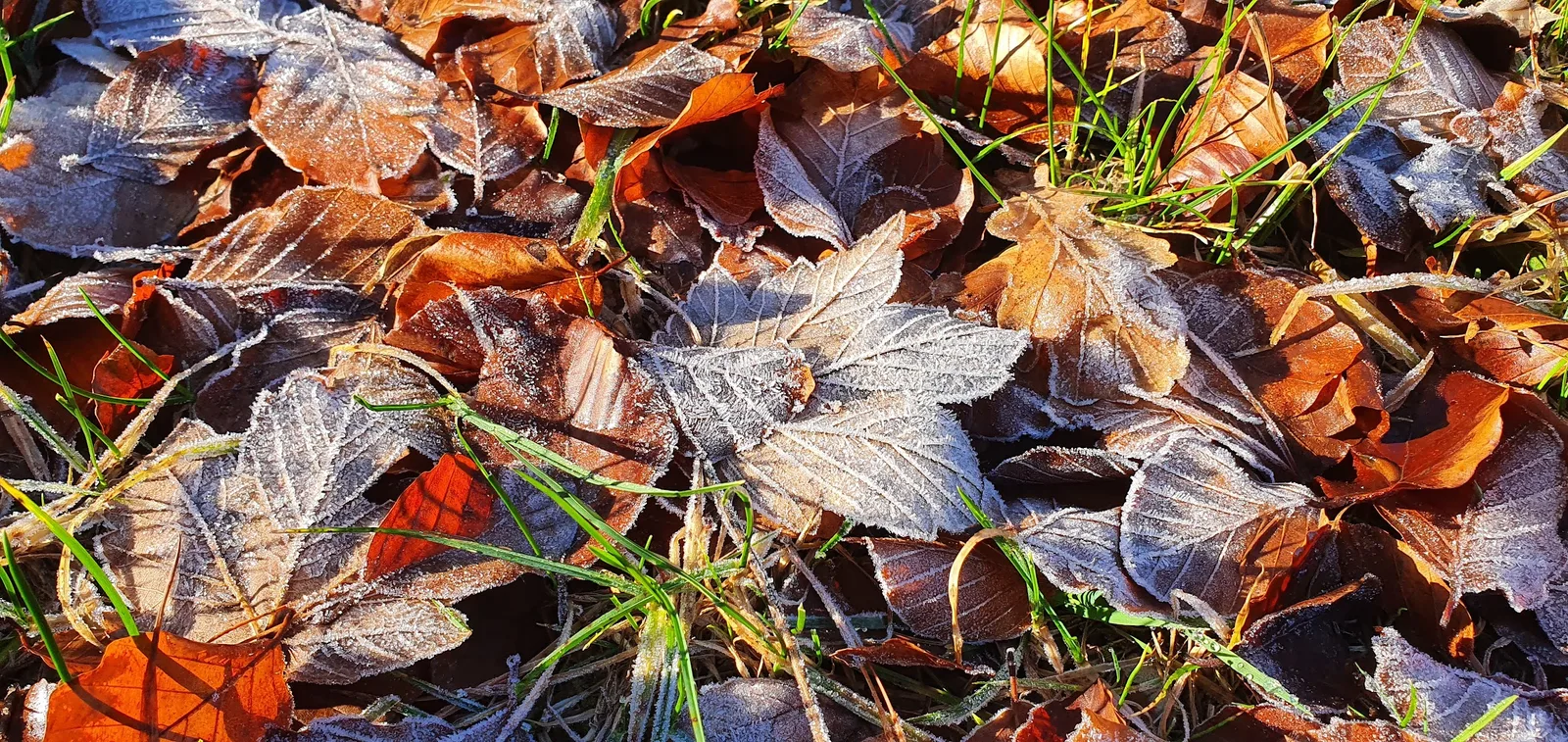
As leaf compost. Leaves belong on the compost heap in thin layers, ideally shredded – with the lawnmower, for instance – and mixed with grass clippings, which helps them rot faster. If you are short of space, they can sit in large jute sacks in the garden: by next year they will have turned into humus (BUND Naturschutz Traunstein).
What to treat differently. Leaves from walnut, chestnut and oak rot more slowly – according to the Gartenakademie because they are more woody, not because of the tannins. Shred them, mix them or pile them up separately and use them as mulch in early summer.
Where leaves have to go
On the lawn. A thin, loose layer does no harm. A dense, wet blanket, however, blocks light and air; the grass dries poorly, and the lawn can suffocate and become matted. Rake off thick layers and spread them on the beds (Lawn care guide).
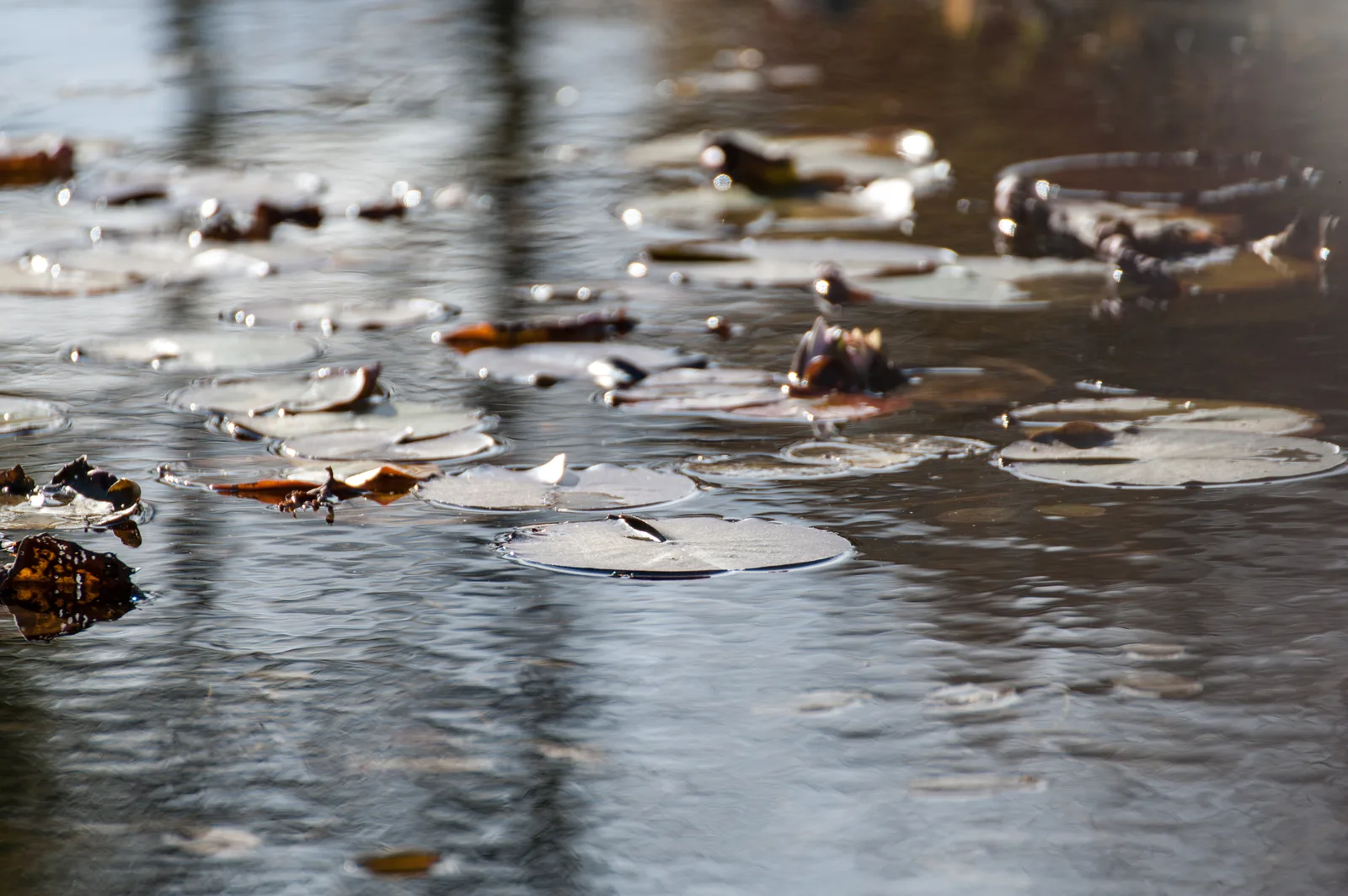
In the pond. Leaves sink, turn into sludge and bring nutrients into the water – food for algae. If there are many trees along the bank, a net over the water is worthwhile in September and October, and the skimmer may need emptying daily (Swimming pond and natural pool care guide). At the Swimming Pond with Alpine View we fish the leaves out of the water at the autumn visit and get the pond ready for winter. More under Swimming Pond.
On paths, slabs and timber. Wet leaves are slippery and leave stains on natural stone and paving, because tannins are released as they decay. Sweep timber decks with a soft broom along the grain.
When they are diseased. Leaves with rose rust or black spot carry the fungal spores into the next year. They should be picked up and disposed of, not put on the compost.
Rake instead of leaf blower. The LBV asks people to avoid blowers and vacuums: they often exceed 100 decibels, the airflow reaches up to 300 kilometres per hour, and leaf vacuums shred small animals overwintering in the leaves. A rake is quieter, and the leaves end up right where they are needed.
A refuge for hedgehogs and other creatures
A leaf pile is a winter home for hedgehogs, shrews and toads. To stop it from collapsing, it goes on a layer of thick and thinner twigs; branches hold it in place against the wind (LBV). The BUND recommends stabilising it with brushwood, sticks, stones and deadwood, for example in a hollow under a dense hedge (BUND). Pro Igel names natural hedges, shrubs and wood piles as places for daytime sleeping, rearing young and hibernation (Pro Igel).
Do not disturb: hedgehogs are out foraging until November, and the BUND advises not to turn compost heaps between November and March. So leave leaf and brushwood piles undisturbed from late autumn until spring.
Where to put the leaves?
Every garden has good spots: under hedges and at the edge of trees and shrubs, between perennials, on cleared beds and as a leaf pile in a quiet corner, for example behind the garden shed – sunny or shaded (Bayerische Gartenakademie).
Compost the surplus yourself; small amounts go in the organic waste bin, and larger amounts belong at the green waste collection points in the district of Bad Tölz-Wolfratshausen (district office). According to WGV Quarzbichl, the recycling centres accept one cubic metre at most; opening hours and quantities are listed at the WGV. Do not dump leaves in woods or fields: it disrupts the nutrient balance, can spread fungal diseases and introduces plants that displace native flora. Burning is also mostly prohibited.
Leaves and neighbours
As a rule, you have to accept leaves from a neighbour's tree. The Federal Court of Justice counts falling leaves among the “similar impacts” under § 906 BGB, and minor nuisances must be tolerated (BGH V ZR 102/03; § 906 BGB). Only where there is considerable extra effort, such as blocked gutters causing damage or a pond that has become unusable, may financial compensation be considered in individual cases – the “Laubrente” (leaf annuity). We are landscape gardeners, not legal advisers; if in doubt, seek legal advice. In everyday life, a chat usually helps: perhaps your neighbour would be glad of the leaves for their flower beds, or you can agree who sweeps and when.
When leaves feel like a burden
We understand: if you spend weeks sweeping every year, you eventually wish you had no deciduous tree at all. A few thoughts before you give one up:
- Choice of trees and location. Soft leaves, such as those of hazel, lime or maple, rot quickly (BUND Naturschutz), while hard ones like oak and walnut stay around for a long time. Location is what matters: a tree set away from the pond, terrace and gutter means much less work.
- Planning with the leaves. Beds and woodland edges with perennials and ground cover simply absorb leaves; they stay put and turn into humus. We help plan such areas – more under Perennial planting.
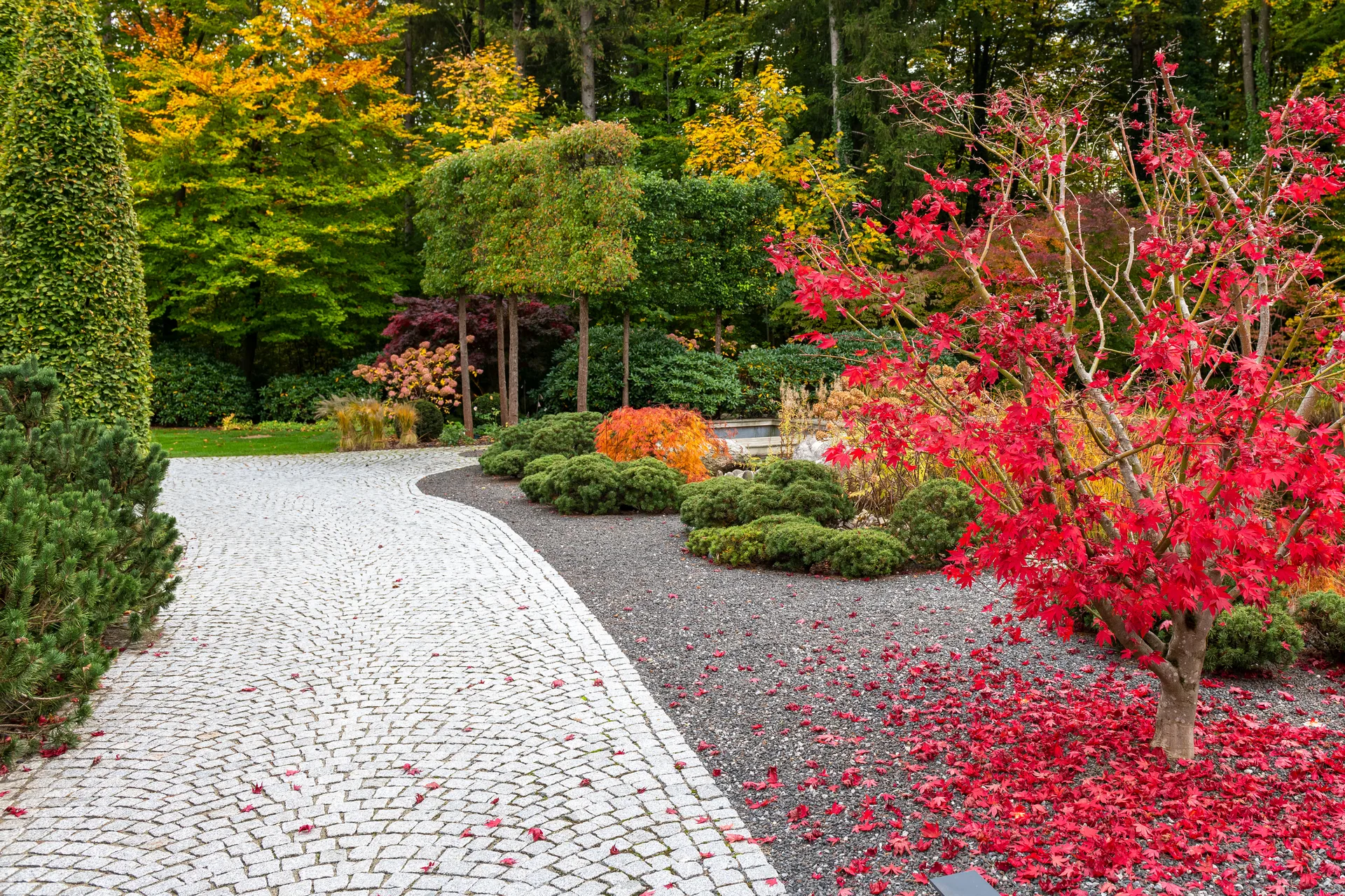
- Help with maintenance. If it has to be tidy, our maintenance service (Fuchs Service) takes care of the autumn leaf work. The cover photo was taken in the company garden “Grüne Visitenkarte” in Geretsried, which we built in 2017 and have maintained ever since. More about garden maintenance.
- The value of deciduous trees. According to the German Environment Agency (UBA), trees with large crowns lower the perceived temperature in summer by 10 kelvin or more, and evaporation adds to the cooling effect. They also bring shade, habitat for birds and insects, and four seasons in the garden. More on trees and large trees.
So your garden doesn’t look bare in winter: evergreens
Once the leaves have fallen and the frost arrives, a lot disappears. That is why a garden should always include evergreens to give it structure in winter. With a few exceptions, conifers are evergreen and form a calm backdrop for other plants (LWG technical article).
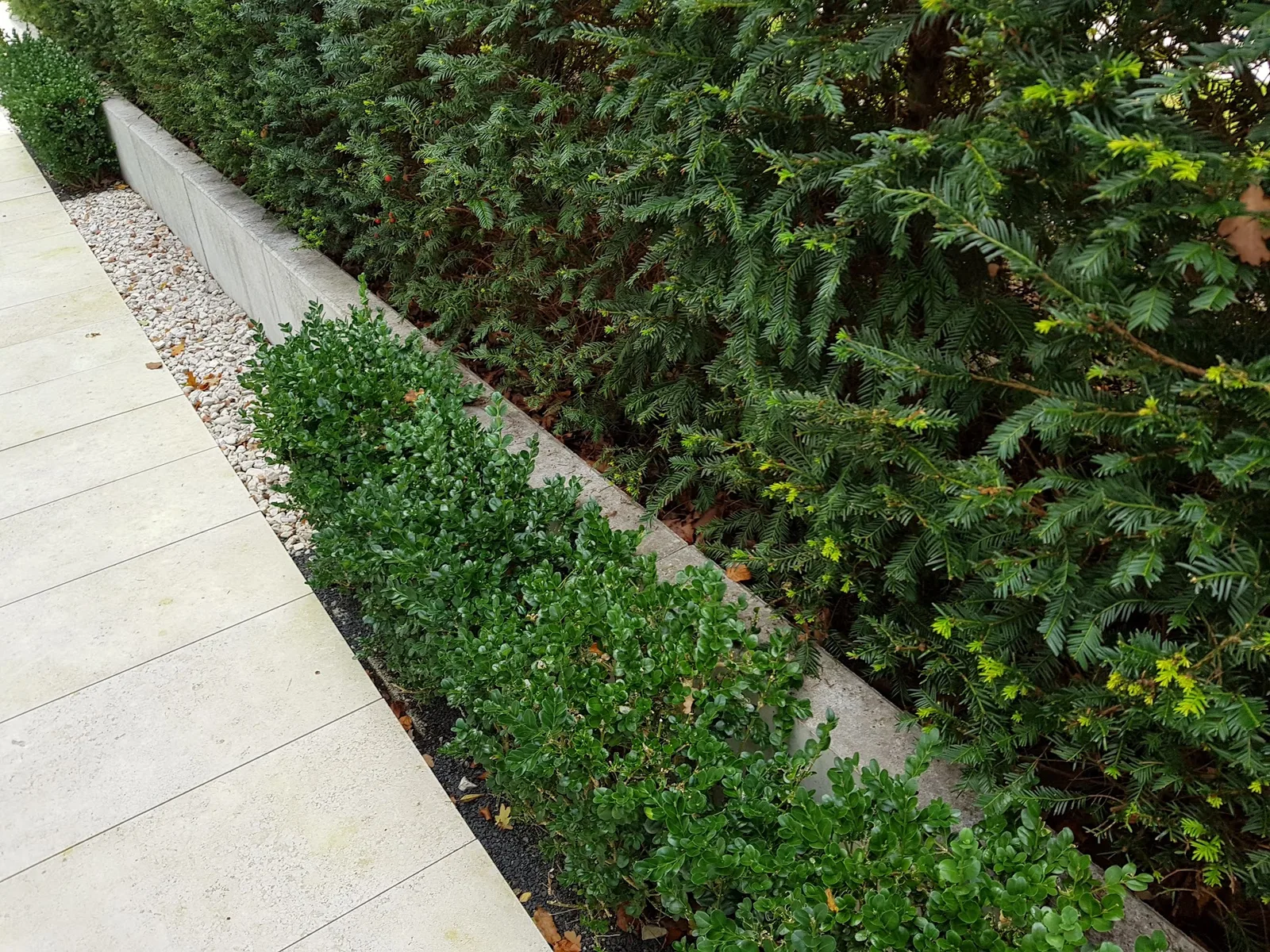
Juniper. Especially valuable to us: its greenery stays in place through the winter. Berries and needles contain mildly toxic essential oils, and some species turn brownish in autumn and winter (LWG technical article).
Pine and mountain pine. The mountain pine (Pinus mugo) has branching roots and finds a hold in the Alps even on steep, stony slopes (Alpenverein). In our experience, it is always a good choice for a slope. In Germany it is protected – digging it up is taboo, so buy it from a nursery. More on gardens on slopes: sloping plot.
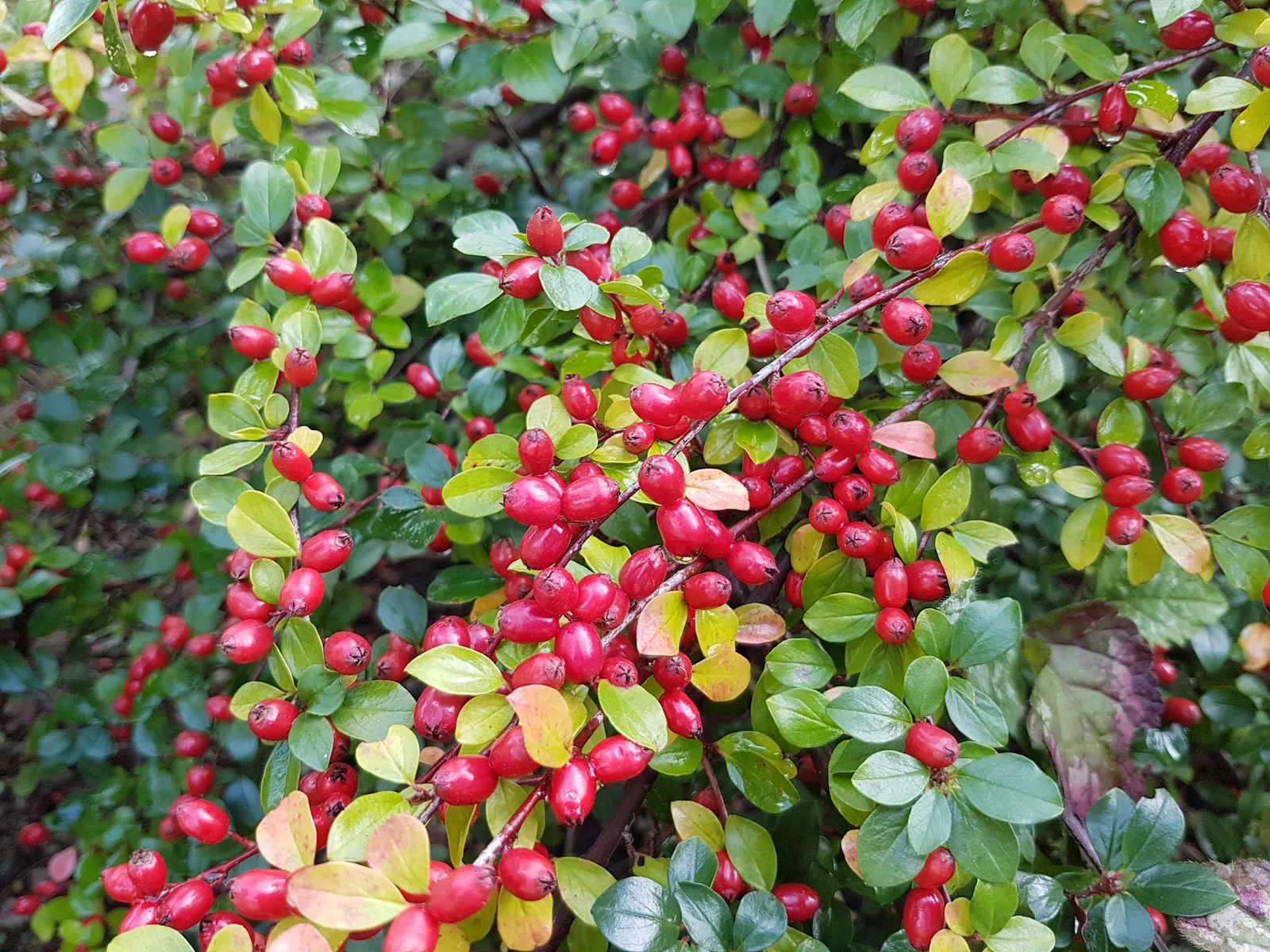
Cotoneaster. Not every one is evergreen: the Gartenakademie lists the bearberry cotoneaster (Cotoneaster dammeri) as evergreen, and most of the other species it mentions as deciduous (LWG list). The LBV puts all Asian varieties on its watch list of potentially invasive species in Bavaria (LBV) – so pay attention to species and cultivar.
Cherry laurel and bay laurel. These are two different plants. Cherry laurel (Prunus laurocerasus) belongs to the rose family, is evergreen and very dense. True bay laurel (Laurus nobilis) is a Mediterranean shrub that needs winter protection in harsh locations (Gartenakademie Rheinland-Pfalz); here in the Oberland it remains a container plant. There are critical voices on cherry laurel: it has self-seeded in a forest near Bonn and can displace native species, and since September 2024 it may no longer be sold in Switzerland (Naturkundemuseum Stuttgart). For trimmed hedges, the LWG suggests yew as an alternative.
Box – and what replaces it. Box is disappearing from many gardens. The LWG names shoot dieback (Cylindrocladium buxicola), box canker, box wilt and the box tree moth as the main problems (LWG). As replacements it suggests Japanese holly (Ilex crenata), box-leaved barberry, creeping spindle, privet ’Lodense’, dwarf honeysuckle and yew; some are less frost-hardy in the colder regions of Bavaria. Where box is still healthy, it advises keeping it (Gartencast “Alternativen zu Buchs”).
Spruce: not for the garden. This is our professional opinion: we do not recommend spruce for gardens, and we would no longer include a spruce hedge in a new design; where a well-kept hedge already stands, it can stay. For forest protection, spruce is the most critical tree species in Central Europe, climate change makes this worse, and drought stress favours the bark beetle (LWF, Waldwissen). As a large tree, it also often becomes a problem in small gardens, because it only shows its full shape after decades (LWG technical article). For privacy screening, we are happy to advise you on hedges.
Photos: Thorsten Scherz for Gärtner von Eden (cover image), Klas Stöver (leaves on the pond), Balbina Fuchs (leaves, frost, evergreens)
Quick answers
Do I need to remove leaves from the lawn?
What should I do with surplus leaves?
Do I have to put up with leaves from my neighbour's tree?
How do I build a leaf pile for hedgehogs?
What would you like to know?
Your question not answered here? Write to us – we reply personally. Sometimes we take up good questions in a new article, without your name, of course.
More from the garden guide
Every Thursday, we answer a question from the garden here – often one that our customers ask us.

Let's talk about your project
We are happy to advise you in person, with no obligation.
Request a consultation