
Having a raised bed built: space, material and height
Timber, steel, concrete or stone? How high, filled with what and with which extras? What matters for a made-to-measure raised bed – shown with gardens we have built.
By Balbina Fuchs, landscape architect and owner · Fuchs baut Gärten, Lenggries · published 9 October 2026 · updated 13 October 2026
A landscape gardening company can build you a made-to-measure raised bed – in our case in timber from our own joinery, or in steel, concrete or natural stone. Whether it brings you joy later comes down to a few questions: where does it stand, what is it made of, how high is it, what is it filled with and what should it be able to do?
First the location, then the bed
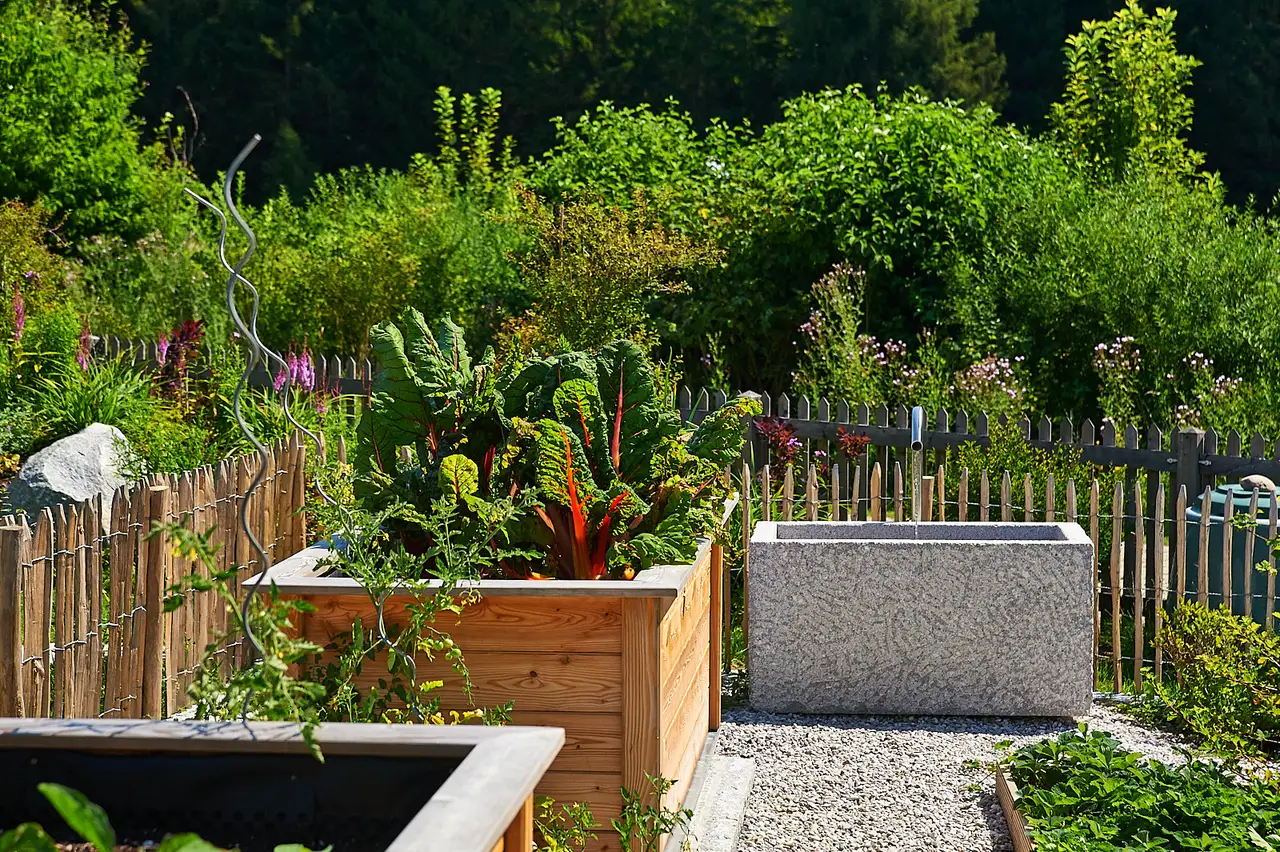
Even the most beautiful raised bed is of little use if you have to walk across the garden with a watering can every evening. That is why, in the family garden in Penzberg, a granite trough with a tap stands right next to the beds. The raised beds are the heart of the garden there – and sit behind a chestnut paling fence, so the children's ball doesn't end up in the chard.
Limited space is no obstacle either. In the town garden in Pullach, timber raised beds and espalier fruit trees share a narrow strip. And even a strictly designed garden can take a kitchen bed: at the glass pavilion in Bad Tölz, kohlrabi and lettuce grow in a raised bed on the productive side of the plot.
For the location, the rules are: sun for the vegetables, water within reach and a path that lets you reach the bed with a wheelbarrow.
Made to measure: around corners, at any height
An off-the-shelf raised bed has fixed dimensions. A raised bed from our joinery Fuchs Holz follows your garden: it can run around a corner, frame a terrace, follow a wall or have exactly the height at which you can work comfortably. It is made in our workshop in Lenggries and assembled at your home – if you like, with a trellis for beans, cucumbers or nasturtiums.

Which material is right?
We have built almost everything: raised beds in timber, concrete, stainless steel and Corten steel, in natural stone and in coloured plastic. The choice depends on the house and the garden, less on fashion – our network, the Gärtner von Eden, also matches materials to garden style.
- Timber looks warm, can be adjusted to the centimetre and is a renewable material. Larch, Douglas fir and oak last many years even untreated, simply turning grey; inside, a studded membrane protects the wood from damp soil.
- Corten steel, stainless steel or galvanised steel are durable and low-maintenance and suit modern architecture. Metal heats up considerably in the sun, so a lining on the inner wall is needed here too (Stiftung Warentest).
- Concrete looks clean and architectural and is very durable, but heavy.
- Natural stone as a dry stone wall makes the raised bed part of the landscape. Lizards and wild bees find shelter in the open joints – more on this under Walls & fences.
- Plastic and glass-fibre reinforced plastic are light, low-maintenance and available in many colours – good for terraces and balconies.
- Woven willow looks rustic and light.
One last warning: old railway sleepers do not belong in any raised bed. They are treated with creosote, and supplying them to private individuals is not permitted (Bayerischer Abfallratgeber).
How high should a raised bed be?
High enough that you can work without bending. The Bavarian State Institute for Viticulture and Horticulture gives about 80 centimetres as a height that is usually enough, and a width of at most 1.00 to 1.20 metres so that you can still reach the middle (LWG leaflet on raised beds). If you are tall and garden standing up, you may want up to a metre. We therefore set the right height together with you during planning.
For wheelchair users there are table-style raised beds: the planter sits on a frame, and you roll up with your legs underneath, as at a table. One practical example from a vocational training centre has a clearance height of 71 centimetres with an overall height of 88 centimetres (bbw Südhessen). Because the soil layer stays shallow, table beds suit lettuce and herbs well, and carrots and other root vegetables less so (Gartenakademie Rheinland-Pfalz). We match the exact dimensions to the person and the wheelchair – and the path to the bed too.
Filling: layered or just soil?
A raised bed is classically layered from coarse to fine: at the bottom a mesh against voles, then branches and twigs, then leaves, green cuttings or chippings, coarse compost above and fine soil with sieved compost on top (ISB Bayern). Rotting creates warmth, so the bed warms up earlier in spring and supplies plenty of nutrients – enough in the first year for heavy feeders such as tomatoes, courgettes and cabbage.
The catch: whatever rots, settles. Up to ten centimetres in the first year is normal, it is topped up with compost and soil every spring, and after a few years the bed has to be rebuilt completely. So think beforehand about whether you want to put in this effort every year.
The alternative is a structurally stable fill: a mineral layer of coarse sand or expanded clay at the bottom, with good, humus-rich soil above. It hardly settles and takes less work; the nutrients then come from fertiliser rather than from rotting. Compost and soil for both approaches are available at our Erdenwerk in Reichersbeuern. How to top up and rebuild is explained in our care guide for raised beds.
What else your raised bed can do
A raised bed can be equipped like a small garden. The most common wishes:
- Irrigation: Raised beds dry out faster than beds at ground level. Drip irrigation saves you daily watering and can be connected to an existing irrigation system.
- Cold frame top and fleece: A top with a lid or a fleece protects against night frost and extends the season in spring and autumn. In sunshine it needs ventilating.
- Trellis: for beans, cucumbers, peas or flowering plants – in timber from Fuchs Holz, matching the bed.
- Protection against voles and slugs: a fine mesh at the base and a metal edge around the rim.
- On a roof terrace: lightweight substrate and a verified load capacity – wet soil is heavy. More under Roof terraces.
Photos: Klas Stöver (cover image, family garden Penzberg); Fuchs Holz (corner raised bed)
Quick answers
Who builds a made-to-measure raised bed?
Are there raised beds for wheelchair users?
How do you fill a raised bed properly?
Do you also build just a single raised bed?
What would you like to know?
Your question not answered here? Write to us – we reply personally. Sometimes we take up good questions in a new article, without your name, of course.
More from the garden guide
Every Thursday, we answer a question from the garden here – often one that our customers ask us.


Let's talk about your project
We are happy to advise you in person, with no obligation.
Request a consultation