
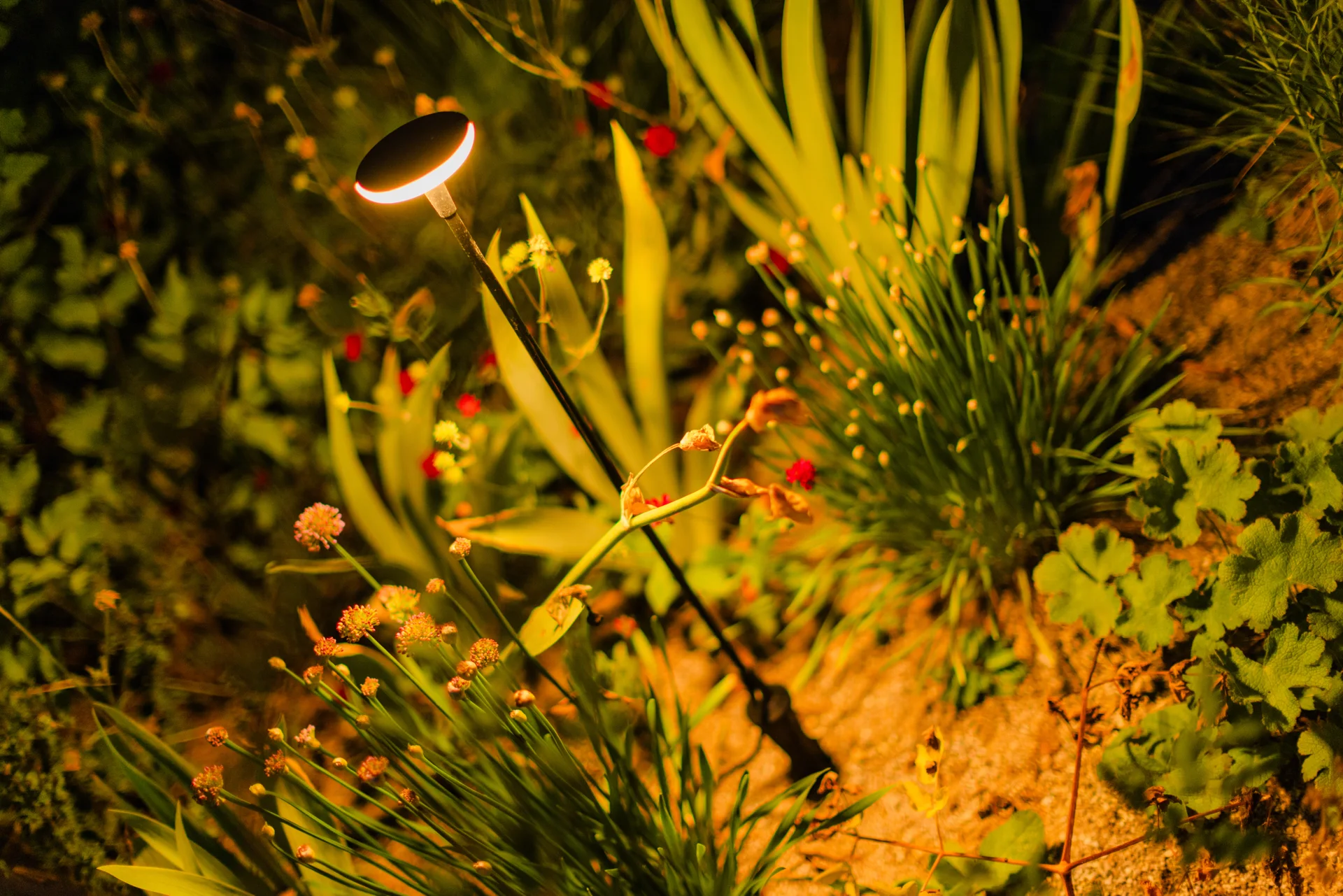
Garden lighting: why you plan it in winter
The best time to plan garden lighting is when it gets dark early: paths, accents, warm white light without glare – and what insects and nature conservation law have to say about it.
By Balbina Fuchs, landscape architect and owner · Fuchs baut Gärten, Lenggries · published 23 November 2026
The best time to plan garden lighting is winter: it gets dark early, and in the evening you can calmly test where light is needed and where it gets in the way. If you plan now, you have until spring to arrange cables and conduits so that they go into the ground along with the construction and planting work.
That is why light belongs in the plan from the very beginning, not as the last item on the list: which trees and shrubs get an accent, which paths need light, where do the conduits run and where does the transformer go? This is how we approach every lighting design. The lighting design can also be commissioned separately if the garden is already finished. You can find out how our planning works overall under Consultation and design.
Why right now?
- Darkness falls early. You can only see where a light belongs in the dark – in winter that is already at the usual end of the working day, not just shortly before bedtime.
- Try it out instead of browsing a catalogue. We work with the lighting manufacturer in-lite and have their sample case. With it, we try out the lights in the evening right at your home, exactly where they are meant to go – you see how warm the light looks and what shadow your own tree casts. The blue hour is ideal (garden lighting).
- Cables before planting. If building or planting takes place in spring, conduits and cables go in at the same time. Later, that often means opening up beds and paving again.
A town garden in Wolfratshausen that we built shows how much light a small garden can take: 65 square metres, and yet the lighting was part of the plan from the start, so that the garden is inviting in the evening too (project page).
What belongs in the light
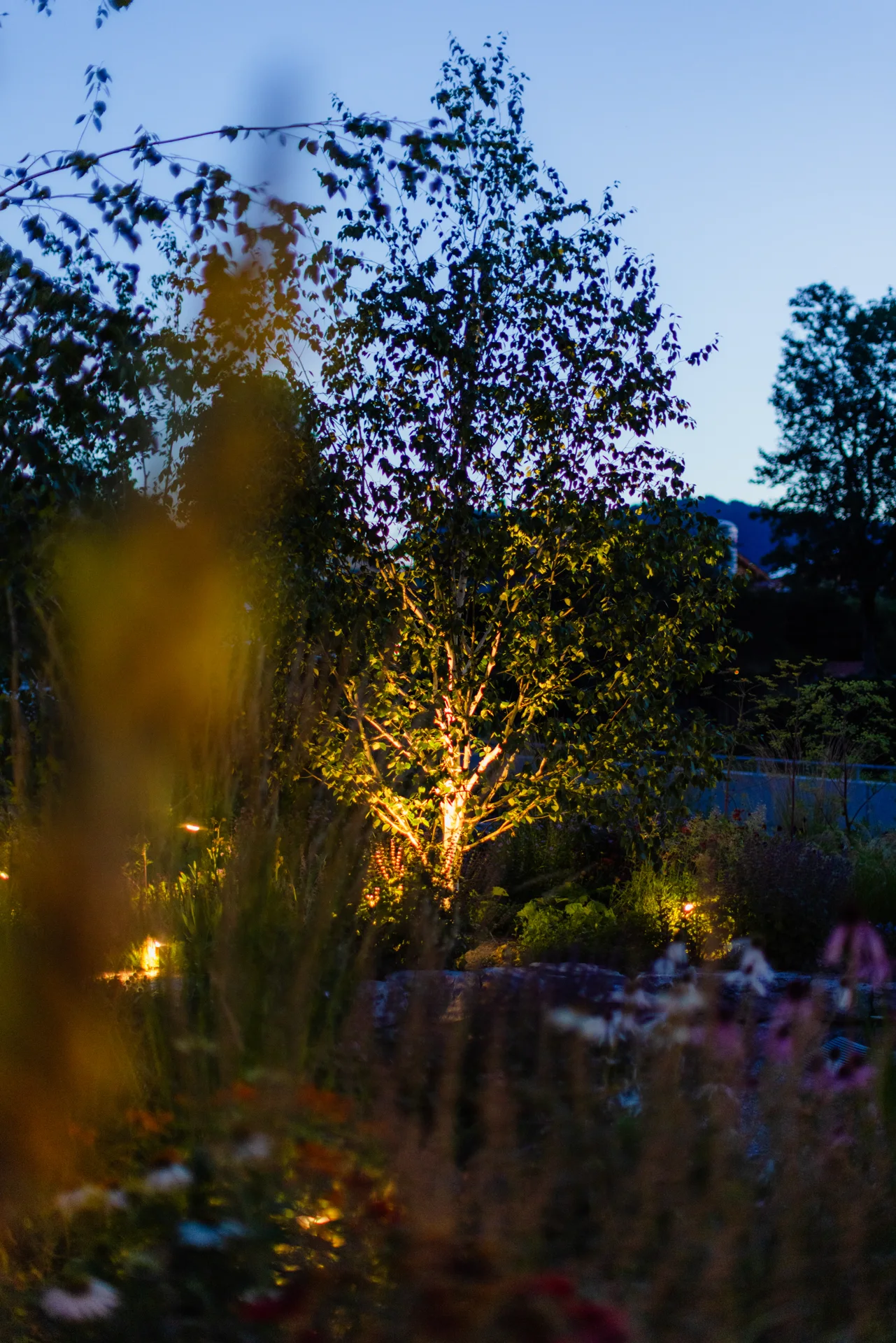
The pictures in this article were taken in our own company garden in Lenggries, at the 2026 summer party. It is a good example of how we plan:
- Paths and steps. They need enough light to walk safely – no more. Low lights that shine downwards are enough for this (StMUV guidelines, p. 7).
- A few accents. A tree with beautiful bark, a clump of grasses, a wall. A good lighting concept thrives on the dark areas in between (garden lighting).
- No glare. Lights are shielded from above and aimed downwards without glare; the lower the light, the less stray light (StMUV guidelines, p. 7). This also spares your neighbours’ view.
- Warm white. Cool white light causes more glare, and its blue component attracts insects. The recommendation is 1,800 to a maximum of 3,000 kelvin, and no more than 2,400 kelvin near protected areas (StMUV guidelines, p. 9).
Light and insects
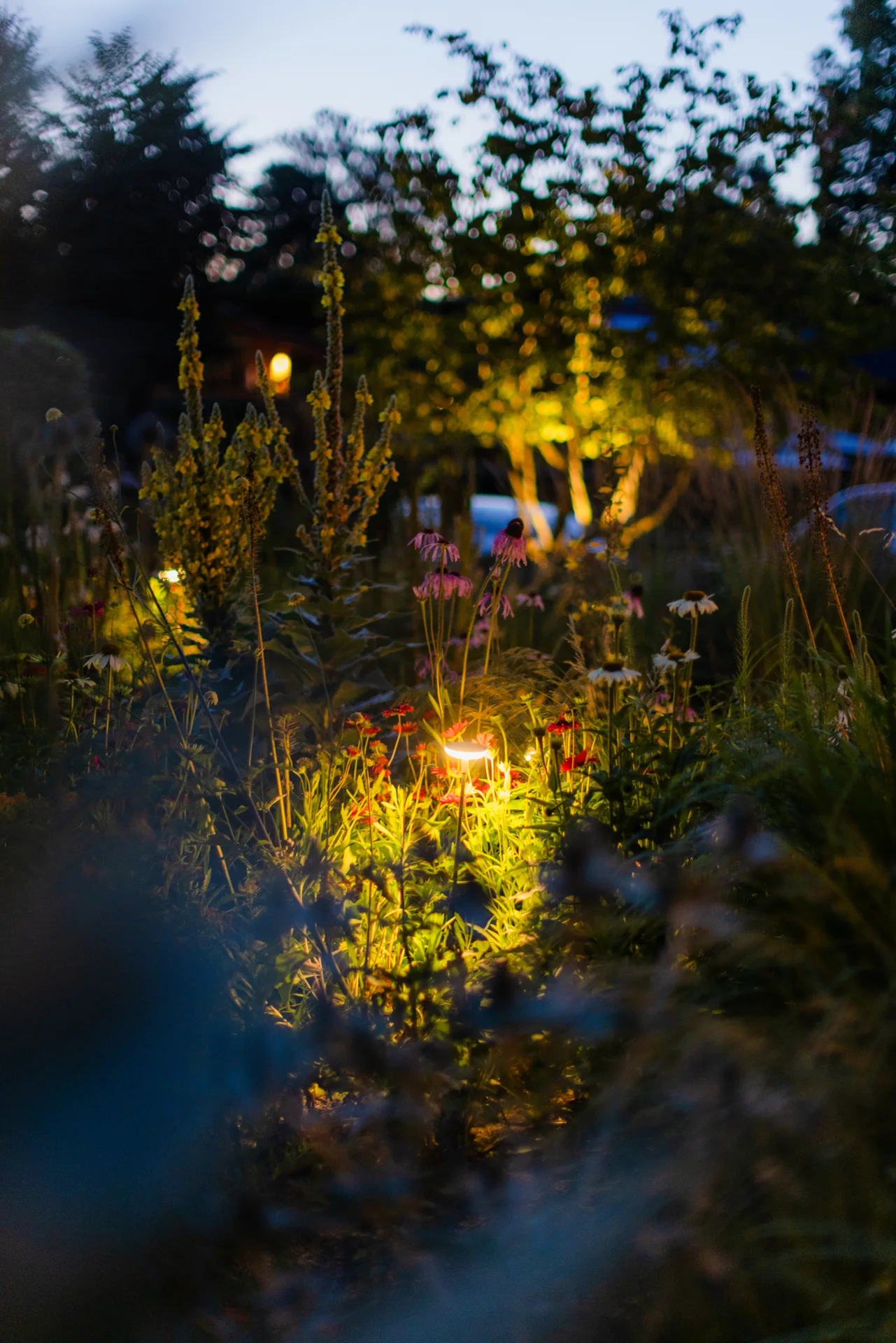
Around 60 percent of all insect species are active at dusk or at night. Bats and hedgehogs also avoid illuminated areas, which shrinks their habitat (StMUV guidelines, pp. 2 and 5). The Federal Agency for Nature Conservation has published its own guidelines for sustainable outdoor lighting, which also cover private gardens (BfN-Schriften 543).
In Bavaria, Art. 11a of the Nature Conservation Act states that interference with insect life from artificial lighting in the outdoor area must be avoided, and that skybeams and similar installations are not permitted (Art. 11a BayNatSchG). “Outdoor area” (Außenbereich) is a term from building law; if in doubt, the district office (Landratsamt) can tell you whether it applies to your plot.
The Bavarian guidelines even advise against uplighting trees for decorative purposes (p. 7). We take that as a call for restraint: a few subtle accents in warm light, and light only when someone is in the garden. A timer or motion sensor helps with this (p. 8).
12 volts or 230 volts?
in-lite lights run on 12-volt low voltage, which makes them easy and safe to install (in-lite). The transformer, however, needs a power supply in the garden. A new outdoor socket, a separate circuit or any other extension of the house installation may only be carried out by an installation company registered with the grid operator (§ 13 NAV). We have two in-house qualified electricians who carry out smaller electrical installations in the garden (garden lighting). It is best to clarify this part right at the planning stage.
How to keep lights clean and correctly aligned afterwards is explained in our garden lighting care guide.
Photos: Benjamin Klopp / frames for good
Quick answers
When is the best time to plan garden lighting?
Which light colour is right for the garden?
Is garden lighting bad for insects?
Can I connect 12-volt lighting myself?
What would you like to know?
Your question not answered here? Write to us – we reply personally. Sometimes we take up good questions in a new article, without your name, of course.
More from the garden guide
Every Thursday, we answer a question from the garden here – often one that our customers ask us.


Let's talk about your project
We are happy to advise you in person, with no obligation.
Request a consultation